

On this page
Parents often encourage waking up at 4 AM for undisturbed study time, sometimes referring to it as the *Brahma Muhurta*. While the house is quiet and distractions are low, a teenager's body is not on an adult's schedule. Waking a student up at dawn often backfires, leaving them too exhausted to actually learn. For students preparing for complex subjects like physics or calculus, being well-rested is far more important than gaining an extra hour of quiet time in the dark.
Why do teenagers struggle to fall asleep early?
During puberty, adolescents experience a biological "phase delay" in their circadian rhythms. According to the American Academy of Pediatrics, this shift pushes a teenager's natural sleep and wake times back by up to two hours. Their bodies do not typically begin releasing melatonin—the hormone that signals sleep—until around 11:00 PM. This is not a matter of discipline or screen time; it is a fundamental shift in how their internal clock operates during their teenage years.
To get the 8 to 10 hours of sleep per 24 hours recommended by the Centers for Disease Control and Prevention (CDC), a student waking at 4 AM would need to be asleep by 8:00 PM. Biologically, this is nearly impossible for most teenagers. They might lie in bed, but they will not be able to achieve restful sleep. This mismatch between biology and early alarms is a major reason why the CDC reports that about 7 out of 10 high school students do not get enough sleep.
What happens to the brain at 4 AM?
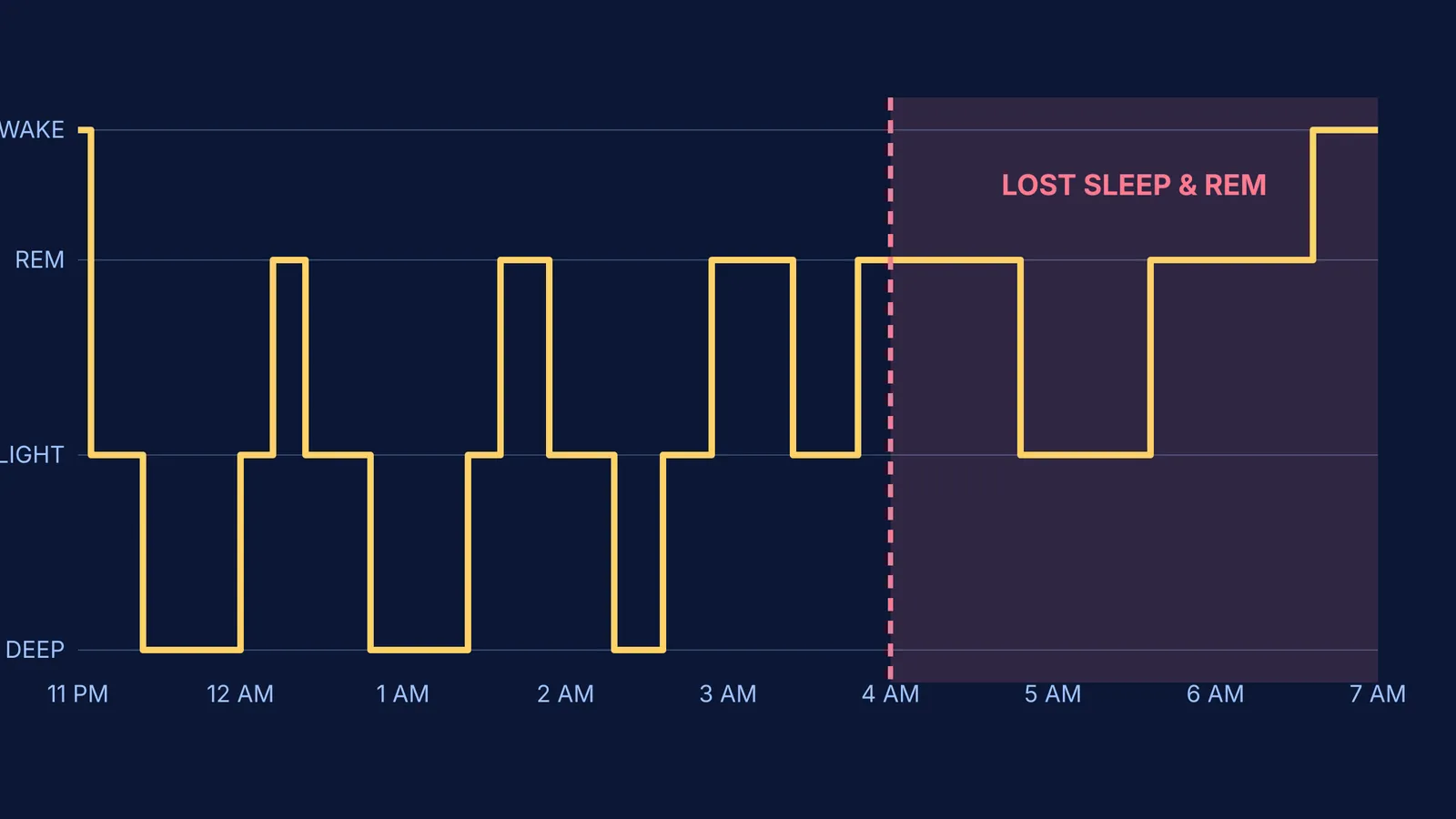
When a student cuts their sleep short to wake up early, they are not just losing a fraction of their total rest; they are specifically losing the sleep that locks in learning. Sleep is not a uniform state; it is highly structured and changes significantly from the moment a teenager falls asleep until they wake up.
According to Harvard's Division of Sleep Medicine, sleep occurs in 90-minute cycles that change as the night goes on. The first half of the night is dominated by deep, slow-wave sleep. This deep sleep physically restores the body and stabilizes basic facts, such as vocabulary words or dates. However, the second half of the night is dominated by Rapid Eye Movement (REM) sleep.
REM sleep is the brain's integration phase. It is when the brain consolidates procedural memories (such as how to apply a physics formula) and finds connections between new concepts. Because REM sleep is heavily concentrated in the final two to three hours of an eight-hour sleep cycle, waking up a few hours early can delete a disproportionate amount of a student's total REM sleep for the night. Without this REM sleep, the math problems practiced the evening before are much less likely to "stick" in long-term memory.
Should my teenager wake up at 4 am to study?
Generally, no. A brain that has completed its full sequence of REM cycles is significantly better at retrieval—the ability to actually find and use the information stored in its long-term memory. Waking up to cram at 4 AM interrupts this critical consolidation process, meaning the student may struggle to recall the very concepts they stayed up learning the previous evening.
Furthermore, because they are sleep-deprived, their working memory is diminished. Working memory is the mental scratchpad used to hold numbers and ideas while solving a problem. When working memory is compromised, making silly arithmetic errors or losing track of a multi-step physics problem becomes much more common. This makes the early morning study session much less efficient than it would be later in the day when the student is fully awake and alert.
How can I choose a wake time that fits the school schedule?
Instead of forcing an arbitrary 4 AM alarm, work backwards from the school schedule to ensure your teenager gets the sleep they need to perform at their best.
Start with the departure time. If your teenager needs to leave the house at 7:30 AM, a 6:30 AM wake-up allows an hour to get ready.
Count back for sleep. Counting back 8.5 hours from 6:30 AM gives a target sleep time of 10:00 PM. It is much more realistic to expect a teenager to fall asleep at 10:00 PM than at 8:00 PM.
Move studying to the afternoon or evening. Use the time after school for focused work. Instead of passively reading textbooks at dawn, students can use Fermi's AI tutor in the evening. The tutor works out what a student knows and builds a plan for the session, so study time is more efficient regardless of the hour.
If they have an exam the next day, staying well-rested is a better strategy than waking up early. For more on how sleep impacts test performance, see Sleep before an exam beats an all-nighter: what research shows. Adjusting your expectations by understanding How much sleep teenagers need, and how parents can help is the most reliable way to support both their health and their long-term academic success.


