On this page
It is 11:30 pm, the room lights are off, and your teen is scrolling for "just five more minutes". Most of the worry is about blue light. Experiments show that evening light does delay the body's sleep signal, but the popular fixes, night mode and blue-blocking glasses, have weak evidence behind them. How bright the whole evening is, and whether the phone stays in hand at all, look like better places to start.
How does light at night affect melatonin?
Melatonin is the hormone your body releases in the evening as a signal that night has begun, and light reaching the eye can hold it back. Light-sensing cells in the retina that contain a pigment called melanopsin carry this signal to the body clock, according to a 2022 expert consensus in PLOS Biology.
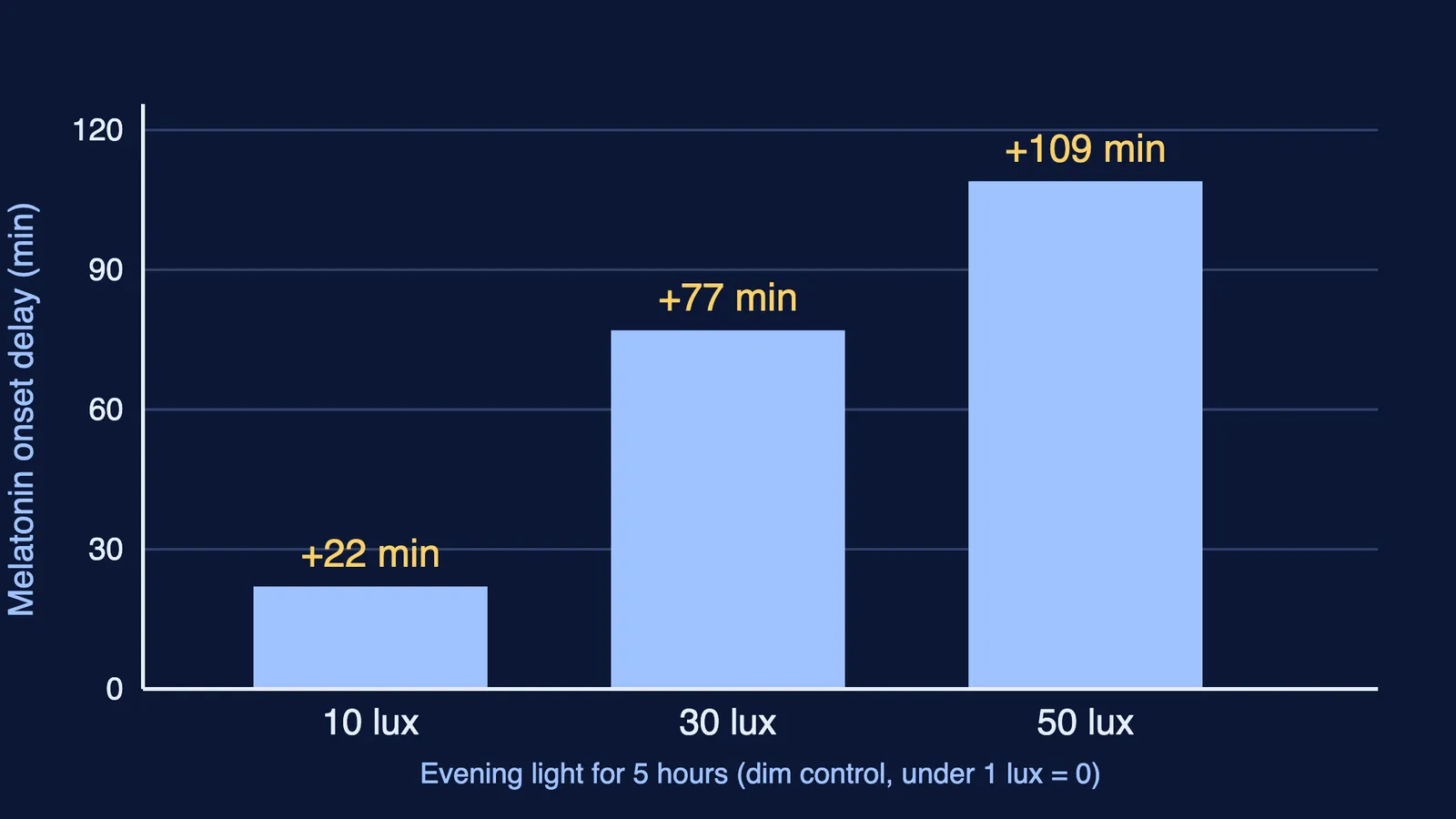
Ordinary indoor light is enough. In a 2019 study in PNAS, 55 adults aged 18 to 30 spent evenings under different light levels for 5 hours. Across the group, 24.6 lux was enough to halve melatonin; the authors say the body clock is highly sensitive to evening light at typical indoor levels. Evening light of 10, 30 and 50 lux delayed melatonin onset by 22, 77 and 109 minutes. People differed widely: the most sensitive person reached 50% suppression at 6 lux, the least sensitive at 350 lux.
Does blue light from phones affect sleep?
The best-known test compared screens with paper. Researchers at Brigham and Women's Hospital and Harvard Medical School had people read on a light-emitting tablet or a printed book in the hours before bed (Chang and colleagues, PNAS, 2015). After tablet reading, people took longer to fall asleep, felt less sleepy in the evening, released less melatonin, had a later body clock and were less alert the next morning.
So yes, a bright screen in the evening can shift sleep. But a phone does more than glow. Messages, reels and games keep the brain busy, and that study tested reading, not scrolling. For that side of the story, see our post on what the science says about phones and dopamine.
Does night mode help you sleep?
Night mode warms the screen colour by cutting some blue. A 2021 trial in Sleep Health tested it with 167 university students aged 18 to 24. For seven nights, each used an iPhone with Night Shift on, an iPhone with it off, or no phone in the hour before bed, while wrist trackers measured sleep.
Across the whole group, sleep did not differ significantly between the three conditions. In an exploratory analysis of students who averaged more than 6.8 hours of sleep, the no-phone group slept best. Changing the screen's colour did not change sleep; putting the phone down may.
Do blue-light glasses help sleep?
A 2023 Cochrane review gathered 17 randomised trials of blue-light filtering lenses in adults. For sleep, six trials with 148 participants disagreed: three found better sleep scores and three found no difference, and the reviewers rated the evidence very low certainty. They could not say whether the glasses help sleep, and found they may not reduce eye strain from computer use in the short term. Reported side effects were infrequent but included headache and discomfort.
What actually helps: a one-week evening light plan
For healthy adults, the PLOS Biology consensus recommends at most 10 lux at the eye (measured in a way weighted for melanopsin) for the 3 hours before bed, under 1 lux in the bedroom during sleep, and at least 250 lux in the daytime (Brown and colleagues, 2022). You do not need a light meter. Try this for seven nights:
Three hours before bed, switch from bright overhead tube lights to a desk lamp aimed at the page.
In the last hour, the phone charges outside the bedroom. Our post on keeping the phone in another room covers what studies found about focus too.
If a screen is needed late, turn the brightness down. Night mode is fine as an extra, not a fix.
Make the bedroom dark: curtains drawn, standby lights covered.
Get outside or sit by a bright window in the morning.
Each morning, note lights-off time, a rough guess of when sleep came, and how alert you feel from 1 to 5. Compare day 1 with day 7.
If you are the parent, try saying: "I'm not taking your phone away. Can we try one week where it charges in the hall from 10:30? If your sleep doesn't change, we'll drop it."
If late nights come from revision that drags on, Fermi's AI tutor can work out what you already know and build a plan for the session, so study ends before the lamp goes off. To see how the eye talks to the body clock, the Fermi Concept Library has a lesson for every concept in biology.
If poor sleep lasts for weeks, or comes with low mood or constant worry, talk to a doctor. The government's free, 24x7 Tele MANAS helpline is on 14416.
For how much screen time makes sense overall, see our 3-bucket screen time plan for teenagers.