On this page
Ask a chatbot to explain biodiversity hotspots and you might get 34 in one answer and 36 in the next. One answer will say India has three hotspots, another four. Often the AI is mixing figures from different years rather than making them up. Here is how to sort them out.
Why do AI answers on hotspots give different numbers?
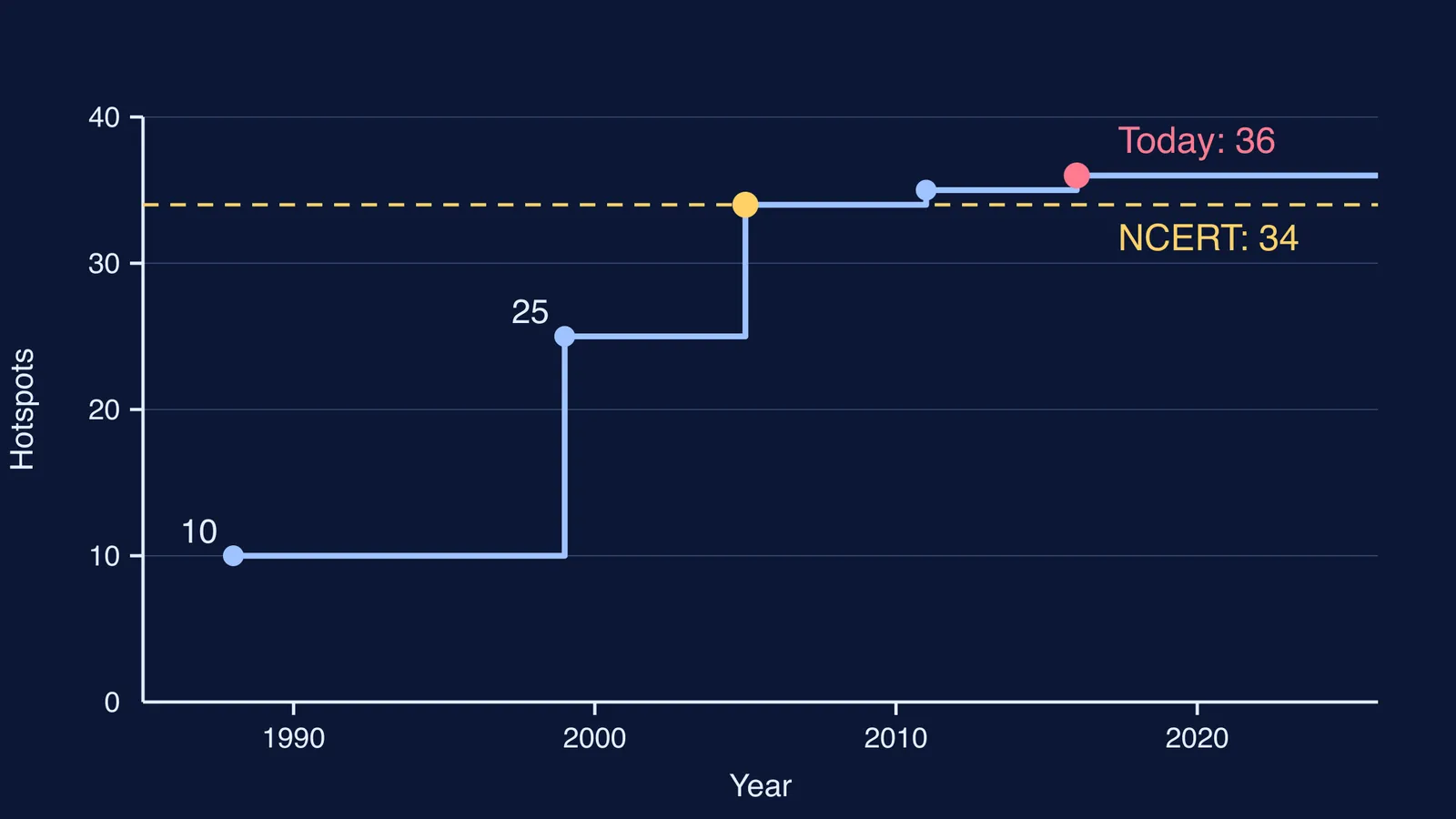
A biodiversity hotspot is a region with at least 1,500 endemic vascular plant species that has lost at least 70 percent of its primary native vegetation, according to the Critical Ecosystem Partnership Fund (CEPF). The same CEPF page gives the history of the count. Norman Myers named 10 tropical forest hotspots in 1988, a global review raised the count to 25, a 2005 analysis took it to 34, Australia's east-coast forests made 35 in 2011, and the North American Coastal Plain became the 36th in 2016.
The 2000 paper by Myers and colleagues in Nature found that as many as 44% of vascular plant species were confined to 25 hotspots covering only 1.4% of Earth's land surface.
Your textbook stopped at 34. The NCERT Class 12 Biology chapter on biodiversity (reprint 2026-27) says nine hotspots were added to the first 25, "bringing the total number of biodiversity hotspots in the world to 34". An AI trained on older notes may repeat 34. We explain why the same question can get different replies in why AI gives different answers to the same question.
How many hotspots does India have: three or four?
NCERT names three: Western Ghats and Sri Lanka, Indo-Burma, and Himalaya (NCERT chapter 13). CEPF's page on the Sundaland hotspot says "the Nicobar Islands, which are under Indian jurisdiction, are also included", so on CEPF's map a fourth hotspot reaches into India. In a school exam set from NCERT, write the textbook's answer; in a project or viva, add the fourth and name its source. Our explainer on the four biodiversity hotspots in India and their criteria goes region by region.
Which Indian conservation numbers go out of date?
Counts of protected areas change often, so these are the numbers to check hardest. Each item sets the NCERT chapter against a newer government figure.
Biosphere reserves: NCERT says India has 14. A Press Information Bureau backgrounder of 3 November 2025 says India has 18, covering about 91,425 sq km, and 13 of them are in UNESCO's World Network of Biosphere Reserves.
UNESCO listing: the Cold Desert Biosphere Reserve in Himachal Pradesh joined the UNESCO network on 27 September 2025, according to the Environment Ministry's announcement on PIB.
National parks and sanctuaries: NCERT gives 90 national parks and 448 wildlife sanctuaries. The ministry's year-end review for 2025 says India's protected areas rose from 745 in 2014 to 1,134 in 2025. That is a total for all protected areas, so compare like with like.
Species share: NCERT says India has 2.4% of the world's land, 8.1% of its species, about 45,000 plant species, and is one of 12 megadiverse countries. A PIB backgrounder of 7 April 2026 says about 8% of species, over 96,000 animal and 47,000 plant species, and one of 17 megadiverse countries.
These are not typos but figures from different dates.
How do you check an AI's hotspot answer, step by step?
Ask with this script: "Explain biodiversity hotspots and in situ versus ex situ conservation for Class 12. For every number and Indian example, tell me the source and the year it refers to."
Underline every number and every named place in the reply.
Check each one against NCERT chapter 13 first, then against whoever owns the number: CEPF for hotspots, the Environment Ministry or PIB for Indian reserves.
Check the category of each example. NCERT puts protected areas and sacred groves (Khasi and Jaintia Hills, the Aravallis, the Western Ghats of Karnataka and Maharashtra, and Sarguja, Chanda and Bastar) under in situ conservation. It puts zoos, botanical gardens, seed banks and cryopreservation under ex situ.
Write each fact with its year: "36 hotspots (CEPF, since 2016); NCERT says 34."
A worked example
Suppose a chatbot replied (we wrote this reply to show the method): "There are 34 hotspots, India has three, India has 14 biosphere reserves, and sacred groves are ex situ conservation." The verdicts:
34 hotspots: matches NCERT, but the CEPF count has been 36 since 2016. Note both.
India has three: matches NCERT. CEPF adds the Nicobar Islands through Sundaland.
14 biosphere reserves: the NCERT figure. PIB said 18 in November 2025.
Sacred groves are ex situ: wrong. They protect species in their own habitat, so they are in situ. See in situ vs ex situ conservation examples.
If the in situ and ex situ split feels shaky, the Fermi Concept Library has a lesson for every concept in biology, along with physics, chemistry, mathematics and computing. Fermi's AI tutor works out what you already know and checks your understanding as it goes.
Your next step: open chapter 13, ask the script above, and mark each number in the reply as matched, outdated or unsourced.