On this page
If a teacher has ever told you to shut the laptop and write by hand, you have met the result of one famous 2014 study. The research since then is more mixed.
What did the famous laptop vs pen study find?
In 2014, Pam Mueller and Daniel Oppenheimer published The Pen Is Mightier Than the Keyboard in Psychological Science. Across three studies, students who took notes on laptops did worse on conceptual questions than students who wrote longhand.
Their explanation was not about screens. Laptop note-takers tended to transcribe the lecture word for word. Longhand writers, the authors argued, processed the ideas and reframed them in their own words. The same paper found that taking more notes can help; it was the verbatim copying that hurt.
Did later studies agree?
Partly. In 2021 a team led by Heather Urry ran a direct replication of the first study, with 74 students on laptops and 68 writing longhand. Laptop users again wrote more words and copied more of the lecturer's exact phrasing. But on a quiz taken soon after, with no chance to study, the handwriters did not score higher. Exploratory mini meta-analyses across eight similar studies echoed that pattern, and in both the original and the replication, more words in the notes went with better quiz scores.
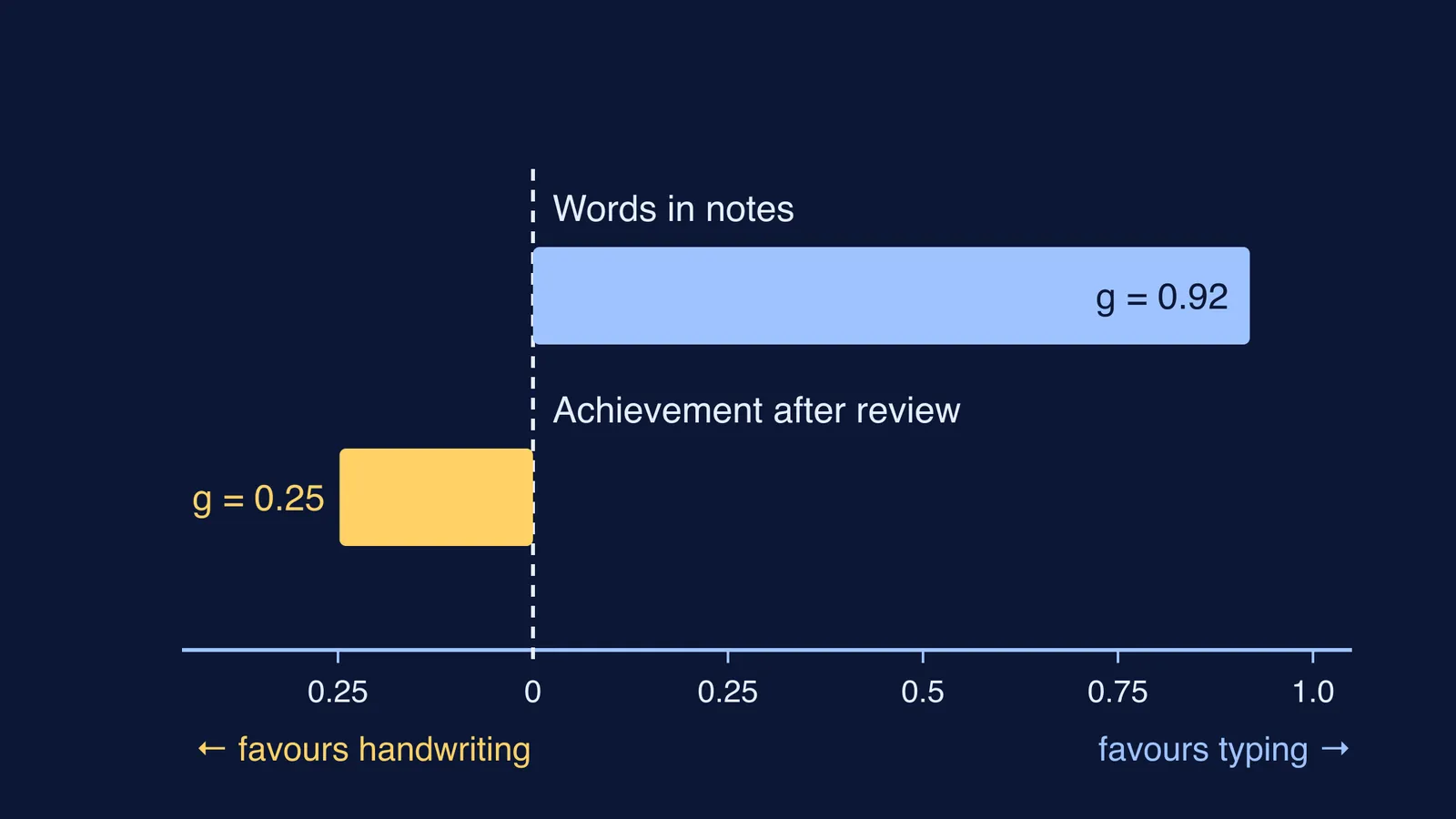
A 2024 meta-analysis in Educational Psychology Review by Abraham Flanigan and colleagues pooled 24 studies from 21 articles on college students. Typing produced far more notes (an effect size of Hedges' g = 0.919). Taking and reviewing handwritten notes led to higher achievement (Hedges' g = 0.248). The handwriting edge is far smaller than the typing edge on volume.
So is handwriting notes better than typing?
On the evidence, handwriting has a small advantage when you go back and study from your notes, and in the replication typing showed no clear cost on a quiz taken soon after the lecture. The step the studies keep pointing at sits in between: does the idea pass through your head, or go straight from the teacher's mouth to the page?
Mueller and Oppenheimer tied the laptop cost to verbatim copying. Urry's team found that link was not robust in their replication, so treat it as a likely reason, not a settled one.
There is also distraction. In a 2013 simulated-classroom study, Faria Sana and colleagues found that laptop multitaskers scored lower on a test, and so did students in direct view of them.
How do you take notes in your own words?
Use a four-step loop: listen, pause, rephrase, check. Here is what it looks like in a physics class.
Your teacher says: "The work done by a conservative force around a closed path is zero, which is why we can define a potential energy for it."
A copied note repeats the sentence. An own-words note looks like this:
Conservative force (gravity, spring): round trip, net work 0
So work depends only on start and end points, and PE can be defined
Friction: not conservative, no PE. Why? Ask tomorrow
After class, run this checklist the same day:
Cover your notes and write a three-line summary of the lesson from memory.
Uncover them and mark what you missed in a different colour.
Turn each miss into a question you can test yourself on later.
Delete or cross out anything you copied but cannot explain.
If you prefer a laptop, keep it but change the rule: close every other tab, and never type a sentence longer than a few words that the teacher said exactly. Our guide on turning your notes into active recall cards with AI shows how to make step 3 quick.
Which should you use for JEE, NEET-UG or board exams?
Derivations, diagrams and graphs (maths, physics, physical chemistry): many students find these quicker by hand, and drawing the figure yourself makes you think about it.
Reading-heavy chapters (biology, inorganic chemistry): either works if you summarise rather than copy. For printed material, annotate lecture slides instead of copying them.
Fair copies: rewriting notes neatly feels productive but can be pure copying. Read when rewriting notes is useful before you spend a Sunday on it.
Sometimes a topic will not go into your own words because you do not understand it yet. That is a concept gap, not a note-taking problem. Fermi's AI tutor works out what you already know, builds a plan for the session and checks your understanding as it goes. The Fermi Concept Library has a lesson for every concept in physics, chemistry, biology, mathematics and computing.
Tomorrow, pick one lecture and take notes you could explain to a friend, whatever you write them with.