

On this page
It is the night before a unit test and you are copying your chemistry notes into a fresh notebook, neater and with coloured headings. Whether it was useful depends on one thing: was the old page open while you wrote?
Is rewriting notes a waste of time?
Copying notes out with the original in front of you is usually a poor use of study time, because your eyes do the remembering and your hand only transfers it. No major study has tested copying notes on its own, but it works much like rereading. A 2013 review by John Dunlosky and colleagues in *Psychological Science in the Public Interest* rated ten common study techniques, and gave its two "high utility" ratings to practice testing and spacing your study out over time (Dunlosky et al., 2013).
The same review rated rereading, highlighting and summarisation as low utility. Of rereading and highlighting, it says that they "do not consistently boost students' performance" (Dunlosky et al., 2013). A copied page is rereading with a pen, not recall.
Why does copying notes feel like it is working?
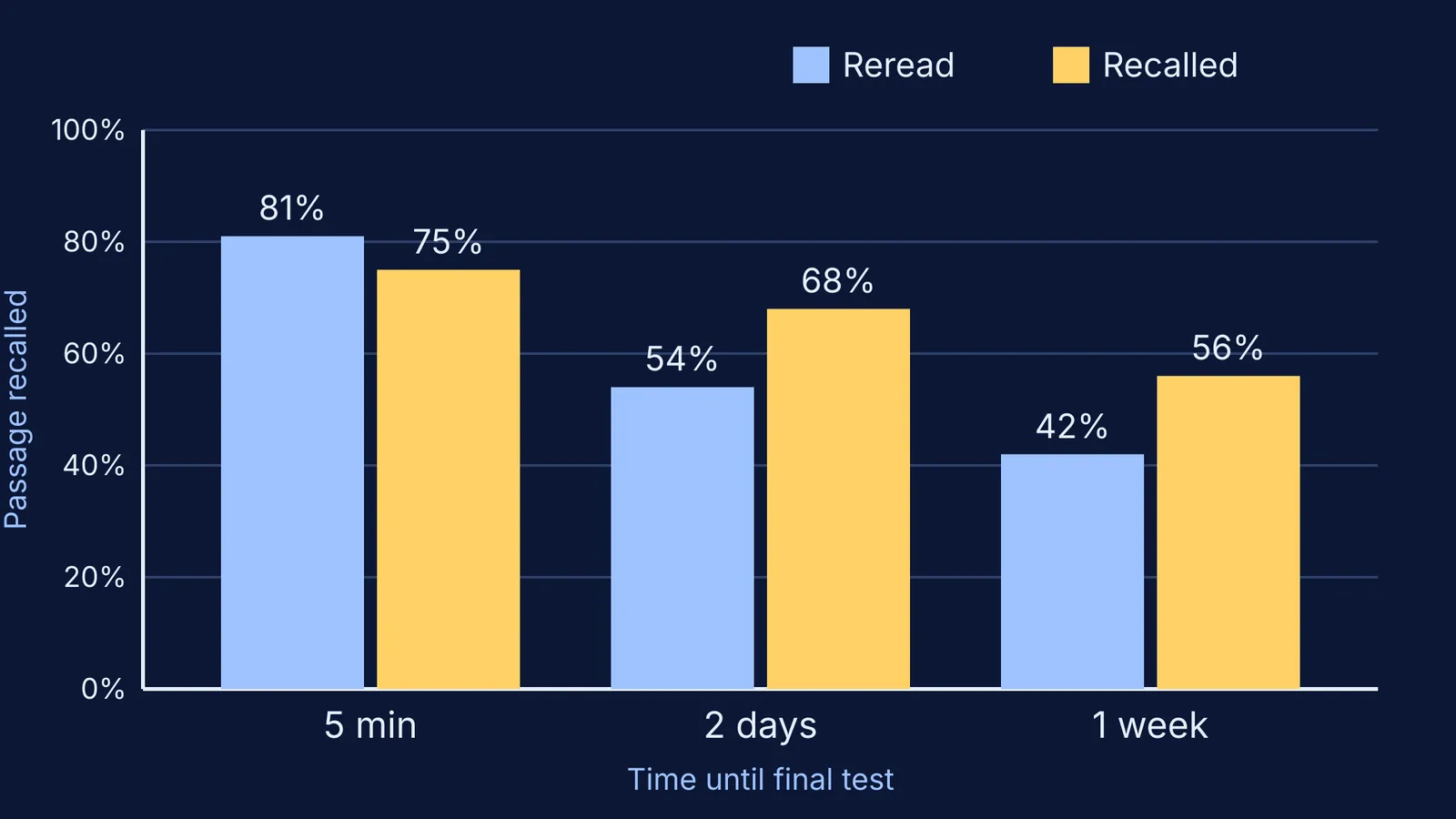
Because in the short term, it does. In a 2006 experiment, Henry Roediger and Jeffrey Karpicke had 120 university students read short prose passages and then either read them again or write down as much as they could remember (Roediger and Karpicke, 2006).
Tested 5 minutes later, the rereading group was ahead: 81% of the passage recalled, against 75%.
Two days later, the recall group was ahead: 68% against 54%.
One week later, the recall group still led: 56% against 42%.
In a second experiment in the same paper, students who studied a passage in four sessions felt more confident they would remember it than students who studied it once and recalled it three times. A week later, the confident group remembered 40% of it; the recallers remembered 61% (Roediger and Karpicke, 2006). That confidence does not last until the exam.
Even rewriting that looks active can lose to plain recall. Karpicke and Janell Blunt found that practising retrieval produced more learning than building concept maps with the text available, including on questions that asked students to make inferences (Karpicke and Blunt, 2011).
When does rewriting notes actually help?
A rewrite earns its time in three situations:
Organising, once. Merging class notes, coaching sheets and NCERT into one clean set is worth doing once, but it is not revision. Our guide on whether to make notes from NCERT or coaching modules helps you pick the base.
Writing from memory. The page is closed and you rebuild the topic yourself, like the recall group above.
Fixing gaps. After checking a recall attempt, you rewrite only the parts you got wrong or left out.
How do you turn a rewrite into a recall exercise?
Use the same move the recall group made in the 2006 study: the passage put away, everything remembered written down (Roediger and Karpicke, 2006). Call it close, write, check, fix.
Read one section of your notes properly once.
Close the notebook. On a blank sheet, write everything you can: headings, formulas, a diagram, one example.
Open the notes and check your sheet with a different-coloured pen. Mark what is missing or wrong.
Rewrite only the marked parts into your notes. This is the rewrite that counts.
Do it again from a blank sheet a few days later, since spacing was the review's other high-utility technique (Dunlosky et al., 2013).
If you like this, the blurting method for revising from a blank page is the same idea applied to whole chapters.
A worked example: projectile motion
The copying version: you copy the range derivation line by line into a new notebook.
The recall version: notes closed, you write the velocity components, the time of flight T = 2u sin θ / g and the range R = u² sin 2θ / g. For maximum height you write u² sin θ / 2g, and you cannot say why the range is largest at 45 degrees. You check. The height should be u² sin² θ / 2g, and the 45-degree answer comes from sin 2θ reaching its maximum of 1 when 2θ is 90 degrees. Those two lines are all you rewrite, plus a margin question: why 45 degrees?
When the check shows a gap your notes cannot explain, the Fermi Concept Library has a lesson for each concept in physics, chemistry, biology and mathematics. For an idea that is easier to see than to read, such as how the launch angle changes the path, the Fermi Simulation Lab has interactive simulations.
What should you do tonight?
Pick the chapter you were about to copy out, read one section, close it, and write. To build the habit, a five-minute recall before each class uses the same blank-page move on yesterday's lesson.


