On this page
You might expect a longer catapult arm to win every time. Run the numbers and range climbs, levels off, then falls. Mark Denny's paper Siege engine dynamics in the European Journal of Physics traces why siege engines ultimately evolved into the highly efficient trebuchet. Here is a desk-sized version with one variable.
Does a longer throwing arm make a catapult throw farther?
Yes, until the arm gets too long. Two textbook results explain the rise.
Every point on a rotating rigid arm moves at v = rω, so the tip of a longer arm moves faster at the same angular speed (OpenStax College Physics 2e, section 6.1).
On level ground with negligible air resistance, range is R = v² sin 2θ / g, so range grows with the square of launch speed and, for a fixed speed, is greatest at 45° (OpenStax College Physics 2e, section 3.4).
The catch: your counterweight releases a fixed amount of energy, and a longer arm makes that energy harder to turn into ball speed.
Why does a longer arm trade force for speed?
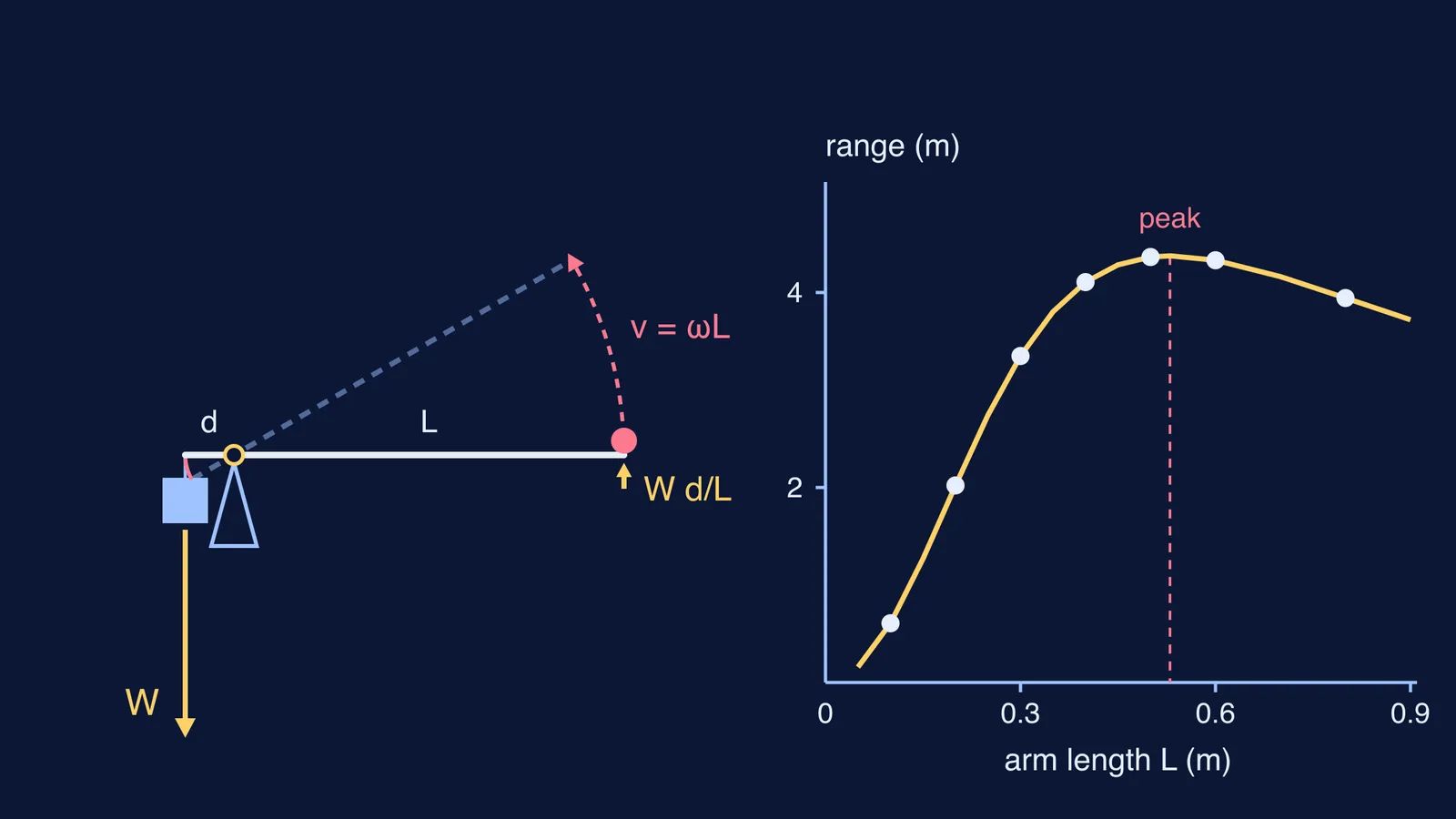
Look at the moments diagram above: the pivot sits a distance d from a counterweight of weight W, and L from the cup. Torque is force times the perpendicular distance from the pivot, τ = r⊥F (OpenStax College Physics 2e, section 9.2). For a balanced arm, taking moments about the pivot gives W × d = F × L, so the force the cup can apply to the ball is roughly F = W × d / L.
With d = 5 cm and L = 40 cm, the cup pushes with only one-eighth of the counterweight's weight. In exchange, it moves eight times as fast as the counterweight end, because v = rω holds for both ends of the same arm. That is the trade-off: a lever cannot give you more force and more speed at the same time.
Long arms also cost energy: a uniform rod pivoted at one end has rotational inertia I = ML²/3, and rotational kinetic energy is K = ½Iω² (OpenStax University Physics, section 10.5). Energy spent spinning a long, heavy arm never reaches the ball.
What range should you expect from a desk catapult?
We ran that model, built from the OpenStax formulas above, for a desk build: a 0.5 kg counterweight 5 cm from the pivot dropping 8 cm, a 5 g ball, an arm of 50 g per metre, release at 45°, no air resistance or friction. Predicted ranges:
10 cm: 0.6 m
20 cm: 2.0 m
30 cm: 3.3 m
40 cm: 4.1 m
50 cm: 4.4 m
60 cm: 4.3 m
80 cm: 3.9 m
Doubling the arm from 10 cm to 20 cm more than triples the range; going from 50 cm to 80 cm loses about 0.4 m. Calculus gives the peak length, L³ = 6Mc d²/λ, about 53 cm here. Real numbers will be lower, but the rise and fall should survive.
How do you run a fair test on arm length?
Change only the throwing-arm length L. Cut a separate strip for each length from the same stock, so the arm gets heavier as it gets longer, as in a real design. Sliding the cup along one long strip keeps the arm's mass fixed and tests a different question.
Write your predicted range for each length before you test.
Keep the counterweight, its distance d and its starting angle the same. Mark the start with tape.
Use the same ball every time.
Fit a stop bar so the ball always leaves at the same angle.
Measure from the pivot to the first landing mark.
Make five throws at each length and record the median.
Your record sheet needs one line per length: L (cm), predicted range, throws 1 to 5, median range, and notes such as the arm bending. Then plot median range against L.
What do your results tell you?
If your peak comes at a shorter arm than the model's, your arm is probably heavier or bendier. If range keeps rising up to your longest arm, cut a longer one: you have not found the peak yet.
How bicycle gears trade torque for speed shows the same trade in another machine. To practise moments, try the lever balance simulation that predicts positions with moments. If you want to vary the release angle next, see why 30° and 60° projectiles have the same range.
For ideas that are easier to see than to read, the Fermi Simulation Lab has interactive simulations. If the algebra for the peak length trips you up, the Fermi Problem Library has worked problems with a step-by-step solver that explains the reasoning rather than printing an answer.
Predict first, then build the arms and test them.