

On this page
A 40 kg block sits on a seesaw and you hold a 25 kg block. Where does it go? Most people slide it around until the plank stops tipping. You learn far more if you calculate the spot first and use the simulation only to check. Here is how, including two cases that trip up Class 11 and JEE students: a plank with its own weight, and a pivot that is not in the middle.
What is the principle of moments on a seesaw?
The moment of a force (torque) about a point is the force multiplied by the perpendicular distance of its line of action from that point, and its SI unit is the newton metre (NCERT Class 11 Physics, Chapter 6). The same chapter, in Section 6.8.1, states the principle of moments for an ideal lever as load arm × load = effort arm × effort, where an ideal lever is a rod of negligible mass.
A rigid body is in equilibrium only when both the net force and the net torque on it are zero, and you are free to take moments about any point you choose (OpenStax University Physics, Section 12.1). For a seesaw, take moments about the pivot: the support force acts there, so it drops out.
Every weight is mass × g, and g appears on both sides, so you can balance in kg·m and skip g. For a refresher with playground numbers, see our post on the seesaw and the principle of moments.
How do you predict where to place a mass on a balancing lever?
About the pivot, total anticlockwise moment equals total clockwise moment.
Example 1: light plank, centre pivot. A 30 kg child sits 1.5 m left of the pivot. Where must a 20 kg child sit?
Anticlockwise moment: 30 × 1.5 = 45 kg·m.
Clockwise moment: 20 × d.
Set them equal: d = 45 ÷ 20 = 2.25 m to the right of the pivot.
Write 2.25 m down before you run the simulation. If the plank still tilts, check that you measured from the pivot, not the end of the plank.
What changes when the lever has its own weight and an off-centre pivot?
A real plank's weight acts at its centre of gravity, which coincides with its centre of mass in uniform gravity (NCERT, Section 6.8.2); for a uniform plank, that is its midpoint. If the pivot is at the midpoint, that weight has no moment. Move the pivot and it does.
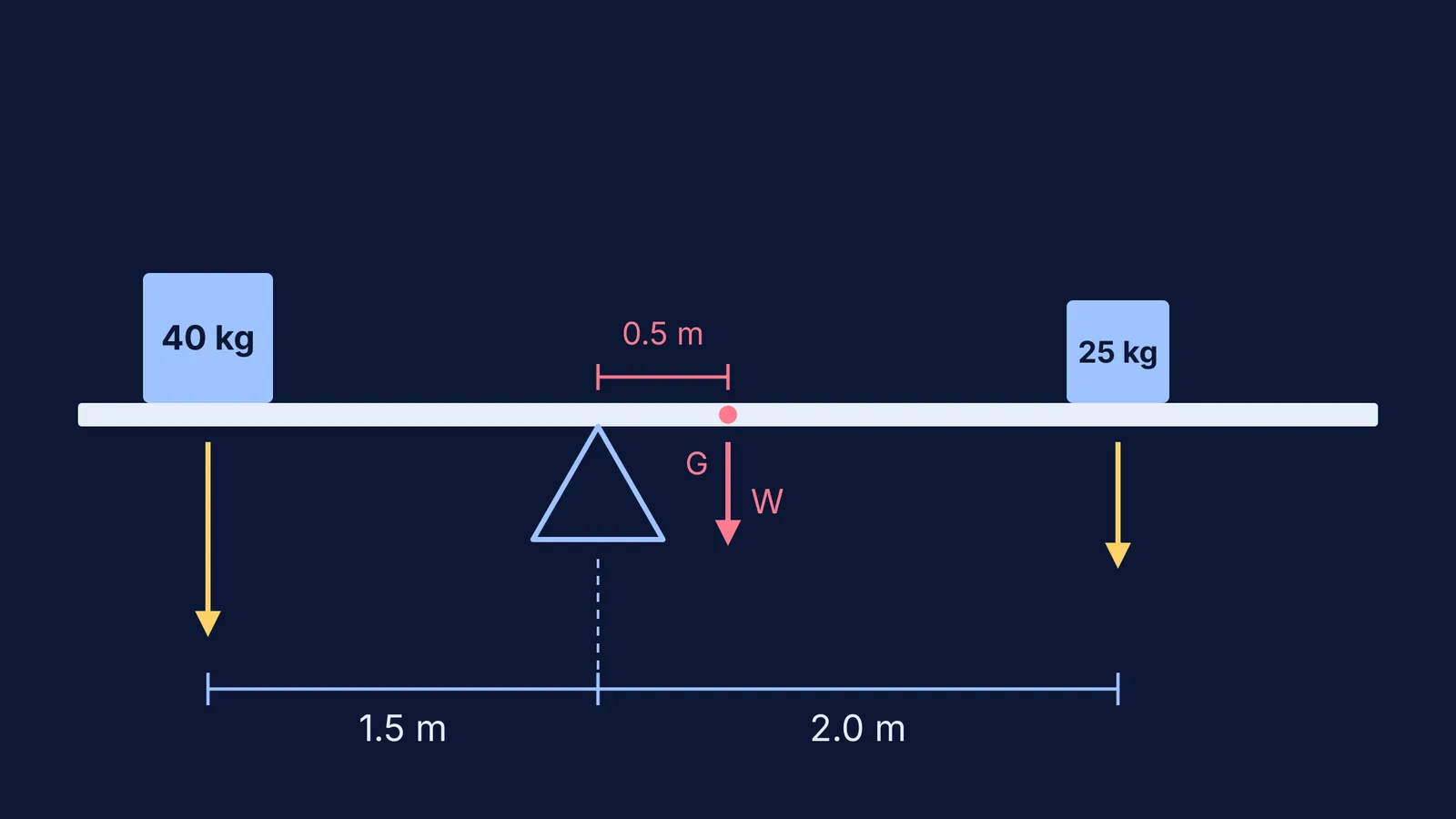
Example 2 (the diagram above). A uniform 5 m plank of mass 20 kg rests on a pivot 2 m from its left end. A 40 kg block sits 1.5 m left of the pivot. Where does a 25 kg block go?
Find G: the plank's midpoint is 2.5 m from the left end, so 0.5 m right of the pivot.
Anticlockwise: 40 × 1.5 = 60 kg·m.
Clockwise: the plank gives 20 × 0.5 = 10 kg·m, plus the block's 25 × d.
Balance: 60 = 10 + 25d, so d = 2.0 m right of the pivot.
Ignore the plank's weight and you get 2.4 m, 40 cm too far.
Example 3: weigh a metre rule with one known mass. A uniform metre rule balances at its 50 cm mark. Hang 100 g at the 5 cm mark and the new balance point is the 32 cm mark. Taking moments about 32 cm: 100 × (32 − 5) = M × (50 − 32), so 2700 = 18M and M = 150 g.
For uneven rods, see the centre of mass of a non-uniform rod; for two supports instead of one pivot, see reactions on a beam on two supports.
How should you use a seesaw simulation to learn moments?
The sample learning goals for the PhET Balancing Act simulation include predicting how masses and their positions affect whether a plank balances or moves, and writing rules to predict which way it will tilt (PhET Balancing Act). Predict is the key word.
In Robert Siegler's 1976 balance-scale studies, children moved from attending to weight only, to using distance only when the weights were equal, to trying and failing to combine the two, before finally comparing torques, as summarised in a 2021 paper by Virginie Filion and Sylvain Sirois (Frontiers in Psychology). Sliding blocks until the plank levels can get you the right position without showing you why it works. Try this routine:
Write your predicted position before touching anything.
Write the moment equation, with the plank's weight at G.
Place the mass. Tilted? Find the wrong term.
Change one thing, such as the pivot position, and predict again.
Finish by predicting the direction of tilt, not a position.
The Fermi Simulation Lab has interactive simulations for the ideas that are easier to see than to read, so you can test predictions like these. If a written lever problem goes wrong, the Fermi Problem Library has worked problems with a step-by-step solver that explains the reasoning rather than printing an answer.
Write the number first; the plank will tell you whether you were right.


