On this page
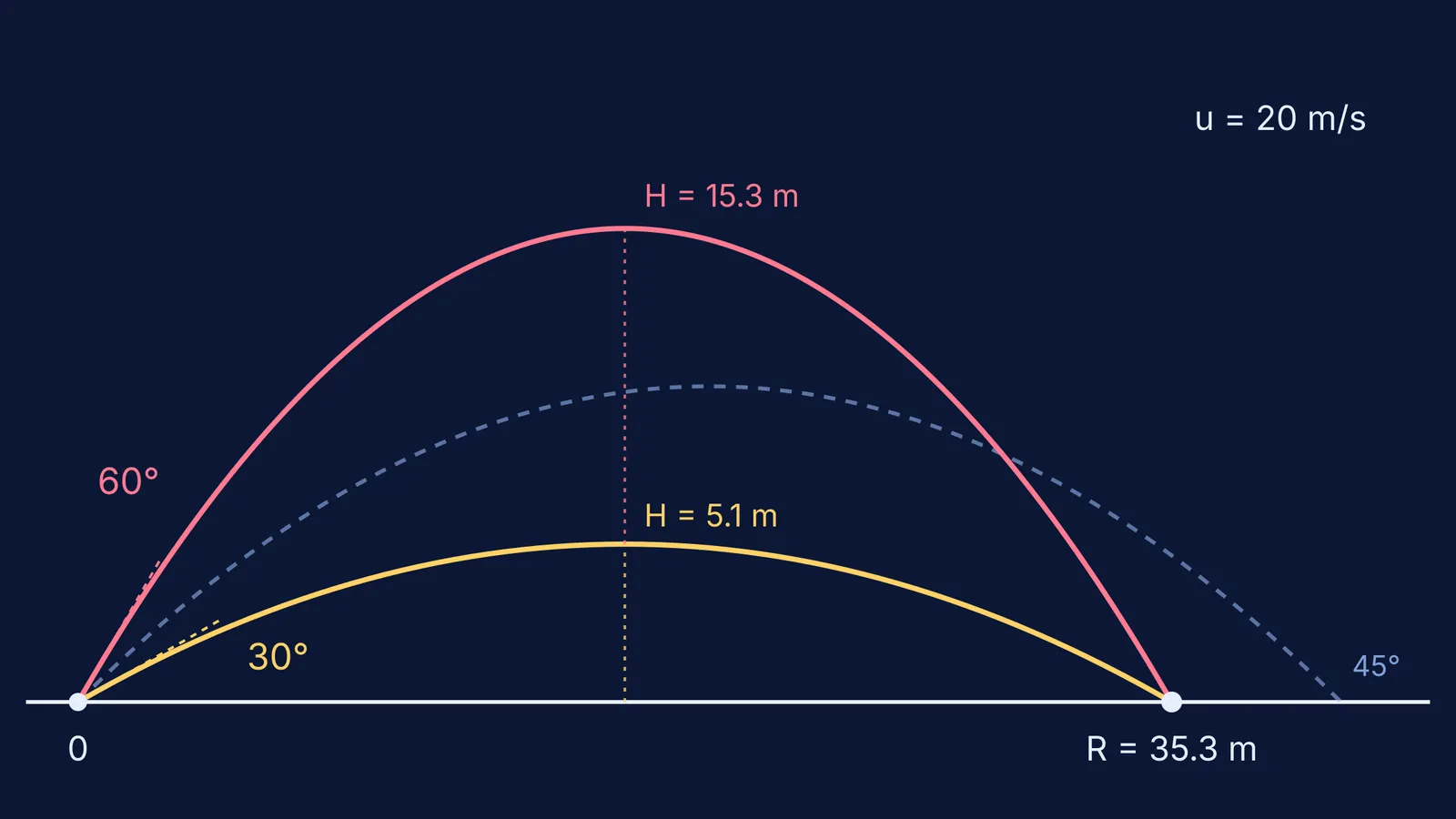
Two balls leave the ground at the same speed. One goes up at 30°, the other at 60°. Before you read on, write down your guess: which one lands farther away? Neither. They land on the same spot, and once you see why, a whole family of exam questions gets shorter.
Predict first: where do the 30° and 60° balls land?
Take a launch speed of u = 20 m/s and g = 9.8 m/s², the standard value used in OpenStax University Physics, section 4.3. That chapter gives the range on level ground as R = u² sin 2θ / g, valid when the ball is launched and lands at the same height and air resistance is negligible.
Make three predictions before you calculate anything:
Which angle gives the longer range, 30° or 60°?
Which ball is in the air for longer?
How many times higher does the 60° ball go?
Now work it out. For 30°, sin 60° is about 0.866, so R = 400 × 0.866 / 9.8, which is about 35.35 m. For 60°, sin 120° is also about 0.866, so R is again about 35.35 m. Same speed, same ground, same landing point.
Why do complementary angles give the same range?
The trigonometry way: R depends on sin 2θ. For θ and 90° − θ, the doubled angles are 2θ and 180° − 2θ, and sin(180° − x) = sin x. So the two ranges are equal. HyperPhysics states it directly: the 60° and 30° trajectories have the same range, as does any pair of launches at complementary angles, and 45° gives the maximum.
The physical way: write the range as R = 2(u cos θ)(u sin θ)/g, the horizontal speed multiplied by the time of flight. At 30° the ball moves fast sideways but comes down quickly. At 60° it moves slowly sideways but stays up longer. Swapping the angles swaps the two velocity components, and their product stays the same.
How do flight time and height compare for each pair?
The same OpenStax chapter gives the time of flight as T = 2u sin θ / g and the maximum height as H = (u sin θ)² / 2g. Here they are for u = 20 m/s, g = 9.8 m/s²:
15°: range 20.41 m, flight time 1.06 s, height 1.37 m
75°: range 20.41 m, flight time 3.94 s, height 19.04 m
30°: range 35.35 m, flight time 2.04 s, height 5.10 m
60°: range 35.35 m, flight time 3.53 s, height 15.31 m
45°: range 40.82 m, flight time 2.89 s, height 10.20 m
Read the pairs. The range is the same for each pair, but the steeper ball always takes longer and climbs higher. For 30° and 60°, the time ratio is tan 60° = √3, about 1.73, and the height ratio is tan² 60° = 3.
What links the two flight times and heights?
Three relations follow from the OpenStax range, time and height formulas, and JEE-style problems often use them:
The flight times multiply to T₁T₂ = 2R/g.
The heights add up to H₁ + H₂ = u²/2g, because sin²θ + cos²θ = 1.
The range is R = 4√(H₁H₂).
Check them against the 30° and 60° numbers. The heights 5.10 m and 15.31 m add to 20.41 m, which is 400/19.6. And 4√(5.10 × 15.31) comes to about 35.3 m, the range.
If a step keeps slipping, the Fermi Problem Library has a step-by-step solver that explains the reasoning rather than printing an answer.
When does the same-range rule stop working?
The rule rests on the two assumptions OpenStax states, and exam setters like to break them.
Air resistance. With drag, R = u² sin 2θ / g no longer holds, so the pair need not land together. See projectile motion with air resistance and why 45° stops working.
Different launch and landing heights. From a cliff or onto a slope, the level-ground formula does not apply.
Two related results: why projectiles with the same maximum height have the same time of flight, and the angle at which range equals maximum height.
A 10-minute plan to make it stick
Choose a speed and a pair, say 20° and 70°. Write down your predictions for range, time and height.
Calculate all six values with the three formulas.
Test T₁T₂ = 2R/g and H₁ + H₂ = u²/2g. If both hold, your working is right.
Double the speed. Every range grows four times, because OpenStax notes that range is proportional to the square of the launch speed, but the time ratio stays at sin θ₂ / sin θ₁.
This idea is easier to see than to read. The Fermi Simulation Lab has interactive simulations for ideas like this one: predict first, then watch.