

On this page
When you throw a ball, its launch velocity splits into two independent parts: a horizontal speed that carries it forward, and a vertical speed that pushes it up.
As established in OpenStax University Physics, these two motions do not affect each other. The vertical speed alone decides how high the ball climbs against gravity and how long it takes to fall back down.
Why does gravity only affect vertical motion?
To understand why maximum height and time of flight are locked together, we first have to look at how gravity behaves. Gravity is a force that pulls straight down toward the centre of the Earth. It has no horizontal component. Because it only pulls down, it can only change a projectile's vertical speed.
When a projectile is launched, its initial horizontal speed remains completely constant throughout the flight, assuming we ignore air resistance. Meanwhile, gravity immediately starts fighting the vertical speed, slowing the object down until it comes to a temporary vertical stop at its peak. Gravity then pulls it back down, accelerating it until it hits the ground.
Because the horizontal motion and the vertical motion are completely deaf to each other, the time it takes for gravity to stop the upward climb and pull the object back down depends exclusively on how much vertical speed it had to begin with.
How do you find time of flight from maximum height?
We can prove this by looking at the standard formulas for a projectile fired on a level surface. Both the maximum height (H) and the time of flight (T) are calculated using only the vertical component of the initial velocity (v_y) and the acceleration due to gravity (g):
Maximum Height: H = v_y² / 2g
Time of Flight: T = 2v_y / g
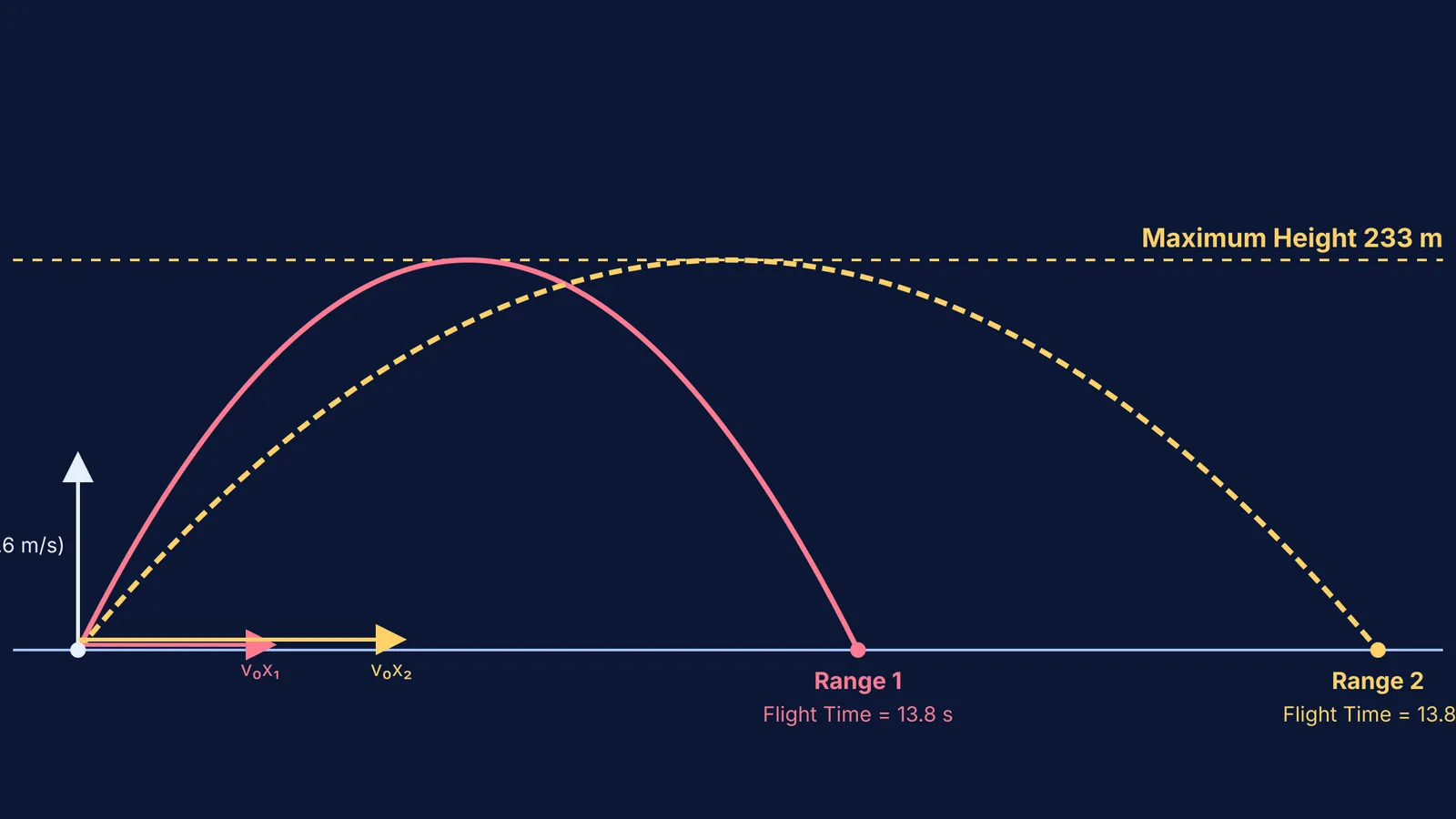
If two projectiles—say, an artillery shell and a thrown stone—reach the same maximum height H, they must have started with the exact same initial vertical velocity v_y. Because they share the same vertical speed, they must also share the same time of flight T.
We can combine these two equations to remove the velocity variable completely, leaving a direct relationship between time and height:
T = 2√(2H/g)
This relationship shows that time of flight is governed entirely by the peak height. As an example from OpenStax University Physics shows, any projectile with an initial vertical velocity of 67.6 m/s will reach a maximum height of 233 metres. Because this vertical speed completely dictates the flight, every projectile that reaches this 233-metre peak will spend exactly 13.8 seconds in the air, no matter what angle it was launched at.
If you have gaps in your understanding of how vectors split, the Fermi Concept Library maps out every concept in physics, each with its own lesson, where the AI tutor can draw the figures to help you trace the vertical and horizontal parts of any motion.
Why do their horizontal ranges differ?
If they land at the exact same time, why do they hit different spots?
The horizontal distance a projectile covers (its range) depends on both its time in the air and its horizontal speed.
If you fire a projectile at a steep angle, most of its speed is vertical. It reaches its peak and falls back down in time T. However, because its horizontal speed is low, it lands close by, having not travelled very far laterally.
If you want a second projectile to reach the exact same height but hit a target much further away, you must launch it at a shallower angle. To keep the same vertical speed (and thus the same height and flight time), you have to fire it with a much greater total speed. That extra energy goes entirely into its horizontal motion. Because it shares the exact same time of flight T, the much larger horizontal speed carries it much further across the ground before it lands.
A checklist for projectile height problems
This principle is a favourite trap in physics exams. When a question asks you to compare the times of flight for different projectiles:
Look purely at the maximum height (H).
Ignore the launch angles and the horizontal ranges.
If H_A = H_B, then T_A = T_B.
If H_A > H_B, then T_A > T_B. Time scales with the square root of height, meaning a higher peak always dictates a longer flight.
If you are exploring how these properties decide whether objects crash into each other, you can read our guide on the relative motion test to see if two projectiles will collide midair. You can also see how this independence of axes works for objects fired straight sideways in our breakdown of a horizontal projectile from a cliff. Finally, if you need to reverse-engineer a projectile's launch conditions from its path, check out our piece on the equation of trajectory.


