

On this page
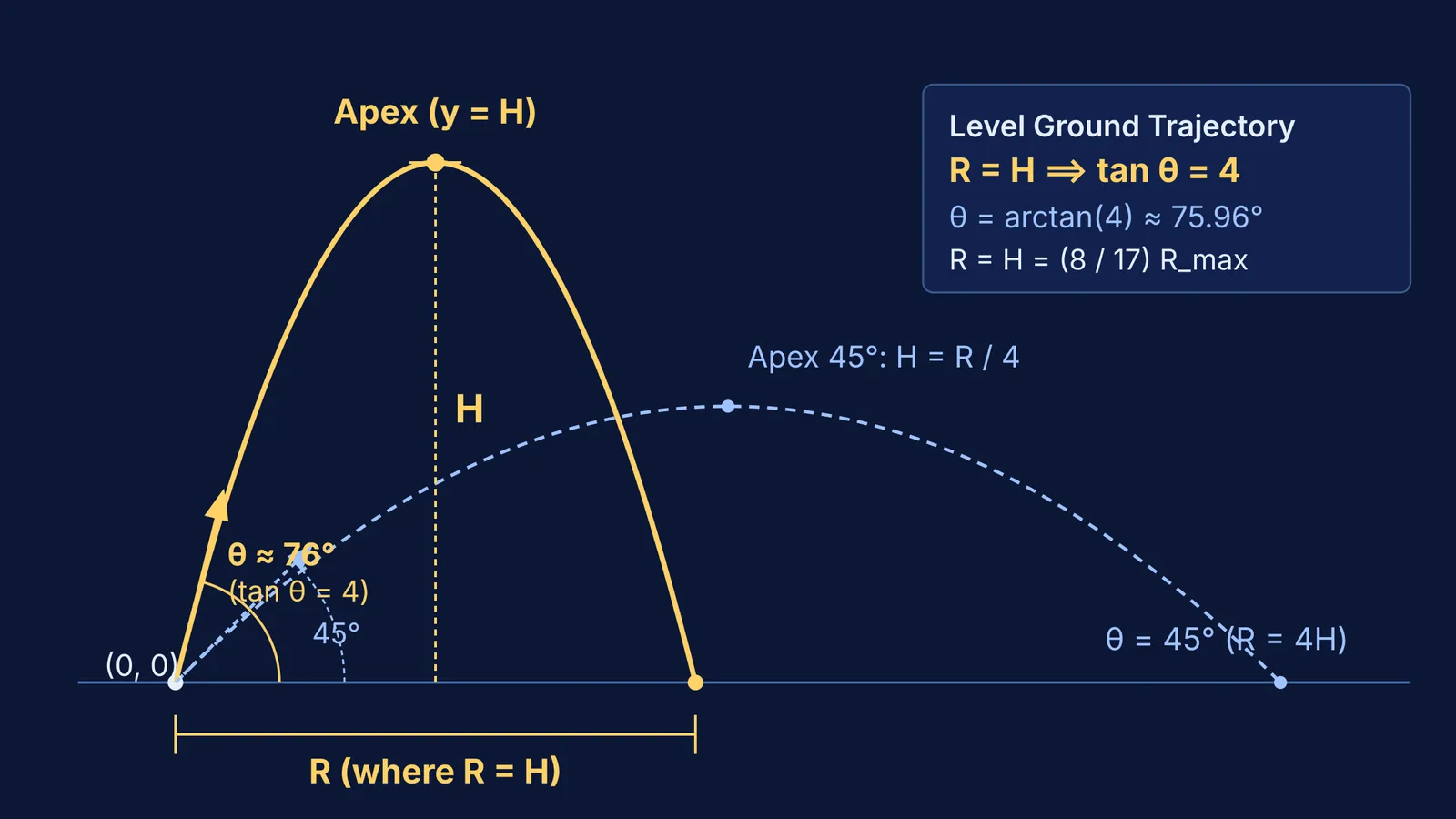
When you launch a projectile across flat ground, its path traces a symmetric parabola. If your goal is maximum horizontal reach, introductory physics teaches you to choose 45°. But what if you want the projectile to travel forward by the exact same distance that it rises—so that its horizontal range equals its peak height?
In exams like JEE Main and NEET-UG, students often guess that range and height balance near 45° or 60°. In reality, setting range equal to height requires a much steeper launch: exactly arctan(4), or approximately 75.96°. Here is the algebraic derivation, the geometric identity behind it, and a numerical check.
At what angle does projectile range equal maximum height?
To find the angle where horizontal range R equals maximum height H, we use standard kinematic formulas for level-ground projectile motion. As detailed in OpenStax University Physics Volume 1, a projectile launched at speed u and angle θ has a horizontal range of:
R = (u² sin 2θ) / g
Its peak vertical height is:
H = (u² sin² θ) / (2g)
Setting R = H gives:
(u² sin 2θ) / g = (u² sin² θ) / (2g)
Because launch speed u and gravitational acceleration g are positive non-zero quantities, we divide both sides by u² / g. Expanding the double-angle identity sin 2θ = 2 sin θ cos θ yields:
2 sin θ cos θ = (sin² θ) / 2
For any forward trajectory (0° < θ < 90°), sin θ is non-zero. Dividing both sides by sin θ cos θ and multiplying by 2 isolates the tangent:
4 = sin θ / cos θ = tan θ
Taking the arctangent gives the required launch angle:
θ = arctan(4) ≈ 75.96°
Rounded to the nearest whole degree, the angle is 76°.
Why does tan θ = 4H / R hold for every projectile?
The result tan θ = 4 comes directly from a universal ratio in parabolic motion. Dividing the maximum height equation by the range equation gives:
H / R = [(u² sin² θ) / (2g)] ÷ [(2 u² sin θ cos θ) / g] = (1/4) tan θ
Rearranging gives the master relation:
tan θ = 4H / R
As demonstrated by A. Tan and A. C. Giere (1987) in the American Journal of Physics, this identity reflects the geometry of the parabola itself. Along the parabolic path defined by the equation of trajectory, the launch slope y'(0) at the origin equals 4H / R. Because tan θ represents this launch slope, tan θ must equal 4H / R for every level-ground trajectory.
This formula links key benchmark launch angles:
At θ = 45°, tan 45° = 1, giving R = 4H (range is four times the height).
At θ ≈ 63.43°, tan θ = 2, giving R = 2H (range is twice the height).
At θ ≈ 75.96°, tan θ = 4, giving R = H (range equals height).
At θ ≈ 82.87°, tan θ = 8, giving H = 2R (height is twice the range).
Notice that neither u nor g appears in tan θ = 4H / R. Whether thrown on Earth, the Moon, or Mars, setting range equal to height always yields θ ≈ 76°. You can explore how these components interact in our guide to horizontal range, maximum height, and time of flight.
How do you verify range equals maximum height by numbers?
To verify the algebra, test a ball launched at u = 20 m/s under standard gravity g = 9.80665 m/s², verified by the NIST reference on fundamental physical constants.
When tan θ = 4, a right triangle with legs 4 and 1 has hypotenuse √(4² + 1²) = √17. The exact trigonometric values are:
sin θ = 4 / √17 ≈ 0.97014
cos θ = 1 / √17 ≈ 0.24254
sin 2θ = 2 sin θ cos θ = 8 / 17 ≈ 0.47059
sin² θ = 16 / 17 ≈ 0.94118
Computing R and H:
Base scale: u² / g = 400 / 9.80665 ≈ 40.7886 m.
Range: R = (u² / g) sin 2θ = 40.7886 × (8 / 17) ≈ 19.195 m.
Height: H = [u² / (2g)] sin² θ = (40.7886 / 2) × (16 / 17) ≈ 19.195 m.
Both values match to the millimetre.
This check reveals a useful ratio: at 45°, the maximum possible range is R_max = u² / g ≈ 40.789 m. When you launch at 76° so that R = H, both range and height equal exactly 8/17—about 47.06%—of that maximum range. You can also evaluate the turn rate at the peak with the radius of curvature at the trajectory peak.
What mistakes do students make in range and height problems?
Students often lose marks on these questions through three errors:
Guessing 45°: Assuming 45° balances range and height equally, when substituting θ = 45° into the trajectory relation yields R = 4H, meaning the projectile travels much farther horizontally than it rises vertically.
Expanding sin 2θ incorrectly: Writing sin 2θ as 2 sin θ instead of 2 sin θ cos θ, which drops the cosine needed to form tan θ.
Searching for missing values: Assuming the question is unsolvable when launch speed or gravity is omitted, even though both variables cancel out.
Solving two-dimensional kinematics requires working through each step methodically. When practicing multi-step problems, you can explore the Fermi Problem Library, where step-by-step solutions explain the physical reasoning behind each transition. To review how two-dimensional motion fits into the wider mechanics curriculum, check the Fermi Concept Library.


