On this page
Here are two short pieces of double-stranded DNA. Before you read on, guess which one comes apart at the lower temperature.
Duplex 1: 5′-ATATGCATAT-3′ paired with its complement
Duplex 2: 5′-GCGCATGCGC-3′ paired with its complement
Write your guess down. You learn more when you test a prediction than when you read an answer. Below, we check it by counting, follow the trend, then look at what holds the helix together.
What is DNA melting temperature?
When you heat double-stranded DNA, the two strands separate. Biologists call this melting, or denaturation. In their 1962 paper, Marmur and Doty80066-7) defined the melting temperature, Tm, as the midpoint of the rise in absorbance at 260 nm as DNA is heated. Separated strands absorb more ultraviolet light than the helix does; the paper calls this the hyperchromic rise.
How does GC content change DNA melting temperature?
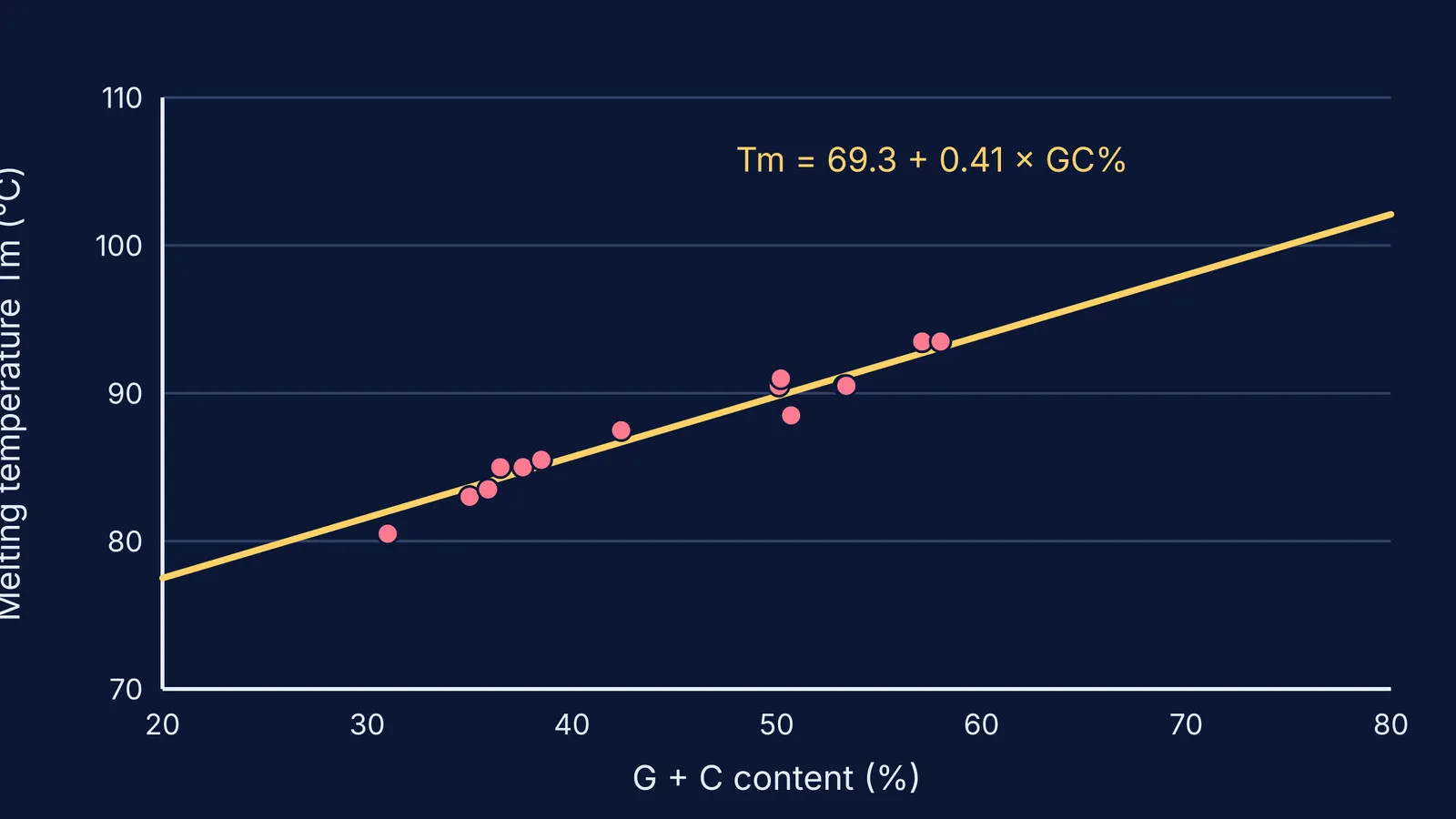
Marmur and Doty measured Tm for 41 DNA samples of known base composition and fitted one straight line: Tm = 69.3 + 0.41 × (%GC), in °C, for a solvent containing 0.2 M sodium ions (Marmur and Doty, Journal of Molecular Biology, 196280066-7)). Their solvent was 0.15 M sodium chloride plus 0.015 M sodium citrate.
The slope means that every 1% rise in G-C content raises the melting temperature by 0.41 °C. In the paper's table, *E. coli* DNA (about 50% G-C) melts at 90.5 °C, while *Clostridium perfringens* DNA (31% G-C in the literature value they list) melts at 80.5 °C.
Salt matters too. In a much weaker solution (0.01 M phosphate plus 0.001 M EDTA), the paper's line had the same slope but sat 20 °C lower. Less salt means DNA melts at a lower temperature.
Worked example: count the hydrogen bonds, then predict
The standard pairing rule: an A-T pair is held by two hydrogen bonds and a G-C pair by three (Base pair, Wikipedia). If you want more practice with this, we cover it step by step in how to count hydrogen bonds in a DNA strand.
Count G and C in one strand. Duplex 1 has 2 of 10 (20% G-C). Duplex 2 has 8 of 10 (80% G-C).
Count hydrogen bonds. Duplex 1: 8 × 2 + 2 × 3 = 22. Duplex 2: 2 × 2 + 8 × 3 = 28.
Predict. Duplex 2 has more hydrogen bonds holding its strands together, so Duplex 1 should come apart first, at the lower temperature.
Now vary the G-C share for a long stretch of DNA and watch the counts and the Marmur-Doty prediction80066-7) move together. Each line gives hydrogen bonds per 100 base pairs and the predicted Tm in 0.2 M sodium:
20% G-C: 220 hydrogen bonds, Tm about 77.5 °C
40% G-C: 240 hydrogen bonds, Tm about 85.7 °C
50% G-C: 250 hydrogen bonds, Tm about 89.8 °C
60% G-C: 260 hydrogen bonds, Tm about 93.9 °C
80% G-C: 280 hydrogen bonds, Tm about 102.1 °C
Each 10% step adds 10 hydrogen bonds per 100 base pairs and 4.1 °C. The 50% prediction (89.8 °C) sits close to the 90.5 °C the paper measured for *E. coli*. If you know only one base's percentage, Chargaff's rule numericals show how to get the G-C share first.
Is the third hydrogen bond really why GC-rich DNA melts later?
Only partly. A 2006 study in Nucleic Acids Research by Yakovchuk, Protozanova and Frank-Kamenetskii measured the two forces separately. It found that base stacking, the attraction between neighbouring bases piled on top of each other, is the main stabilising force in the double helix. In that study, A-T pairing on its own was always destabilising and G-C pairing added almost no stabilisation.
The same paper reports that stacking accounts for 0.6 of the 1.2 kcal/mol stability difference between A-T and G-C polymers. G-C-rich stretches also stack more strongly, so for long DNA in the same salt solution, counting hydrogen bonds usually puts strands in the same order as their melting temperatures. It just isn't the whole explanation. If an exam asks you to rank strands, the count usually gets you the right answer. If a teacher asks why, mention stacking as well.
How can you see DNA melting instead of memorising it?
A rule like "more G-C, higher Tm" sticks once you have watched the trend yourself. Change one variable at a time (G-C share, then salt) and predict before each change. The Fermi Simulation Lab has interactive simulations for ideas that are easier to see than to read. If base pairing itself still feels shaky, the Fermi Concept Library gives each concept in biology and chemistry its own lesson.
Next, see where melting is put to work: each PCR cycle heats DNA to separate its strands, and our post on PCR cycles and DNA doubling walks through the counting.