

On this page
If you place a single double-stranded DNA molecule into a microcentrifuge tube and run 30 thermal cycles of polymerase chain reaction (PCR), how many target strands will you hold an hour later? When Kary Mullis conceived PCR in 1983, the core insight was that cyclical DNA replication could yield runaway geometric expansion, as recounted in our profile of Kary Mullis and the invention of PCR. In their landmark paper on thermostable DNA polymerase, Saiki et al. (1988) demonstrated that repeating denaturation at 94 °C, primer annealing at 55 °C, and enzymatic extension at 70 °C (commonly 72 °C in modern protocols) amplified single-copy genomic sequences by a factor of more than 10 million with extreme specificity, turning undetectable molecular traces into visible diagnostic bands.
How many DNA copies do 30 PCR cycles produce?
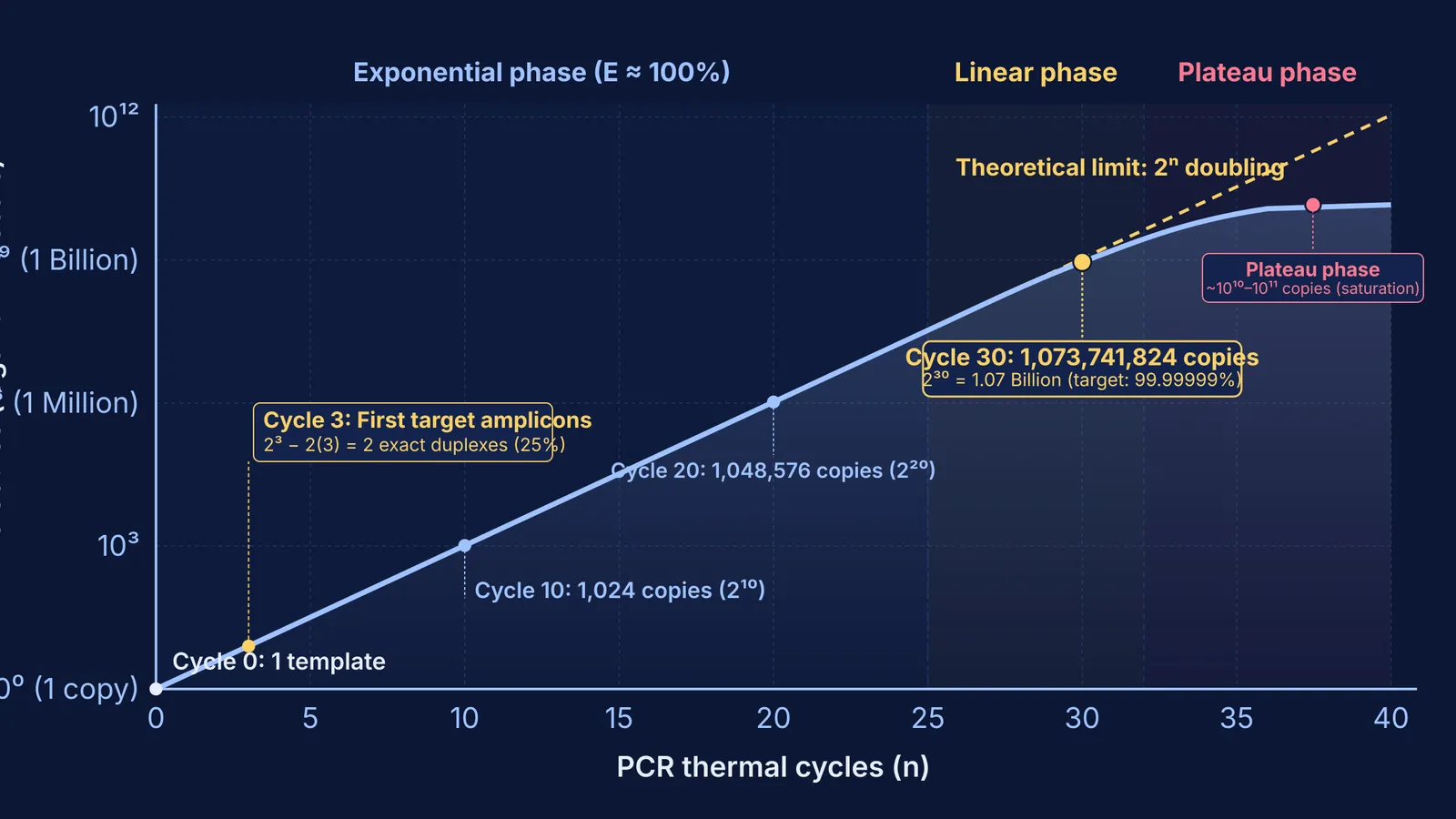
Under ideal conditions where each template strand is replicated once per round, the number of double-stranded DNA molecules doubles with every thermal cycle. The total yield follows the exponential power law N = N₀ × 2ⁿ, where N₀ represents the starting template count and n denotes completed cycles. Starting with N₀ = 1 single double-stranded molecule, cycle 1 produces 2 molecules, cycle 2 yields 4, and cycle 10 reaches 2¹⁰ = 1,024 copies. By cycle 20, the reaction contains 2²⁰ = 1,048,576 molecules (exceeding 1 million copies), and by cycle 30, the theoretical count reaches 2³⁰ = 1,073,741,824 copies—amplifying the original DNA strand more than 1.07 billion times, a classic benchmark tested in recombinant tools and PCR steps in biotechnology. As Saiki et al. (1985) documented during the earliest clinical demonstrations of beta-globin amplification for sickle-cell diagnosis, exponential replication achieved over 220,000-fold enrichment even before automated thermal cyclers existed.
Why do exact target DNA strands appear only in cycle 3?
A common trap in biology problem-solving is assuming that every newly synthesized strand matches the exact target sequence between the two primers from the outset. In reality, primers only define the 5′ boundary of a newly synthesized strand. When DNA polymerase extends a primer annealed to the original genomic template in cycle 1, synthesis continues until thermal denaturation halts the enzyme, creating variable-length intermediate strands that overrun the target sequence at the 3′ end, a mechanism detailed by Mullis and Faloona (1987)55023-6).
To see why exact-length target amplicons require three full cycles, trace each strand through a cycle-by-cycle framework:
Cycle 0: 1 original double-stranded template (2 template strands of indefinite length).
Cycle 1: 2 double-stranded molecules. Primers define the 5′ ends, but synthesis overruns the 3′ ends, producing 2 intermediate strands and 0 exact target molecules.
Cycle 2: 4 double-stranded molecules. Intermediate templates produce the first 2 single strands of exact target length, but exact double-stranded amplicons remain at 0.
Cycle 3: 8 double-stranded molecules. The exact single strands yield complementary exact partners, producing the first 2 double-stranded target amplicons (25% of the total product).
Cycle n: Total double-stranded molecules equal 2ⁿ, intermediate molecules grow linearly at 2n, and exact target amplicons follow the formula 2ⁿ − 2n.
At cycle 30, out of 1,073,741,824 total double-stranded molecules, exactly 2 × 30 = 60 molecules remain intermediate, while 1,073,741,764 molecules (over 99.99999%) are pure target amplicons.
What causes the PCR amplification curve to plateau?
If exponential doubling continued without limit, 40 cycles would generate over 1 trillion DNA molecules (2⁴⁰ ≈ 1.1 × 10¹²) from a single template, rapidly consuming the available free nucleotides and primers in the reaction tube. As Morrison and Gannon (1994)90076-0) demonstrated in their analysis of quantitative amplification kinetics, PCR does not expand indefinitely; it follows a sigmoidal accumulation curve divided into an exponential doubling phase, a linear deceleration phase, and a plateau phase.
Kinetic modeling by Schnell and Mendoza (1997) confirmed that product accumulation shifts from the exponential law Nₙ = N₀(1 + E)ⁿ toward zero growth due to four interlocking biochemical constraints:
Reagent depletion: Free dNTPs and primers deplete as product mass reaches micromolar levels.
Strand re-annealing: High concentrations of complementary amplicon strands re-anneal faster than primers can bind, outcompeting extension.
Enzyme degradation: Repeated exposure to 94 °C denaturation reduces Taq polymerase activity over 30 to 35 thermal cycles.
Pyrophosphate accumulation: Inorganic pyrophosphate released during nucleotide addition builds up and inhibits polymerase activity.
To overcome the ambiguity of the plateau phase where different starting concentrations converge on similar end-point yields, Higuchi et al. (1992) introduced real-time kinetic PCR using ethidium bromide fluorescence, capturing signals during early exponential cycles before the reaction plateaued, a principle that underpins diagnostic quantification and gel electrophoresis separating amplified DNA.
How can stepping through a PCR simulation build intuition?
Tracking invisible molecular collisions across 30 thermal cycles in your head is difficult because humans naturally think in linear additions rather than geometric powers. Stepping through an interactive cycle simulator allows you to alter temperature setpoints, vary starting primer ratios, and watch how intermediate single strands give rise to pure target amplicons across the first three cycles.
The Fermi Simulation Lab offers interactive simulations for ideas that are easier to see than to read, allowing students to visualize strand denaturation, primer annealing, and the transition from log-linear doubling into the plateau phase. For numerical practice on cycle yields and dilution factors, the Fermi Problem Library has worked problems with a step-by-step solver that explains the reasoning rather than printing an answer.


