On this page
Most strawberry DNA guides tell you what to add. Here you predict what each ingredient does, then leave one out at a time and check. That turns a kitchen demo into a real experiment, and trains the question practical examiners ask: not "what did you add?" but "why?"
How do you extract DNA from strawberries at home?
This method is adapted from the at-home activity by the Carl R. Woese Institute for Genomic Biology at the University of Illinois, which lists ice among its materials.
Make the extraction solution: ½ cup of liquid dish soap, 1½ cups of water and 2 teaspoons of salt.
Chill your 70% rubbing alcohol in a bowl of ice.
Put one strawberry inside a folded half sheet of paper towel in a zip-lock bag and smash it to a pulp.
Add 2 to 3 tablespoons of the extraction solution and massage the bag for 2 to 5 minutes.
Cut a small corner off the bag and squeeze only the liquid into a small vial, about a quarter full.
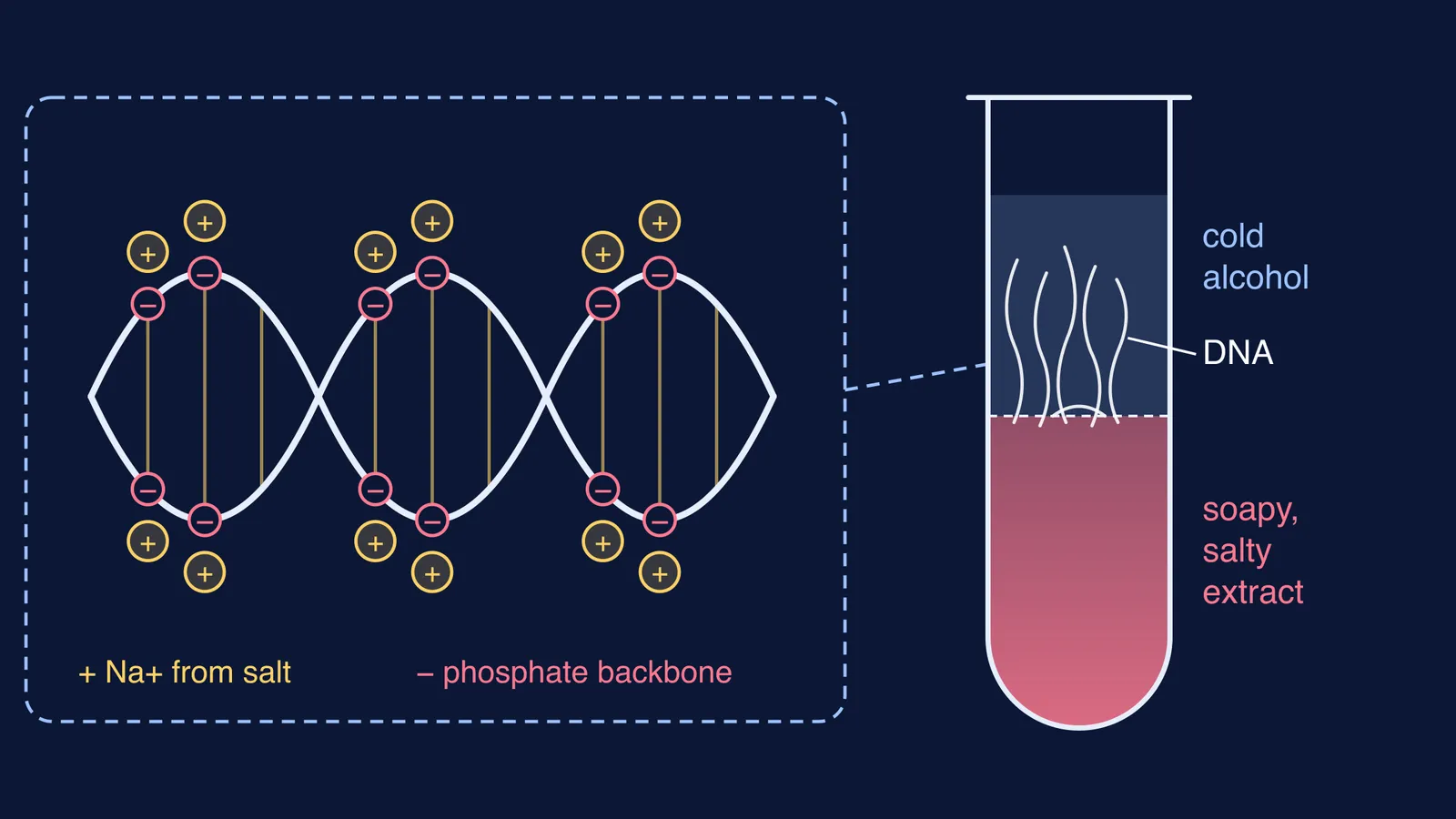
Pour the cold alcohol slowly down the side so it sits on top as a separate layer.
Watch the boundary between the two layers.
The Utah DNA extraction guide says white, stringy clumps form where the water and alcohol layers meet and rise into the alcohol. The Illinois sheet says it will "look like wet cotton fibers, a spider web", and you can lift it out with a toothpick.
Rubbing alcohol catches fire easily and is poisonous to drink, so keep it away from flames and small children, and do this with an adult nearby. For more on choosing safe home experiments, see how to plan a safe science experiment at home.
What do soap, salt and cold alcohol each do?
Before you read on, write one sentence for each ingredient. Then compare.
Soap opens the membranes. A strawberry cell's DNA sits inside the nucleus, behind the cell membrane and the nuclear membrane, both made of fatty lipids. Soap molecules have a water-loving head and a water-hating tail, the Genetic Science Learning Center at the University of Utah explains, which lets them break up those lipid layers the way they lift grease off a plate. Smashing tears open the tough cell walls; soap dissolves the membranes behind them.
Salt lets the DNA clump. DNA's backbone is a chain of phosphate groups that carry a negative charge. In lab DNA precipitation, cations supplied as salts are added "to neutralize the negative charge of the DNA phosphate backbone", according to a protocol by Michael Green and Joseph Sambrook in Cold Spring Harbor Protocols. With those charges shielded, strands stop pushing each other apart and can clump together.
Cold alcohol pulls DNA out of solution. The Utah guide puts it simply: "DNA normally stays dissolved in water, but when salty DNA comes in contact with alcohol it becomes undissolved." The same guide says cold slows enzymes that can break DNA apart, and that ice-cold water and alcohol increase your yield.
What happens if you skip one step?
Set up four vials side by side and change only one thing in each. Write your prediction on a sticky note before you pour.
Vial A, full recipe: soap, salt and cold alcohol. This is your control.
Vial B, no soap: salty water only. Prediction to test: with the membranes intact, far less DNA escapes, so expect little or nothing at the boundary.
Vial C, no salt: soapy water only. Prediction to test: the negative charges are not shielded, so expect fewer or thinner threads. If some DNA still appears, ask where else charged ions in the mix might come from.
Vial D, room-temperature alcohol: Prediction to test: alcohol still does the precipitating, so some DNA should appear, but compare the amount with vial A.
If even vial A shows nothing, the Illinois troubleshooting notes suggest more salt or alcohol, less water and more smashing.
Then score yourself. For each vial, was your prediction right, partly right or wrong, and which sentence of your explanation needs fixing?
If a result surprises you and you cannot work out why, Fermi's AI tutor can go through it with you: it notices where you are stuck and decides whether to explain, ask or show. And for ideas that are easier to see than to read, the Fermi Simulation Lab has interactive simulations to explore.
Why do strawberries give so much DNA?
Strawberries are soft, so they smash easily, and each cell carries a lot of DNA. The cultivated strawberry, Fragaria × ananassa, is octoploid: its genome descends from four ancestral diploid species, according to a 2019 genome study in Nature Genetics. Octoploid means eight sets of chromosomes, compared with two in most human cells, as the Illinois activity sheet notes.
The Illinois sheet says kiwi, banana and peaches also work well, so you can repeat the four-vial test with them; start with how to extract DNA from a banana. For the lab method with enzymes, read how to isolate DNA from plant tissue, and why each step works.