On this page
Your first technical interview can feel like a viva where the examiner also watches you code. What interviewers look for is largely predictable, though, and you can practise all of it. Google's interview guide for student internship candidates says its engineers evaluate "not only your technical abilities but also how you approach problems and how you try to solve them" (Google Technical Internships Interview Preparation guide). That gives you four things to prepare.
What does a technical interview for freshers actually test?
Many fresher interviews move through four parts: your projects, core-subject questions, a problem solved in front of the interviewer, and your questions. Our guide to how the campus placement process works walks through the rounds, and preparing for placement aptitude tests covers the screening test that often comes first.
The same Google guide asks candidates to "substantiate what your CV/resume says": if you list Python as your main language, questions on Python are fair game. Cut anything from your CV you cannot discuss with confidence.
How do I explain my projects in an interview?
Interviewers ask about projects to see whether you understood what you built. Use five lines and say them aloud until you need no notes:
Problem: what was broken or missing, and for whom.
Your part: what you personally did, separate from the team.
One decision: a choice you made and why (a database, a library, an algorithm).
Result: what worked, honestly stated.
Next: what you would change now.
A worked example, for a second-year attendance app: "Our class tracked attendance on paper, so shortfalls showed up only at the end of term. I built the backend in Python with a SQLite database. I chose SQLite over a server database because the app ran on one laptop and needed no setup. It worked for our section for a month. Next, I would add logins so students could check their own records." Expect follow-ups: why not MySQL?
Explaining also exposes your gaps. In a study by Michelene Chi and colleagues, eighth-graders prompted to explain each line of a text on the circulatory system to themselves made larger gains on a test of the topic than students who read it twice (Chi et al., 1994, Cognitive Science). Where your project explanation stalls is likely where the interviewer will push.
Which core subjects should I revise first?
Google's guide says you will be expected to know the complexity of an algorithm and how to improve it, and calls understanding Big-O analysis "particularly important", alongside sorting and hashing (Google interview preparation guide). For software roles, revise:
Arrays, strings, linked lists, stacks, queues, hash maps and trees
Time and space complexity of whatever you write
Sorting and searching
One language you know well, including its standard library
The basics your degree covered: OOP, DBMS and SQL, operating systems, networks
Revise by testing yourself, not re-reading. In a study by Henry Roediger and Jeffrey Karpicke, students who took recall tests on prose passages remembered substantially more two days and a week later than students who restudied them, though restudying did better after five minutes (Roediger and Karpicke, 2006, Psychological Science). Close your notes, write what a hash map does and its lookup cost, then check.
If a basic idea from mathematics or computing has gone fuzzy, the Fermi Concept Library has a lesson for every concept in physics, chemistry, biology, mathematics and computing, so you can patch the gap before the interview.
How do I think aloud while solving a coding problem?
Google's guide tells candidates to "think out loud", state assumptions and ask clarifying questions. A script to practise:
Restate: "So I return the longest substring with no repeated characters. Can the string be empty? Only lowercase letters?"
Example: work one small input by hand.
Brute force: "The simple way checks every substring, which is slow for long strings."
Improve: "A sliding window with a set makes it O(n). The trade-off is extra memory."
Code, narrating each block.
Test: walk your example and one edge case through the code out loud.
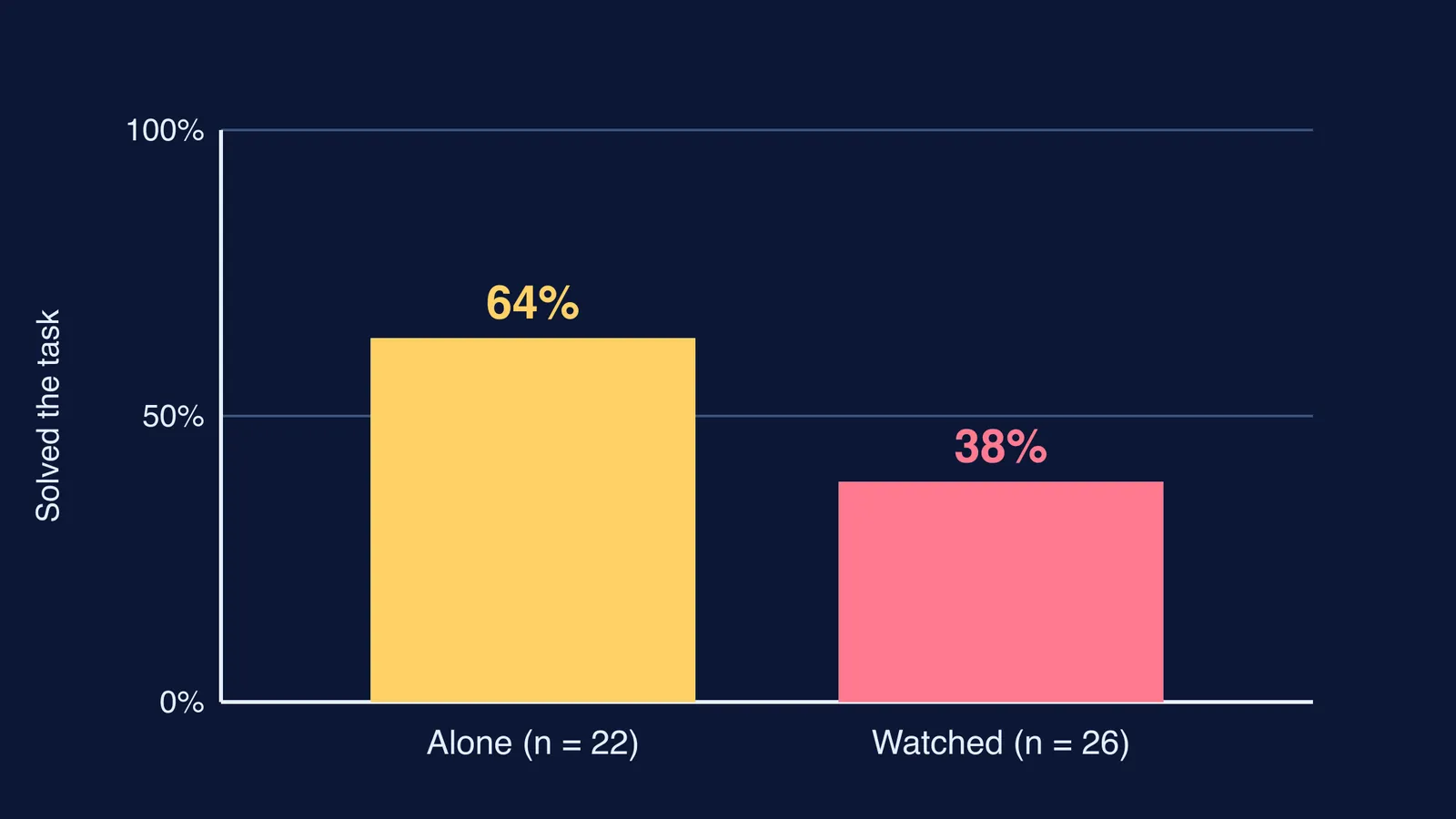
Talking while watched is a separate skill. In a 2020 randomised trial at NC State University, 26 computer science students solved a coding problem at a whiteboard while thinking aloud in front of an experimenter and 22 solved it alone in a private room; 61.5% failed in the watched setting, compared with 36.3% in private (Behroozi et al., ESEC/FSE 2020). The watched group also showed higher stress and cognitive load.
Our guide to practising interviews with peers shows how to run them. If the interviewer drops a hint, take it; Google's guide says hints are meant to help.
What questions should I ask at the end of a technical interview?
Google's guide notes that most interviewers will ask whether you have questions, so prepare some:
"What would a new graduate work on in the first three months?"
"How does the team review code?"
"What does training for freshers cover?"
Skip anything already in the job posting. A specific question lets you leave sounding curious rather than relieved.