On this page
Why is practising with a friend more effective than rehearsing alone?
Most students prepare for interviews, university vivas, or scholarship panels by silently reading notes or rehearsing bullet points in their heads. When you think through an answer silently, your internal monologue creates an illusion of competence. Speaking aloud to a friend forces you to translate fragmented thoughts into complete, coherent arguments under realistic time pressure.
In learning science, this exchange is known as peer assessment. A meta-analysis of 54 control-group studies by Double, McGrane, and Hopfenbeck (2020) found that peer assessment produced a significant positive effect on performance across domains (Hedges' g = 0.31, p < 0.001) compared to no assessment, and even outperformed teacher assessment alone (g = 0.28, p = 0.007). The benefits run in both directions: the speaker practices under social pressure without high-stakes evaluation anxiety, while the reviewer develops evaluative judgment by analyzing what makes an argument convincing. Just as collaborative routines help students learn without excessive pressure, having to articulate reasoning to a peer quickly exposes conceptual gaps that silent review conceals.
In selection settings, structured practice delivers measurable results. In a trial of 104 students published in the Wisconsin Medical Journal, Hueston and Holloway (2016) found that over 90% of participants agreed mock interviews identified critical strengths and weaknesses, with participants achieving a 99% placement rate compared to 94% among nonparticipants (p < 0.001).
How should you structure a 45-minute peer mock interview?
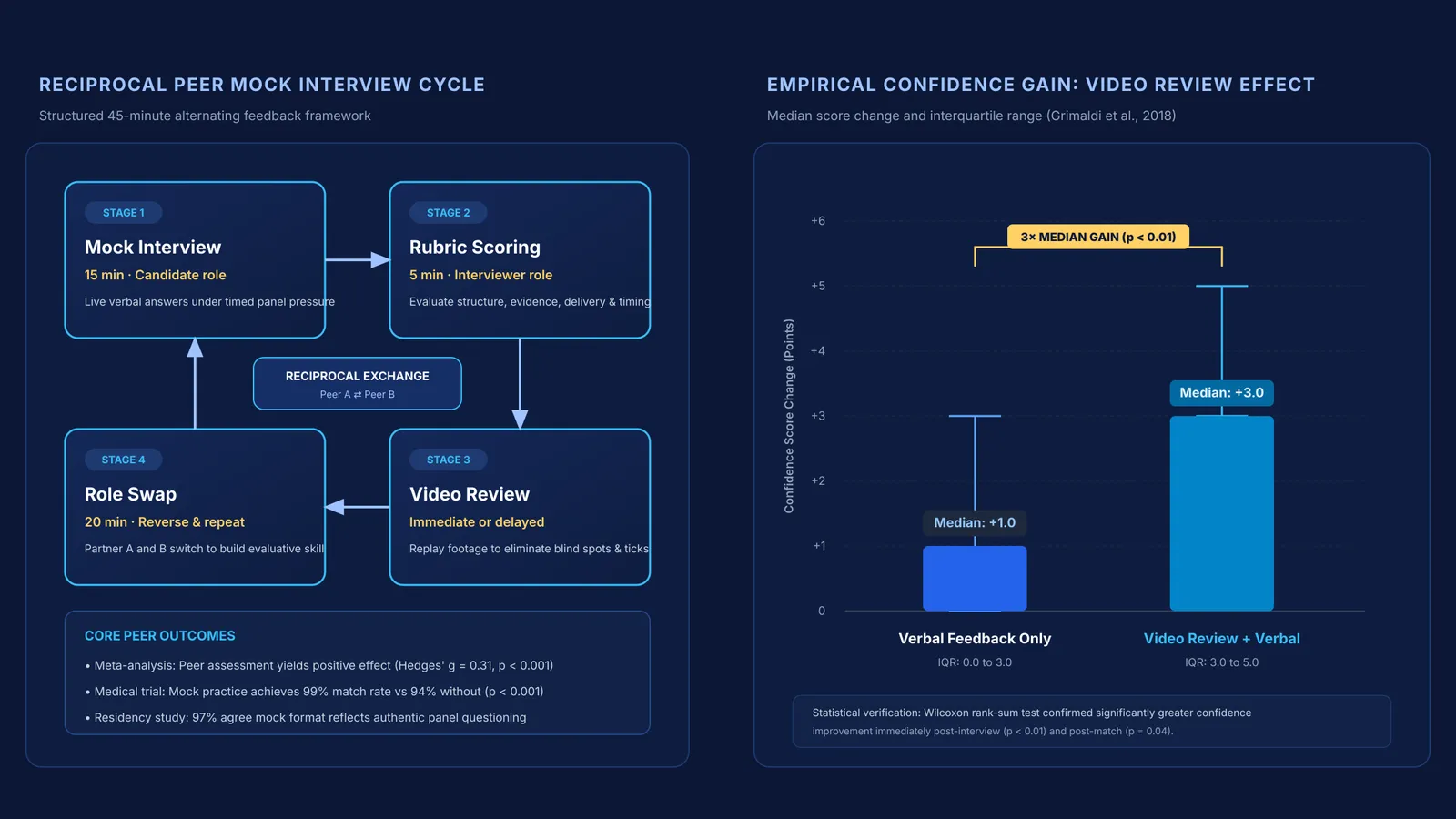
Unstructured conversations between friends easily devolve into informal chats. To simulate a real interview room, establish a strict 45-minute timetable:
Setup and exchange (5 minutes). Share your target program description, resume, and 5 core questions. Agree on whether the session focuses on behavioral stories, academic concepts, or technical problem-solving.
First mock trial (15 minutes). Partner A acts as interviewer; Partner B acts as candidate. The interviewer maintains professional composure and asks questions without breaking character.
Rubric debrief (5 minutes). Partner A provides immediate feedback using an objective rubric while Partner B records specific corrections.
Role swap (20 minutes). Reverse roles and repeat the 15-minute simulation followed by the 5-minute debrief.
Just as when you run a study group that actually helps you learn, agreeing on clear ground rules beforehand keeps the session focused and productive.
What should you look for on an interview feedback rubric?
Vague compliments like "you sounded confident" do not improve performance. Research on selection interviews by Campion, Palmer, and Campion (1997) demonstrates that structured interviews with anchored rating rubrics reduce evaluator bias and create reliable benchmarks. Score each response from 1 to 4 across four specific criteria:
Structure. Did the candidate start with a direct thesis, or did they wander before addressing the prompt?
Evidence. Did the candidate cite concrete numbers, project milestones, or specific examples to substantiate claims?
Delivery. Did they maintain steady eye contact, control filler words ("um," "like"), and speak at a steady pace?
Timing. Did the answer conclude cleanly within 90 to 120 seconds, or did it trail off into repetitive loops?
If your interview involves technical coursework or quantitative problem-solving, test your foundational reasoning with Fermi's AI tutor. Rehearsing conceptual solutions in the Fermi Problem Library—which offers worked problems with a step-by-step solver that explains the reasoning—ensures your core ideas are sound before you defend them aloud.
Why should you record your mock interview on video?
Candidates rarely realize their own nervous habits, such as shifting posture, rushing through sentences, or avoiding eye contact. Setting up a phone to record your practice run introduces objective self-observation.
In a trial published in *MedEdPublish*, Grimaldi and colleagues (2018) examined mock interviews with video-stimulated recall across 33 candidates. Students who reviewed their video recordings alongside verbal feedback achieved a median confidence gain of 3 points (interquartile range 3 to 5), compared to just 1 point (interquartile range 0 to 3) for students receiving verbal feedback alone (p < 0.01). Similarly, in a study of 59 candidates by Buckley and colleagues (2018), 88% completed post-session evaluations and unanimously reported improved confidence, with 97% agreeing mock trials closely mirrored real panel conditions.
How do you answer common behavioral questions with the STAR method?
When interviewers ask behavioral questions—such as describing a project hurdle or resolving team conflict—unprepared candidates often narrate long, unedited stories. The STAR framework keeps your narrative structured:
Situation (15 seconds): Describe the context and problem concisely.
Task (15 seconds): State your specific role and objective.
Action (60 seconds): Explain the concrete actions you took and the reasoning behind them.
Result (30 seconds): Highlight the measurable outcome and what you learned.
Pairing STAR with the self-explanation technique ensures you explain the logic behind your choices rather than reciting a chronology. For instance, instead of saying "I prepared thoroughly for our science project," say: "When our robotics team faced sensor calibration errors (Situation), my task was to stabilize signal noise (Task). I installed shielded wiring and coded a moving-average filter (Action), eliminating sensor errors and helping our team secure second place (Result)."
By combining structured mock interviews, rubric evaluations, and video reflection, you and your friend transform nervous rehearsal into deliberate practice.