

On this page
In short
Extracting DNA from a banana is a classic kitchen experiment that makes the microscopic world visible to the naked eye. By mashing the fruit and mixing it with dish soap, salt and cold rubbing alcohol, you can break open the cells and precipitate the DNA as a cloudy, stringy mass.
How does the DNA extraction work?
Deoxyribonucleic acid (DNA) is the molecule that carries genetic information for the development and functioning of an organism (NHGRI). Every living cell contains DNA, and in a banana, every single cell is packed with these genetic blueprints. However, this DNA is locked tightly inside the nucleus, which is further protected by the cell membrane and, in plants, a rigid cell wall.
To see the DNA, we have to break through these physical and chemical barriers using everyday chemistry:
Mashing: Physically squishing the banana breaks the rigid plant cell walls, creating a larger surface area for the chemicals to act upon.
Dish soap: The soap dissolves the lipid (fatty) membranes of the cells and the nuclei, bursting them open and releasing the DNA into the liquid (Science Notes).
Salt: The salt (sodium chloride) removes proteins bound to the DNA and helps the long DNA strands clump together.
Cold alcohol: DNA dissolves easily in water, but it is highly insoluble in cold alcohol. When the ice-cold rubbing alcohol meets the watery banana mixture, the DNA precipitates—turning from a dissolved, invisible substance into a solid mass.
What you eventually see is not a single DNA double helix, but millions of strands clumped together. If you are exploring biology with your child or testing out ideas from the Fermi Simulation Lab, doing this experiment at home connects the theory of cells, cell division and genetics to something you can actually hold in your hand.
What materials do you need for a banana DNA extraction?
You only need a few basic items from the kitchen and bathroom (Science Notes):
1 banana (a ripe one is easiest to mash)
1/2 cup of water, plus 2 tablespoons
1 teaspoon of clear liquid dish soap
1/4 teaspoon of table salt
Rubbing alcohol (isopropyl alcohol), kept in the freezer for at least 30 minutes so it is ice-cold
A resealable plastic bag
A coffee filter or a fine sieve
A clear glass or jar
A wooden skewer or a toothpick
What are the step-by-step instructions?
Mash the fruit: Place the banana and 1/2 cup of water into the plastic bag. Seal it tightly, pressing out the air, and mash the banana with your hands until it becomes a smooth paste (Science Notes).
Make the extraction liquid: In a separate cup, mix 2 tablespoons of water, 1/4 teaspoon of salt and 1 teaspoon of liquid dish soap. Stir gently until the salt dissolves. Try not to create too many soap bubbles, as excess foam can trap the DNA later on.
Break the cells: Add the soapy saltwater mixture to the bag with the mashed banana. Reseal it and gently squish the mixture together for five minutes. This gives the soap time to dissolve the cell membranes and release the genetic material.
Filter the mixture: Place your coffee filter over the clear glass. Pour the banana mixture into the filter and wait for the liquid to drip through. You need about an inch of this clear liquid (the filtrate) in your glass. Do not squeeze the filter, or you will force cloudy cellular pulp through with the liquid, ruining the clarity.
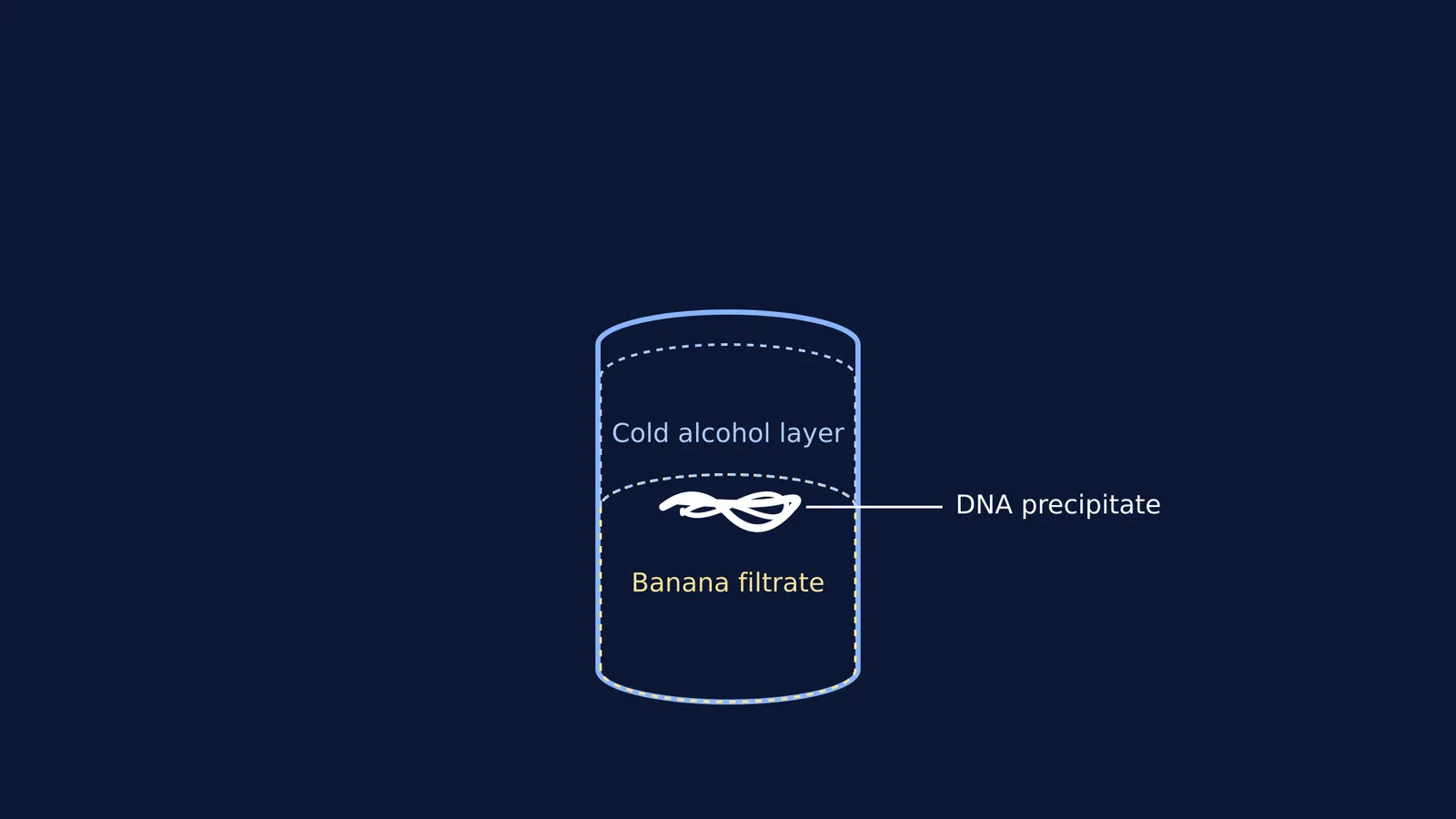
Precipitate the DNA: Tilt the glass and very slowly pour the ice-cold alcohol down the inside edge so that it forms a clear layer sitting on top of the banana liquid. Do not stir the two layers together.
Collect the strands: Let the alcohol and filtrate sit undisturbed for four to five minutes and watch the boundary between the two liquids. You will see a white, cloudy, web-like substance form in the alcohol layer. This is the banana's DNA. Use your skewer to gently swirl and lift the strands out of the glass.
Why might the DNA extraction fail?
If you do not see any white strands forming in the alcohol layer, check these common mistakes:
Was the alcohol cold enough? Warm alcohol will not precipitate the DNA effectively. Leave it in the freezer for at least half an hour before you start.
Did you stir the layers? The alcohol must sit undisturbed on top of the banana liquid. If you mix them, the DNA will not clump together at the boundary.
Did you squeeze the filter? Squeezing pushes cloudy cellular debris into your clear liquid, which hides the white DNA strands. Let gravity do the work, even if it takes ten minutes.
Was the banana too green? Ripe bananas are softer and their cell walls are already beginning to break down, making the DNA much easier to extract.
To explore more about how DNA builds living things, see our guide to Nucleosides vs nucleotides: the chemistry of DNA and RNA units or learn about the Discovery of nuclein. If you are preparing for a biology exam, you can test your understanding with Chargaff's rule numericals.


