On this page
Take a circle, mark 5 evenly spaced dots and join every second one. You have drawn a pentagram without lifting your pencil. Try 6 dots and you get two triangles instead. The difference comes down to one number you already know from Class 6: the HCF.
What is a star polygon?
A star polygon {n/k} is the figure you get by joining every kth point out of n points spaced evenly around a circle, as Wolfram MathWorld defines it. The same page notes that k = 1 gives an ordinary regular polygon, the pentagram is {5/2} and the hexagram, or six-pointed star, is {6/2}.
The strict definition asks that n and k share no common factor, so that the line is one closed path. When they do share a factor, Wikipedia's article on polygrams describes the drawing as a compound: rotated copies of a smaller polygon laid on top of each other, with the number of copies equal to gcd(n, k). The gcd (greatest common divisor) is the same thing as the HCF.
How do you draw a star polygon by skipping points on a circle?
You need a compass, a protractor and a pencil from your geometry box.
Draw a circle and mark its centre.
Divide 360° by n. For 10 points that is 36°, so mark a dot every 36° around the circle.
Number the dots 0, 1, 2 and so on up to n − 1, going clockwise.
Start at 0 and draw a line to dot k, then to 2k, then 3k. When the count goes past n − 1, subtract n (with n = 10 and k = 3, after 9 comes 12, which is dot 2).
Stop when you land back on 0.
If some dots are still untouched, start again from the lowest unused dot and repeat with a new colour.
Step 4 is clock arithmetic: you are working out remainders after dividing by n. If that idea is new, our post on adding hours on a 12-hour clock walks through it.
Why does the HCF of n and k decide the shape?
Your pencil visits dots 0, k, 2k, 3k and so on, each counted as a remainder after dividing by n. You are back at 0 the first time a multiple of k is also a multiple of n, that is, at LCM(n, k). That takes LCM(n, k) ÷ k steps, which works out to n ÷ HCF(n, k).
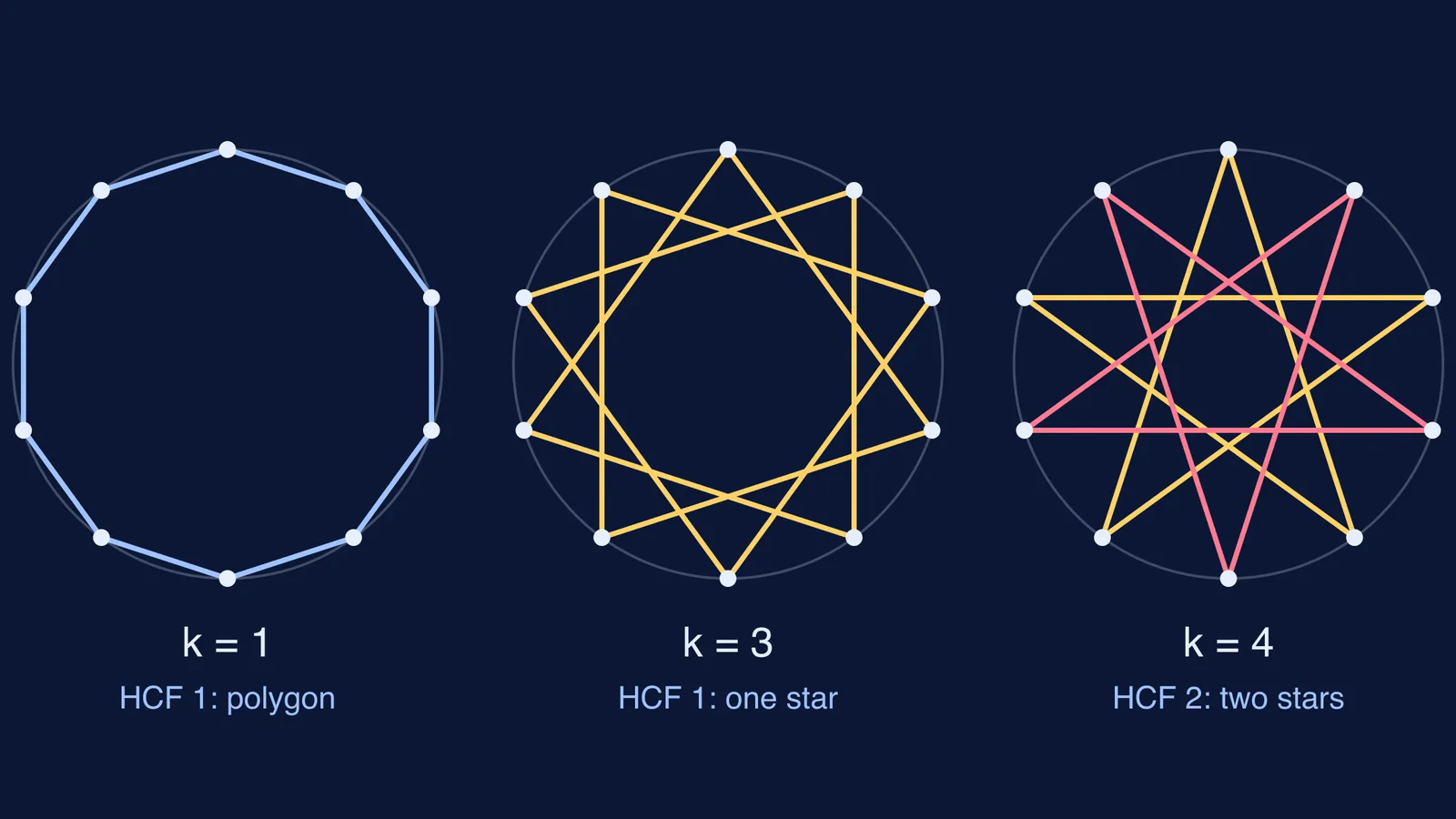
So with d = HCF(n, k), each loop touches n/d dots, and you need d loops to use all n dots. That gives three cases:
k = 1: you join neighbours and get the regular n-sided polygon.
HCF = 1, k between 2 and n − 2: one line visits every dot and you get a single star.
HCF = d > 1: you get d separate shapes, each with n/d corners.
This matches the examples on the polygram page: {6/2} is two triangles, {8/2} is two squares, {9/3} is three triangles and {10/4} is two pentagrams. The same counting sits behind our post on spirograph patterns and LCM.
What happens if you join 12 points on a circle?
k = 1: HCF 1, a regular 12-sided polygon.
k = 2: HCF 2, two hexagons.
k = 3: HCF 3, three squares.
k = 4: HCF 4, four triangles.
k = 5: HCF 1, one 12-pointed star, {12/5}.
k = 6: HCF 6, six diameters, since each shape has only 12 ÷ 6 = 2 corners.
k = 7 to 11: the same pictures as k = 5 down to 1.
Wikipedia's star polygon article shows, with the pentagon, that joining every third vertex gives the same figure as joining every second, reached in the opposite direction. In general {n/k} and {n/(n − k)} match. Skipping 7 forward is the same as skipping 5 backward, so 12 points give just one true star.
How many different stars can n points make?
The OEIS entry A055684, "Number of different n-pointed stars", gives the count as (φ(n) − 2) ÷ 2, where φ(n) is Euler's totient: how many numbers from 1 to n share no factor with n. The φ(n) counts the skips with HCF 1, the −2 removes the polygon (k = 1 and k = n − 1), and the ÷2 pairs each k with n − k.
From the same entry, 5 points give 1 star, 7 points give 2, 12 points give 1 and 17 points give 7. A prime number of points gives the most stars for its size, because every skip has HCF 1.
For ideas that are easier to see than to read, the Fermi Simulation Lab has interactive simulations. And if the HCF step is the shaky part, our post on Euclid's algorithm as square tiles shows how to find it quickly, or you can look it up in the Fermi Concept Library, which has a lesson for every concept in mathematics.