On this page
In short To find the time 100 hours after 9 o'clock, you add 100 to 9 to get 109, then divide by 12 to find a remainder of 1, meaning it will be 1 o'clock. This wrap-around counting is called modular arithmetic, a system formalised by Carl Friedrich Gauss in his 1801 book *Disquisitiones Arithmeticae* (Wikipedia).
Have you ever wondered what time it will be exactly 100 hours from now? If you try to calculate it using normal addition, you quickly run into a mathematical problem. A standard clock face only has 12 numbers. When the hour hand reaches 12, the numbers do not keep going up to 13, 14, or 109; they start again at 1.
This repeating pattern is a fundamental concept in mathematics known as modular arithmetic. It is a system that focuses entirely on cycles and remainders, and understanding it gives you a useful method for solving complex problems.
What is clock arithmetic?
Clock arithmetic is a way of counting where numbers wrap around after reaching a certain value, which we call the modulus. On a standard analogue clock, the modulus is 12. If it is 10 o'clock and you add 4 hours, you do not say it is 14 o'clock. You count forwards: 11, 12, 1, 2. The result is 2 o'clock.
This happens because you are working modulo 12. You take the total hours (14), divide it by the modulus (12), and look at the remainder. The remainder is 2, so the time is 2 o'clock.
If you are using a military or digital clock, the modulus changes to 24. Adding 4 hours to 22:00 gives 26, which divided by 24 leaves a remainder of 2, so the time is 02:00. The underlying mathematical principle remains exactly the same. The history of these systems stretches back far before Gauss; ancient mathematicians like Qin Jiushao used them to develop the remainder theorem.
How do you calculate 100 hours after 9 o'clock?
Let us solve the 100-hour problem step by step. When you are faced with a large number, counting on your fingers around a circle will take too long and lead to mistakes. Instead, you can use the remainder method.
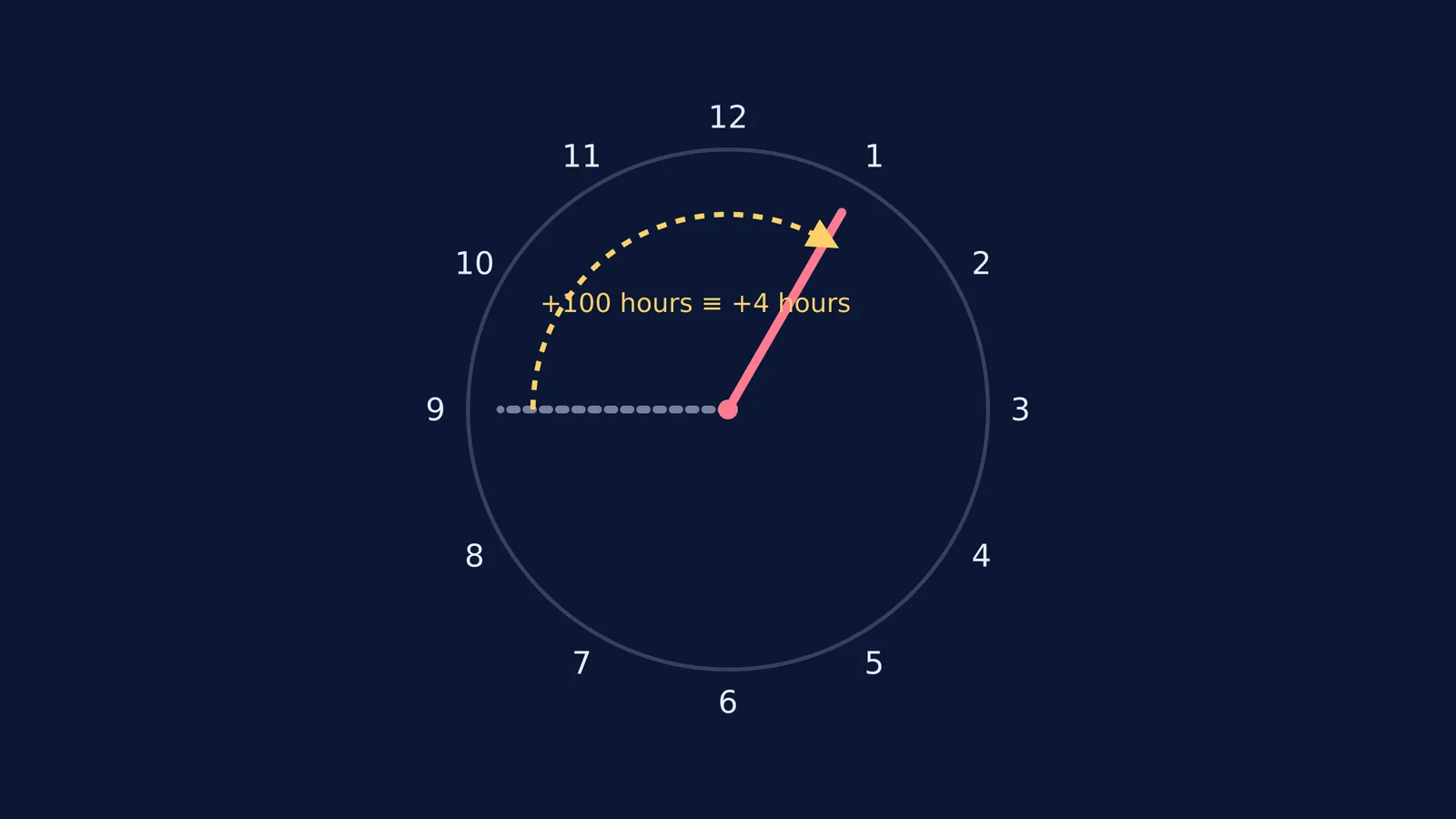
Add the hours together: Start with your current time on the clock face, which is 9. Add the number of hours you want to predict into the future, which is 100. This gives you a total of 109 hours.
Divide by the modulus: Because the clock face resets every 12 hours, you need to find out how many full 12-hour cycles fit into 109. You divide 109 by 12.
Find the remainder: 12 goes into 109 exactly 9 times, because 12 × 9 = 108. Those 9 full cycles bring you right back to 12 o'clock. Subtract 108 from 109, and you are left with a remainder of 1.
The answer is 1 o'clock. This is written mathematically as 109 ≡ 1 (mod 12).
If you find visualising these cycles difficult, playing with an interactive model can help. The Fermi Simulation Lab provides interactive simulations for the ideas that are easier to see than to read, letting you explore these cyclical systems directly.
Why is modular arithmetic important?
While the 12-hour clock is the most familiar example, modular maths governs many systems we use every day. The days of the week work on a modulo 7 system. If today is Tuesday, you know that in 7 days it will be Tuesday again. In 10 days, it will be Friday, because 10 ÷ 7 = 1 with a remainder of 3. Tuesday plus 3 days is Friday.
Recognising these cyclical patterns is just as useful in advanced algebra, such as when finding the pattern in matrix powers.
Beyond calendars, this system secures the internet. Modern digital cryptography relies on the fact that while it is easy to multiply numbers in modular arithmetic, it is very difficult to do the reverse. If a computer multiplies two huge prime numbers modulo another large number, figuring out the original primes from just the remainder is impossible for modern computers to solve quickly.
How should you study modular arithmetic?
If you are studying this topic for an exam, memorising the formula is far less effective than understanding how the cycle works.
Here is a checklist for approaching any modular arithmetic problem:
Identify the modulus: What is the limit before the system resets? It is 12 for hours on a standard clock face, 7 for days of the week, and 60 for minutes or seconds.
Find the total amount: Add, subtract, or multiply the values given in the question to find the raw total.
Extract the remainder: Divide the total by the modulus. The remainder is your final answer.
Check for negatives: If a question asks what time it was 10 hours ago from 3 o'clock, you get 3 − 10 = −7. In modulo 12, you add 12 to the negative number to find the positive equivalent: −7 + 12 = 5 o'clock.
When dealing with more complex geometric clock problems, it helps to draw the cycle or trace the movement. If you get stuck on the underlying logic, Fermi's AI tutor can work out what you already know, build a plan for the session, and teach through it until the mathematical concept clicks.