
On this page
Physics-education researchers have spent years turning your phone's accelerometer, light sensor and microphone into lab instruments. Patrik Vogt and Jochen Kuhn described analysing free fall with a smartphone acceleration sensor in The Physics Teacher in 2012, then pendulum motion with the phone as the bob. A team at RWTH Aachen University built phyphox, a free app for Android and iOS, and described it in Physics Education in 2018.
One rule runs through all five: write your prediction down before you press start. A result that matches a prediction you committed to is evidence; a graph you only look at afterwards is a picture.
What do you need for smartphone physics experiments at home?
A phone with a sensor app such as phyphox.
A second phone for the light and beats experiments.
A measuring tape, string, an old sock, and a pillow or bed.
A notebook with three columns per experiment: prediction, measurement, reason for the gap.
How do you measure acceleration in a lift with your phone?
Lay the phone flat on the lift floor and record vertical acceleration with gravity included. At rest it should read close to standard gravity, which is 9.80665 m/s² by definition.
Predict: going up, what does the reading do as the lift starts, cruises and stops?
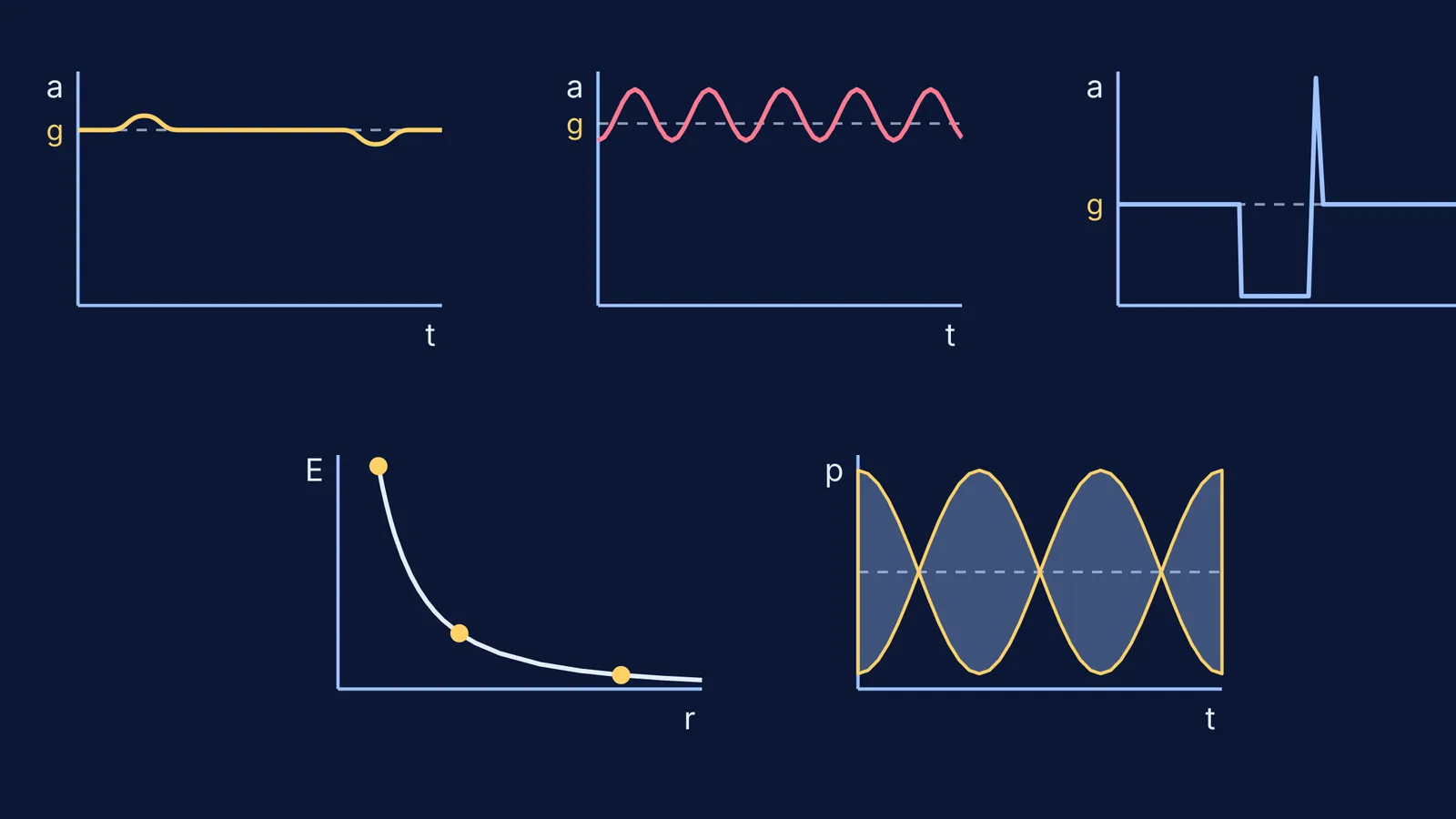
Starting upwards, the reading rises above g; cruising, it returns to g; slowing to a stop, it dips below. Going down, the pattern flips. Worked example: a peak reading of 10.3 m/s² means the lift is accelerating at 10.3 − 9.8 = 0.5 m/s² upwards. It is the same physics as weighing-machine readings in a lift. Jochen Kuhn, Patrik Vogt and Andreas Müller used phone acceleration sensors to study a lift cabin's oscillations, so look for small wobbles as it stops.
What does a phone pendulum show?
Put the phone in a sock, tie it to string so the phone's middle hangs 1.00 m below the knot, and let it swing gently. For small swings the period is T = 2π√(L/g), valid for angles under about 15°.
Predict: with L = 1.00 m and g = 9.8 m/s², T = 2π√(1.00/9.8) ≈ 2.0 s. Along the string, the reading peaks each time the phone passes the bottom, where it moves fastest. That happens twice per swing, so the peaks on your graph should sit about 1.0 s apart, not 2.0 s. Compare with the L–T² graph method for measuring g.
Why does a falling phone read almost zero?
Hold the phone 40 cm above a pillow and let go. Predict: what will the accelerometer read during the fall, and for how long?
An accelerometer senses the push of whatever supports it. In free fall nothing does, so the reading drops close to zero, the situation Vogt and Kuhn analysed in their free-fall paper. The fall lasts t = √(2h/g) = √(2 × 0.40 / 9.8) ≈ 0.29 s, so look for a flat stretch near zero that long, then a spike as the pillow stops the phone.
Does light really follow the inverse-square law?
In a dark room, point one phone's torch at the other phone's light sensor (usually near the front camera) and measure from torch to sensor. Leonardo Vieira and colleagues demonstrated the inverse-square law with exactly this kit: two smartphones, free apps and a ruler.
Predict: if the reading is E at 10 cm, what is it at 20 cm and at 40 cm? The inverse-square law says E/4 and E/16. Take readings at 10, 15, 20, 30 and 40 cm, then plot reading against 1/r². A straight line through the origin is your evidence. If close readings bend away from the line, ask whether the torch still behaves like a point.
How do you hear beats with two phones?
Run a tone-generator app on both phones, one at 440 Hz and the other at 443 Hz, held side by side. Two close frequencies make a loudness that rises and falls at the beat frequency, |f₂ − f₁|.
Predict: how many beats in 10 seconds? A 3 Hz difference gives 30. Count by ear, or record the sound level on a third device's microphone and count the peaks. For exam-style practice, try these beat frequency problems and the tuning-fork method.
What should you do when a prediction is wrong?
A wrong prediction is the most useful line in your notebook. Check the causes in order:
Sensor: were you reading the right axis, with gravity included or removed?
Measurement: was the length, distance or height measured to the right point?
Model: did you break an assumption, such as a large swing angle or a torch held too close?
If you want to see an idea with the noise removed, the Fermi Simulation Lab has interactive simulations for ideas that are easier to see than to read, so you can change one variable at a time before testing it again with your phone.