On this page
In organic chemistry the molecules turn into zigzags: no C, no H, just lines. Molecular formulas, sp3 carbon counts and degrees of unsaturation all depend on one skill, seeing the atoms that are not drawn. An AI chatbot can help you practise, if it counts out loud and you check by hand.
What does a skeletal formula leave out?
A skeletal (bond-line) formula draws the carbon framework and any atoms other than carbon and hydrogen. The IUPAC standards for structure diagrams say carbon atoms "are traditionally left unlabeled when they are bonded to at least two other atoms", and that their presence "is implied by the 'bend' in the bonds" (IUPAC Graphical Representation Standards, GR-2.1.2). The same document states that "wholly unlabeled atoms represent carbon atoms with the proper number of hydrogen atoms to satisfy a valence of four." A labelled atom with no H written beside it has no hydrogens, so OH carries one hydrogen and a bare O in a ring or in C=O carries none.
An unlabelled line end is a carbon too; IUPAC assumes a terminal single bond is a methyl group, CH3. For a refresher, see our guides to reading and drawing bond-line structures without slips and writing a condensed structural formula and expanding it back.
Can AI read skeletal formulas correctly?
Not reliably, though the evidence comes from text questions, not drawings. The ChemBench study, published in Nature Chemistry in May 2025 by Adrian Mirza and colleagues, tested leading language models on more than 2,700 chemistry questions (Mirza et al., 2025). On average, the best models outperformed the best human chemists in the study, yet the authors found the models "struggle with some basic tasks and provide overconfident predictions."
Structure questions were a weak spot. Predicting how many NMR signals a molecule gives means working out which atoms in its structure are equivalent, and even o1-preview got 22% of those questions right (full text on PubMed Central). The authors suggest models may lean on how close a molecule is to their training data rather than reasoning about it.
So treat a chatbot's atom count as a claim to test.
How do you describe a skeletal structure to an AI?
Type a description instead of uploading a photo: describing forces you to read the drawing. Use this script:
"I will describe a skeletal formula in words. Do not name it yet."
"Number every carbon. For each, tell me its carbon neighbours, its bonds to other atoms, and its hydrogens."
"Then give the molecular formula."
Then describe the structure corner by corner: "A zigzag chain with six corners, counting both ends. From the third corner, one line goes straight down and stops." The carbon-by-carbon list matters: a bare total shows an error, not which carbon went wrong.
Worked example: count it, then draw every atom
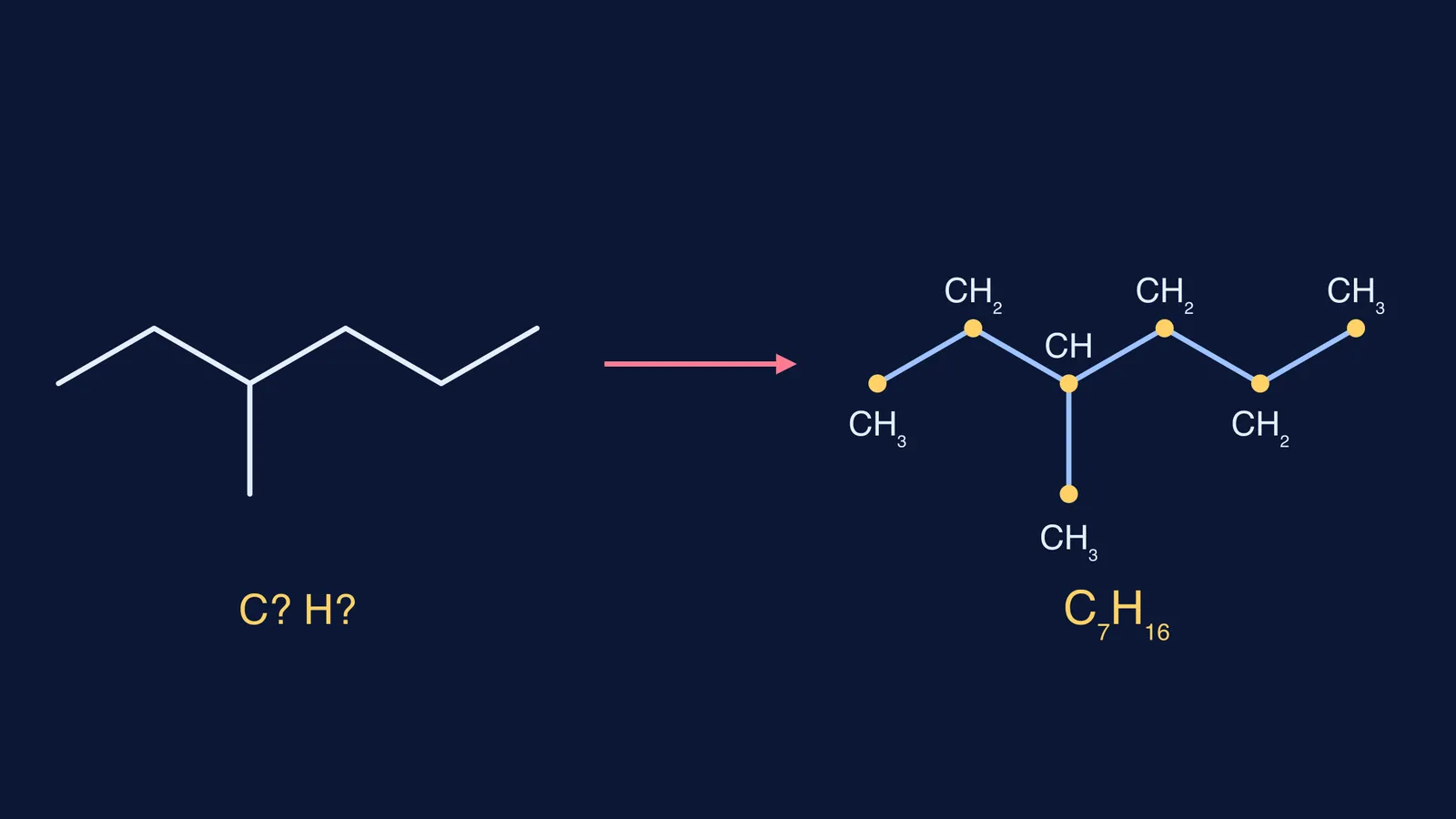
Example 1 is that zigzag (the diagram above).
Carbons: six in the chain plus one at the branch end, so seven.
The three line ends have one carbon neighbour each: CH3.
The branch point has three: CH.
The other three chain carbons have two each: CH2.
Hydrogens: 3 × 3 + 1 + 3 × 2 = 16, so C7H16 (3-methylhexane).
Check: open-chain alkanes fit CnH2n+2, and 2 × 7 + 2 = 16.
Example 2: "A six-membered ring with one double bond. The carbon next to one end of the double bond carries an OH."
Six carbons, one oxygen.
The OH carbon has two ring neighbours plus oxygen: one H.
Each double-bond carbon spends two bonds on the double bond: one H each.
The other three ring carbons are CH2: six H.
Add the H on oxygen: 1 + 2 + 6 + 1 = 10, so C6H10O (cyclohex-2-en-1-ol).
Check the degree of unsaturation: (2 × 6 + 2 − 10) ÷ 2 = 2, one ring plus one double bond.
Then redraw the skeleton on paper, write in every C and H, and count the letters. That catches the mistake, yours or the AI's.
What should you do when your count and the AI's disagree?
Compare its carbon-by-carbon list with yours and look for:
A skipped line end. Every unlabelled end is a carbon.
A triple bond. The C≡C carbons and their neighbours sit in a straight line, with no bend to mark them. Count both ends.
A double bond. Each of its carbons has one hydrogen fewer.
A labelled atom. OH and NH2 carry only the hydrogens written.
A ring closure. The closing corner is one carbon, not two.
Your description. The AI may have counted exactly what you wrongly described.
If the same mistake keeps returning, it is a concept gap, not a counting slip. The Fermi Concept Library has a lesson for every concept in chemistry, for revisiting valence or hybridisation. Fermi's AI tutor works out what you already know, builds a plan for the session and checks understanding as it goes.
Tonight, describe five textbook structures to an AI and draw every atom before accepting its count. Then try the method on all the isomers of C5H10.