

On this page
A full structural formula shows every atom and every bond. That is clear but slow to draw. A condensed structural formula packs the same information into one line of text. Once you can move between the two in both directions, organic chemistry questions get faster to read and to check.
What is a condensed structural formula?
NCERT's Class 11 chemistry textbook, in Unit 8, section 8.3.1, defines it this way: a condensed structural formula is what you get when you omit some or all of the dashes for covalent bonds and show the number of identical groups attached to an atom with a subscript. The same section gives ethane as CH3CH3, ethene as H2C=CH2, ethyne as HC≡CH and methanol as CH3OH.
The key point is that a condensed formula still tells you the connections. CH3CH2OH and CH3OCH3 have the same atoms but are different molecules, and the condensed formula shows which is which. A molecular formula like C2H6O does not.
How do you write a condensed structural formula from a full structure?
Use this four-step method.
Find the main chain: start at one end and trace a path of carbons (and any O or N in the chain) without lifting your pen.
Walk along it and write each carbon with the hydrogens bonded to it: CH3, CH2, CH or C.
When a carbon has a branch, write the branch in brackets right after that carbon.
Write the functional group where it sits, such as OH at the end, and drop all the dashes for single bonds.
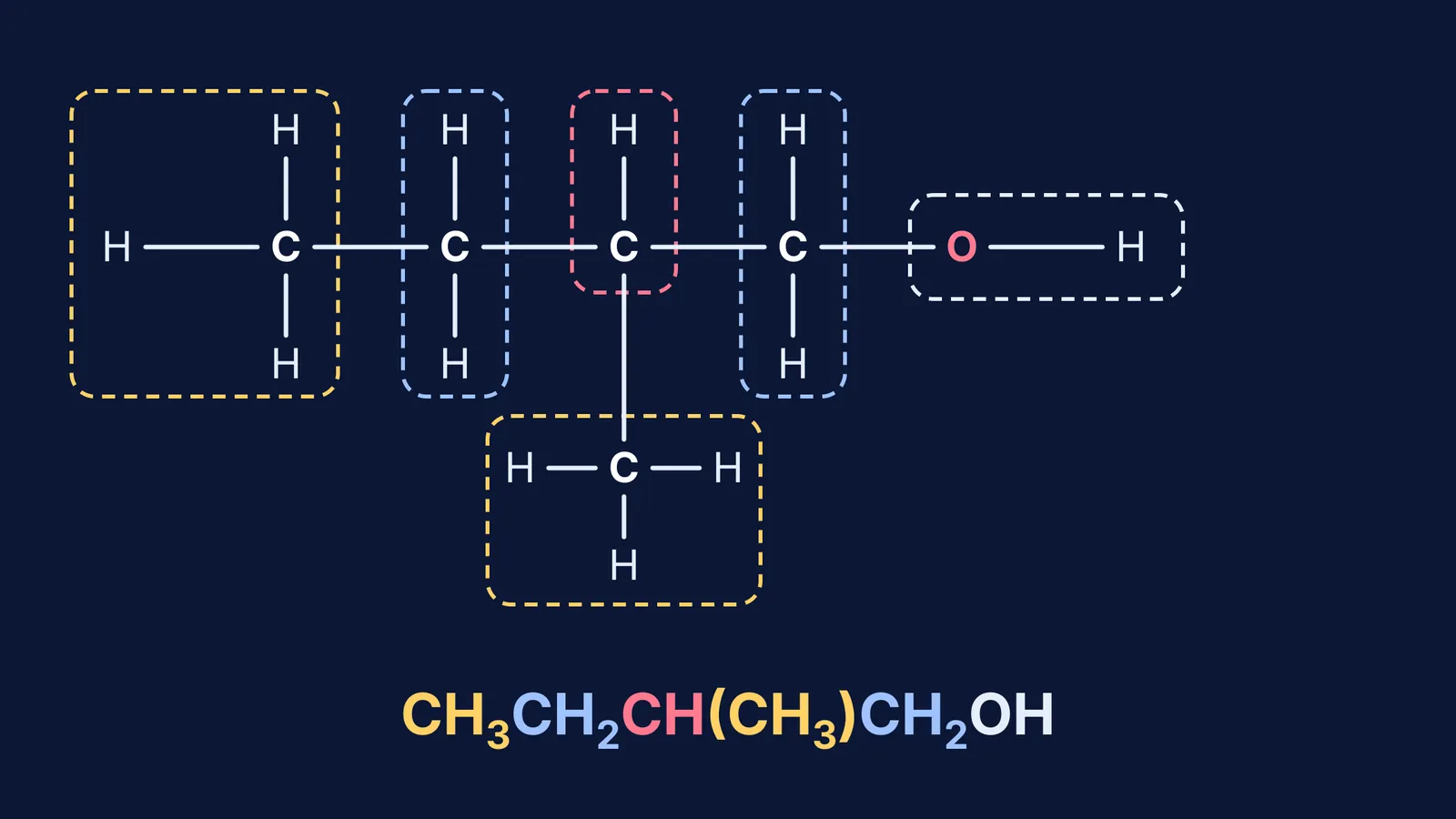
Here is a worked example. Take a five-carbon alcohol whose full structure has a chain of four carbons, a CH3 hanging below the third carbon from the left, and OH on the last carbon.
First carbon has three H: write CH3
Second carbon has two H: write CH2
Third carbon has one H and the branch: write CH(CH3)
Fourth carbon has two H and the OH: write CH2OH
Put together: CH3CH2CH(CH3)CH2OH. Now check your count. That gives 5 carbons, 12 hydrogens and 1 oxygen, which matches the molecular formula C5H12O that PubChem lists for 2-methylbutan-1-ol. The name numbers the chain from the OH end, which is why the methyl sits on carbon 2 there. For more C5H12O alcohols to practise on, our post on the eight pentanol isomers of C5H12O lists them all.
How do you group repeated CH2 units?
When the same group repeats in an unbroken row, write it once in brackets with a subscript. NCERT's own example in section 8.3.1 condenses CH3CH2CH2CH2CH2CH2CH2CH3 to CH3(CH2)6CH3.
The same textbook's Problem 8.5 shows two kinds of grouping in one line: HOCH2CH2CH2CH(CH3)CH(CH3)CH3 becomes HO(CH2)3CH(CH3)CH(CH3)2. Three rules follow from these examples.
Group only groups that sit next to each other in the chain. CH2CH(CH3)CH2 cannot become (CH2)2.
(CH3)2 at the end means two methyl groups on the same last carbon, so CH(CH3)2 is an isopropyl end.
Count the subscript against the original. (CH2)6 means exactly six CH2 units, so recount before you write it.
How do you expand a condensed formula back into a full structure?
Work left to right and decide what each bracket means.
Write the carbons of the main chain in a row. A bracketed group with a subscript, such as (CH2)3, is repeated: three CH2 carbons in a row.
A bracketed group with no subscript, such as (CH3), is a branch: hang it below the carbon just before it. (CH3)2 at the end means two CH3 groups on that last carbon.
Add the hydrogens written beside each carbon and draw every bond as a dash.
Check valency: every carbon must have exactly four bonds, oxygen two, hydrogen one.
NCERT's Problem 8.4 asks you to do exactly this for CH3CH2COCH2CH3, where the C=O in the middle shows up as a double bond to oxygen on the third carbon. To start from a name instead, see how to draw a structure from its IUPAC name.
What mistakes cost marks most often?
Writing CH2 for a middle carbon that carries a branch, which gives that carbon five bonds.
Putting the bracket before the carbon it belongs to.
Grouping CH2 units that a branch separates.
Forgetting that the OH hydrogen counts in the molecular formula.
If a conversion keeps going wrong at the same step, the Fermi Problem Library has worked problems with a step-by-step solver that explains the reasoning rather than printing an answer. For a gap in the idea itself, such as why carbon forms four bonds, the Fermi Concept Library gives each concept in chemistry its own lesson.
The habit of drawing bonds as lines is older than you might think; read about Archibald Scott Couper, the chemist who first drew bonds as lines. Then try five formulas from your textbook in both directions tonight.


