

On this page
In the spring of 1858, a 27-year-old Scottish chemist in Paris wrote down an idea that sits on almost every chemistry page you study: atoms joined by short lines, each line standing for one bond. His name was Archibald Scott Couper, and most students never hear it.
Who was Archibald Scott Couper?
Couper was born on 31 March 1831 in Kirkintilloch, Scotland, and died there on 11 March 1892 (Wikipedia: Archibald Scott Couper). He studied mainly classics at Glasgow and logic and metaphysics at Edinburgh, decided to study chemistry during 1854 to 1856 in Berlin, and joined Charles-Adolphe Wurtz's laboratory in Paris in the autumn of 1856 (Encyclopedia.com, Dictionary of Scientific Biography).
How did Couper draw bonds between atoms?
Couper's paper, “On a new chemical theory”, proposed that carbon atoms are tetravalent and can link to one another following valence rules (Wikipedia). To show this, he put dotted lines or dashes between the atom symbols in his formulas.
Couper's 1858 paper contained the first structural formula, with element symbols for atoms and lines between them for bonds (Royal Society of Chemistry, Education in Chemistry). He also drew cyanuric acid as a ring of three carbon and three nitrogen atoms joined by valence lines, the first ring formula ever published (Encyclopedia.com).
Kekulé's own 1858 diagrams, nicknamed “Kekulé sausages”, used ovals and circles for atoms with no bond sign, so they could not show the spatial relationship of the atoms (RSC Education). In 1861 Alexander Crum Brown kept Couper's lines and put the element symbols in circles, the same article explains.
Why did Kekulé get the credit instead?
Early in 1858 Couper asked Wurtz to present his manuscript to the French Academy of Sciences, but Wurtz delayed taking any steps (Encyclopedia.com). Through a misunderstanding with Wurtz, August Kekulé's paper appeared in print first, in May 1858, in Annalen der Chemie und Pharmacie, so Kekulé captured the priority for the self-linking of carbon atoms (Wikipedia).
Jean-Baptiste Dumas finally presented Couper's paper to the Academy on 14 June 1858 (Encyclopedia.com). The full English version followed in August in the Philosophical Magazine. By December, Kekulé had replied in the same journal with “Observations on Mr. Couper's new chemical theory”.
When Couper angrily confronted Wurtz, Wurtz expelled him from the laboratory (Wikipedia). In May 1859 he suffered a nervous breakdown, he did no more serious scientific work, and he spent the last 30 years of his life in his mother's care, according to the same article. In 1909, Richard Anschütz, Kekulé's former assistant and successor at Bonn, published “Life and Chemical Work of Archibald Scott Couper” in the Proceedings of the Royal Society of Edinburgh.
How do you draw a structural formula the Couper way?
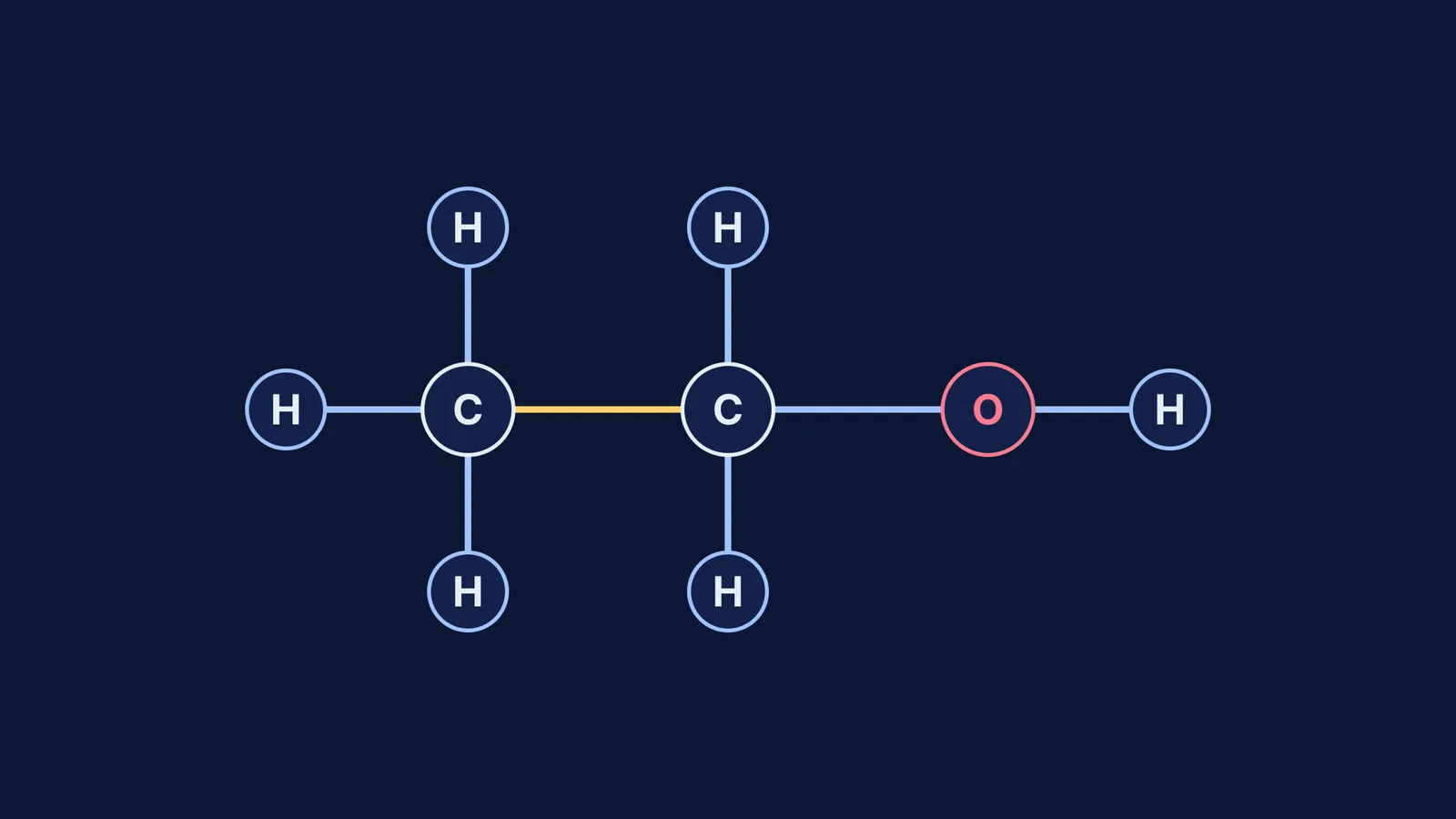
Couper's idea of one line per bond still works as the first move on a Class 11 structure question. Try it on C2H6O. (Couper took oxygen's atomic weight as 8, so his formulas doubled the oxygen atoms, but the counting works the same.)
Write each atom's valency: carbon makes 4 bonds, oxygen 2, hydrogen 1.
Count bond ends: 2 × 4 + 1 × 2 + 6 × 1 = 16. Each bond uses two ends, so the molecule has 8 bonds.
Join the heavy atoms first. There are two ways: C–C–O or C–O–C.
Fill every remaining bond with a hydrogen. C–C–O gives CH3–CH2–OH (ethanol). C–O–C gives CH3–O–CH3 (dimethyl ether).
Check: each carbon has exactly four lines, the oxygen two, each hydrogen one, and you have drawn 8 lines in total.
One molecular formula, two different molecules. These are isomers, and the molecular formula alone cannot tell them apart; the structure can. For a bigger version of the same exercise, see our walkthrough of the alcohol isomers of C5H12O. If step 1 is where you get stuck, start with writing chemical formulae using valency.
If a structure question stalls because valency or isomerism is shaky, the Fermi Concept Library gives every chemistry concept its own lesson and shows its place in the map. If you draw the right atoms but still reach the wrong answer, the Fermi Problem Library has worked problems with a step-by-step solver that explains the reasoning rather than printing an answer.
What can students learn from Couper's story?
Draw before you calculate. Couper's lines let you check a molecule bond by bond, so counting errors show up on the page.
Get your work in front of someone. A correct idea that waits in a drawer helps no one. Show your solution to a teacher or friend the same week.
Notation is a tool, not decoration. The line-bond style was confirmed as the common convention in 1865, when Kekulé published the first representative structure of benzene (RSC Education). You can see where that led in our explainer on the structure of benzene.
Next time you write CH3–CH2–OH, count the lines on each carbon. Four each, just as Couper's theory says.


