

On this page
How do you find all alcohol isomers of C5H12O?
When finding the alcohol isomers of C5H12O, mapping the hydrocarbon skeletons first prevents missing structures or duplicating rotated bonds. Saturated acyclic alcohols follow the general formula CnH2n+2O with zero degrees of unsaturation, meaning no rings or double bonds exist. Much like distinguishing the structural isomers of C4H10O, every constitutional pentanol is formed by attaching a single hydroxyl (-OH) group to one of pentane's three carbon skeletons.
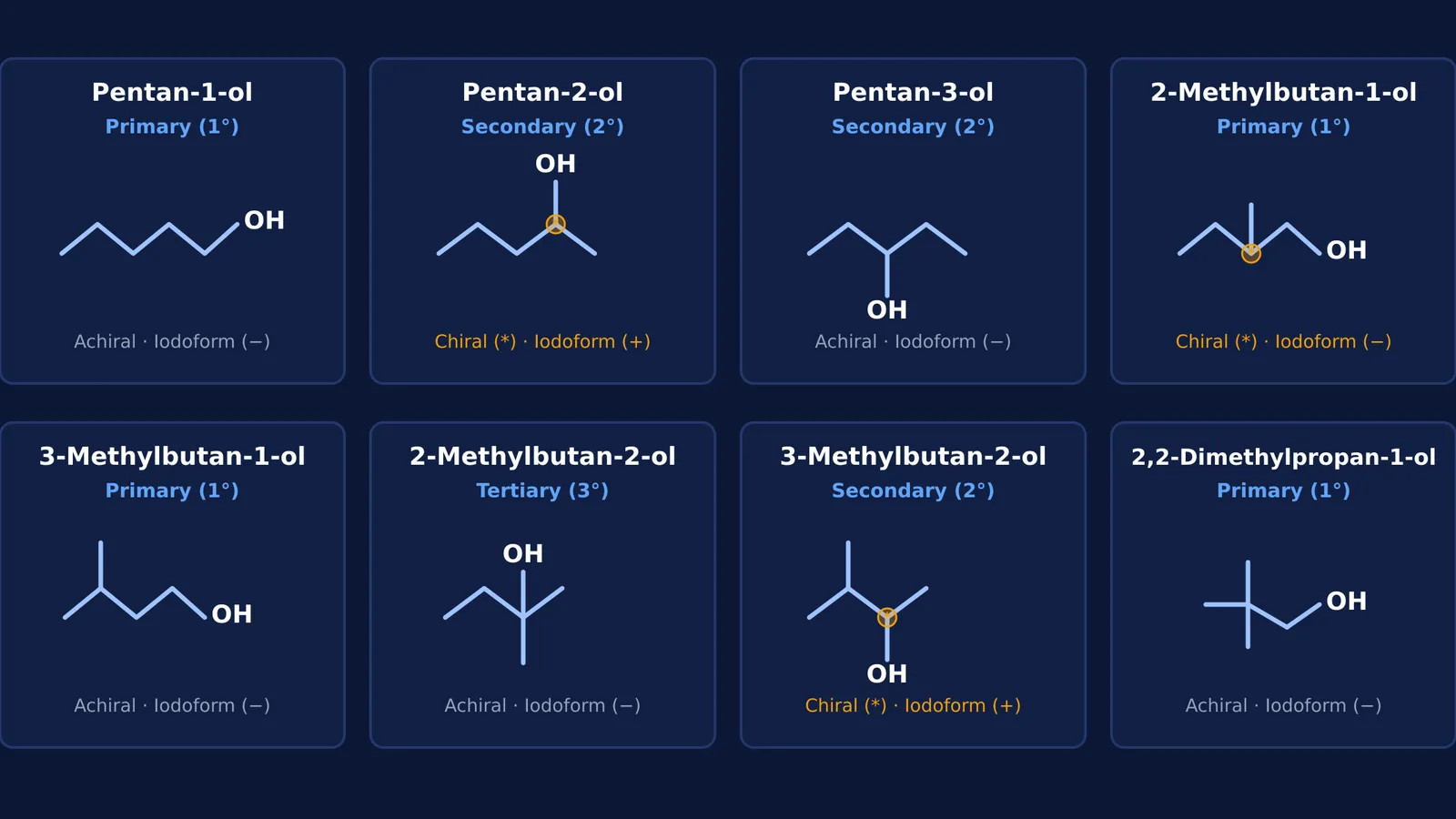
As recorded in the NIST Chemistry WebBook, straight-chain n-pentane has three chemically unique positions for hydroxyl substitution, producing pentan-1-ol, pentan-2-ol, and pentan-3-ol. Pentan-1-ol has a normal boiling point of 138 °C. The branched skeleton of 2-methylbutane (isopentane) contains four non-equivalent carbons, generating four distinct alcohols: 2-methylbutan-1-ol, 3-methylbutan-1-ol, 2-methylbutan-2-ol, and 3-methylbutan-2-ol. Finally, symmetrical 2,2-dimethylpropane (neopentane) has four equivalent methyl groups around a quaternary carbon, offering only one substitution site to yield 2,2-dimethylpropan-1-ol (neopentyl alcohol).
Combining these three skeletal pathways produces exactly eight constitutional alcohol isomers.
Which pentanols are primary, secondary, and tertiary?
The eight pentanols are classified by the degree of substitution of their carbinol carbon—the carbon atom directly bonded to the hydroxyl group:
Primary (1°) alcohols have their carbinol carbon bonded to only one other carbon atom (-CH2OH). Four isomers belong to this class: pentan-1-ol, 2-methylbutan-1-ol, 3-methylbutan-1-ol, and 2,2-dimethylpropan-1-ol.
Secondary (2°) alcohols have their carbinol carbon bonded to two other carbon atoms (-CH(OH)-). Three isomers belong to this class: pentan-2-ol, pentan-3-ol, and 3-methylbutan-2-ol.
Tertiary (3°) alcohols have their carbinol carbon bonded to three other carbon atoms (-C(OH)-). Exactly one isomer is tertiary: 2-methylbutan-2-ol (tert-pentyl alcohol).
In practical laboratory tests, the Lucas reagent (a solution of anhydrous ZnCl2 in concentrated HCl) differentiates these three classes through an SN1 pathway. As formulated by Lucas (1930), tertiary alcohols react almost immediately at room temperature to form an insoluble alkyl chloride layer, secondary alcohols develop turbidity within five minutes, and primary alcohols show no reaction at room temperature.
Which C5H12O alcohols are chiral and optically active?
A molecule is chiral if it contains an asymmetric carbon atom bonded to four entirely different atoms or groups, making it non-superimposable on its mirror image. When counting stereoisomers from chiral centres, each asymmetric centre gives rise to a pair of non-superimposable enantiomers.
Among the eight constitutional pentanols, three contain a stereocentre:
Pentan-2-ol: Carbon-2 is bonded to a hydrogen atom, a hydroxyl group, a methyl group, and a propyl group (-CH2CH2CH3). Documented in NCBI PubChem with a molar mass of 88.15 g/mol, pentan-2-ol resolves into two distinct enantiomers: (2R)-pentan-2-ol and (2S)-pentan-2-ol.
2-Methylbutan-1-ol: Carbon-2 is bonded to a hydrogen atom, a methyl group, an ethyl group (-CH2CH3), and a hydroxymethyl group (-CH2OH). Because all four attached groups are different, this molecule is chiral and was historically isolated from fermentation fusel oil as optically active amyl alcohol.
3-Methylbutan-2-ol: Carbon-2 is bonded to a hydrogen atom, a hydroxyl group, a methyl group, and an isopropyl group (-CH(CH3)2). This asymmetric carbon produces another pair of enantiomers.
Because each of these three structural isomers exists as two enantiomers, the C5H12O alcohol family contains eleven stereoisomers in total: five achiral structures plus six enantiomeric forms.
Which pentanol isomers give a positive iodoform test?
The iodoform test detects methyl ketones (CH3-CO-) and secondary methyl carbinols (CH3-CH(OH)-). Under alkaline conditions in the presence of iodine, sodium hypoiodite (NaOI) first oxidises qualifying secondary alcohols into methyl ketones, tri-iodinates the adjacent alpha-methyl group, and cleaves the tri-iodomethyl ketone to form a pale-yellow precipitate of iodoform (CHI3).
As reviewed by Fuson and Bull (1934), only alcohols containing a methyl group directly bonded to the carbinol carbon can undergo this cleavage. Exactly two pentanols meet these reagent requirements for the iodoform test:
Pentan-2-ol: Possessing the CH3-CH(OH)-CH2CH2CH3 structure, it is oxidised by hypoiodite to pentan-2-one and yields a yellow iodoform precipitate alongside sodium butanoate.
3-Methylbutan-2-ol: Bearing the CH3-CH(OH)-CH(CH3)2 structure, it oxidises to 3-methylbutan-2-one (methyl isopropyl ketone), forming yellow iodoform alongside sodium 2-methylpropanoate.
None of the other six pentanols give a positive test. Pentan-3-ol is a secondary alcohol, but its carbinol carbon is flanked by two ethyl groups, yielding pentan-3-one upon oxidation with no alpha-methyl group available for haloform cleavage. Primary pentanols lack secondary carbinol carbons, while tertiary 2-methylbutan-2-ol has no carbinol hydrogen and resists oxidation under these conditions.
The analytical sensitivity of this reaction was established by Adolf Lieben (1870), who demonstrated that iodoform precipitation can detect alcohol concentrations down to 500 ppm in aqueous solution.
How do you solve C5H12O isomer problems in competitive exams?
In CBSE board exams, JEE Main, and NEET-UG, isomer problems test whether you can systematically separate structural variations from stereoisomers and diagnostic tests:
Structural versus total count: When asked for the number of isomeric alcohols of molecular formula C5H12O, the answer is eight. When asked for total isomers including stereoisomers, the count is eleven.
Optical activity: If asked for optically active pentanols, select the three chiral structures (or six enantiomers).
Combined tests: An unknown C5H12O alcohol that turns the Lucas reagent turbid without heating and yields a yellow iodoform precipitate must be either pentan-2-ol or 3-methylbutan-2-ol.
When practicing multi-step organic deductions, having access to structured explanations makes a significant difference. The Fermi Problem Library provides worked problems with a step-by-step solver that explains the reasoning rather than printing an answer. For exploring stereochemical definitions and mechanisms, the Fermi Concept Library covers every concept in physics, chemistry, biology, mathematics and computing, each with its own lesson and its place in the map.


