

On this page
When you study carbon and its compounds in Class 10, most chains you draw are straight or branched. But carbon can also form rings. The most famous of these cyclic hydrocarbons is benzene.
Benzene often appears in board exams because its bonding breaks the usual rules you learn for simple alkanes and alkenes. Understanding its unique shape and stability is a key milestone in organic chemistry.
What is the structure of benzene class 10 cyclic hydrocarbon?
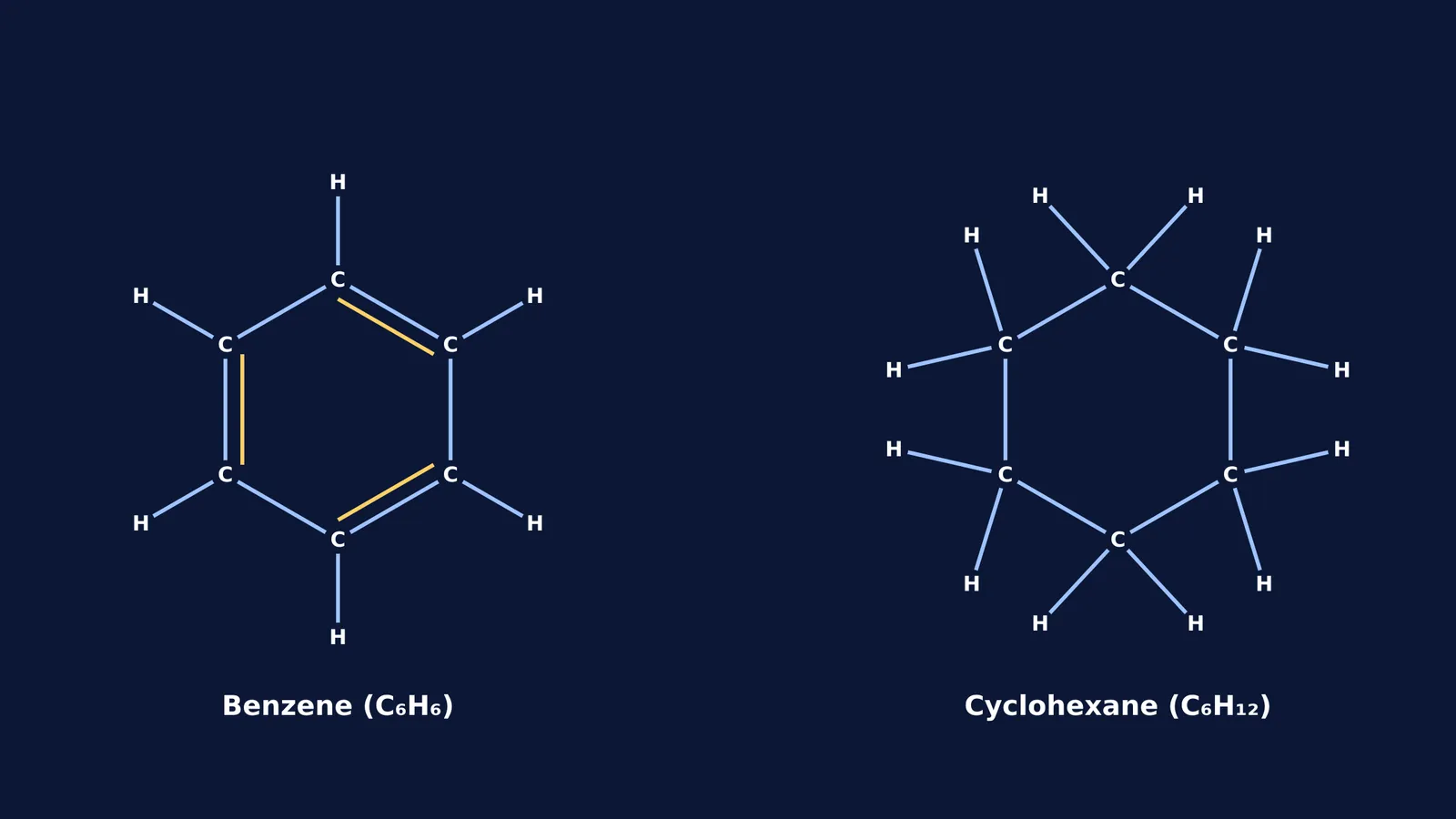
The chemical formula of benzene is C₆H₆ (Wikipedia). It contains six carbon atoms joined together in a flat, perfectly regular hexagonal ring.
To satisfy carbon's valency of four, the ring features what are often drawn as alternating single and double bonds. This means every carbon atom forms a double bond with one neighbour and a single bond with the other. Because these three double bonds use up three of each carbon's available outer electrons, exactly one hydrogen atom attaches to each carbon vertex.
If you are asked to draw this in an exam, draw a hexagon of carbon atoms (C), add three double lines between alternating carbons, and draw one straight line outwards from each carbon to a hydrogen atom (H). The bond angles in this planar ring are exactly 120° (Wikipedia).
In modern chemistry, we know these bonds do not strictly alternate. Instead, the electrons are delocalized, meaning they are shared equally around the entire ring. This is why you will sometimes see benzene drawn as a hexagon with a circle in the middle. This delocalization gives benzene a special kind of stability known as aromaticity.
How does benzene differ from cyclohexane?
A common exam trap is asking you to distinguish benzene from cyclohexane. Both are six-carbon cyclic hydrocarbons, but their structures are entirely different (Wikipedia).
Formula: Benzene is C₆H₆. Cyclohexane is C₆H₁₂.
Bonds: Benzene is an unsaturated hydrocarbon with three double bonds (or a delocalized electron cloud). Cyclohexane is a saturated hydrocarbon containing only single bonds and 12 hydrogen atoms (Wikipedia).
Hydrogen count: Because cyclohexane has no double bonds, each carbon atom needs two hydrogen atoms to complete its valency, not one.
Geometry: While benzene is perfectly flat, cyclohexane is actually non-planar. To keep its single bonds at the ideal tetrahedral angle of 109.5°, the cyclohexane ring puckers into 3D shapes, most commonly known as the "chair" conformation.
If you struggle to picture how saturation changes a molecule's shape, the Fermi Concept Library can help. Fermi's AI tutor steps you through the valency rules and asks you to build the ring atom by atom, so you see exactly why cyclohexane needs 12 hydrogens while benzene only needs six.
How do we know the structure of benzene?
The structure of benzene puzzled scientists for decades after it was first isolated. A chemical formula of C₆H₆ suggested it was highly unsaturated, yet it did not react like typical alkenes.
The breakthrough came in 1865 when the chemist August Kekulé proposed that the carbon atoms form a ring with alternating single and double bonds. He later suggested these bonds rapidly interchanged.
Today, we use Kekulé's alternating bonds in basic structural drawings, but we understand that the real molecule is a resonance hybrid. All carbon-carbon bonds in benzene are identical in length—approximately 1.39 to 1.40 Å, which sits between a typical single bond and a double bond (Wikipedia).
How to draw the electron dot structure?
When drawing the electron dot structure (Lewis structure) for benzene, remember the electron sharing rules you learned when studying Ionic vs Covalent Compounds: Properties for Class 10 Explained.
Draw the six carbon atoms in a hexagon.
Place two pairs of dots (four electrons) between the carbons that share a double bond.
Place one pair of dots (two electrons) between the carbons that share a single bond.
Place one pair of dots between each carbon and its hydrogen atom.
This sharing ensures every carbon atom has access to eight electrons, completing its octet.
If you want to review how valency works across different elements before tackling rings, our guide on How to write chemical formulas using valency in Class 9 is a good starting point. You can also explore AI analogies for chemical bonding: are they right? to test your understanding of shared electrons.


