On this page
Units like the farad and the tesla are easy to define and hard to feel. You can write 1 F = 1 C/V in an exam and still not know if a 1 F capacitor fits in your palm. An AI chatbot quickly turns units into everyday comparisons, but it can slip by a power of ten or mix up two units. Treat each example it gives you as a claim, and check it against a textbook or standards value.
What are a coulomb, a farad, a tesla and a pascal?
Every everyday example has to agree with the official definitions. The SI Brochure from the International Bureau of Weights and Measures lists all four in its table of named derived units (BIPM SI Brochure):
The pascal (pressure) is one newton per square metre.
The coulomb (electric charge) is one ampere-second.
The farad (capacitance) is one coulomb per volt.
The tesla (magnetic flux density) is one weber per square metre.
How big is a coulomb in real life?
The elementary charge is exactly 1.602176634 × 10⁻¹⁹ C (NIST), so one coulomb is the charge of about 6.24 × 10¹⁸ electrons.
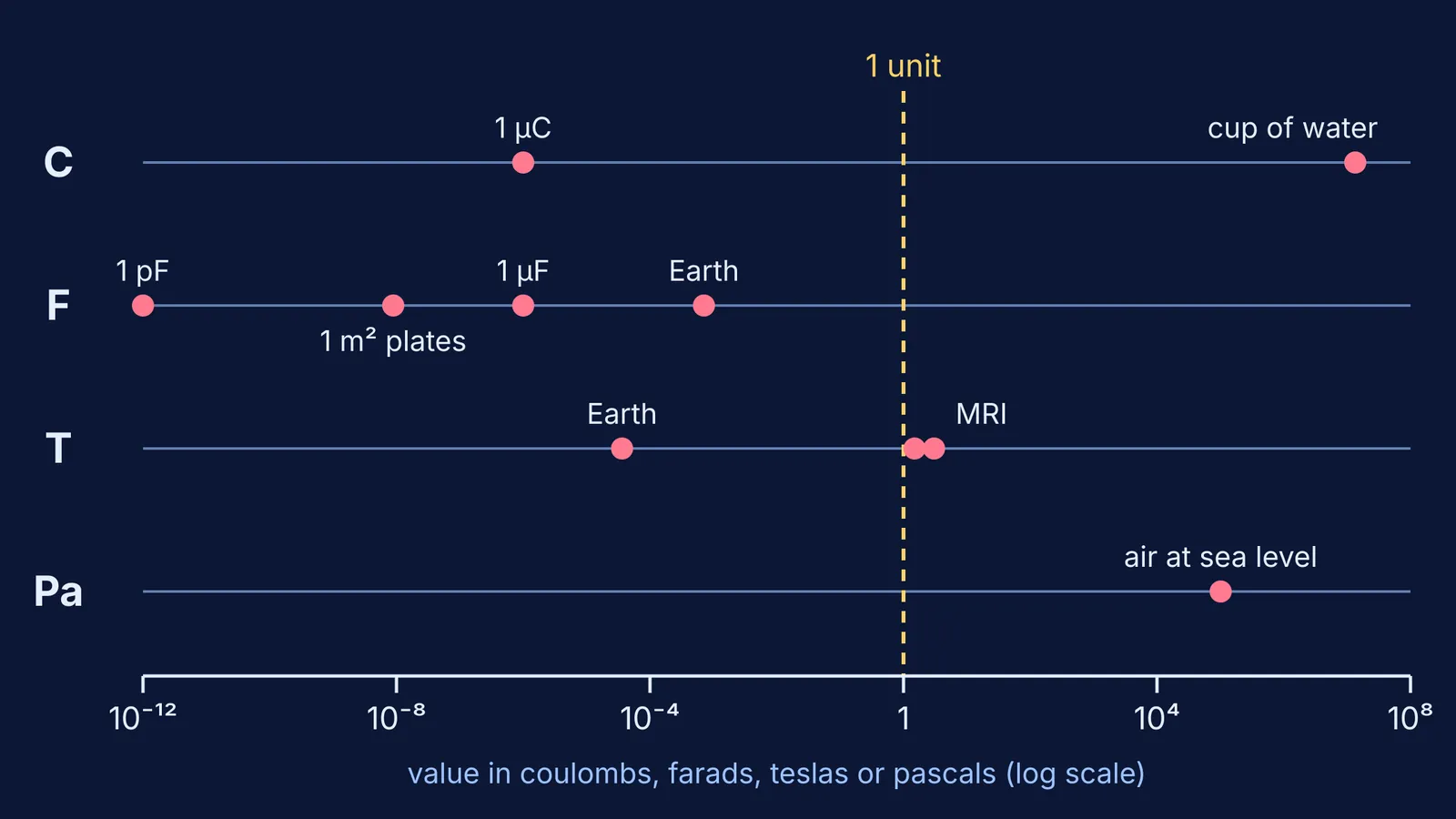
In NCERT's Class 12 Physics (NCERT Chapter 1), two 1 C charges 1 m apart would repel with a force of 9 × 10⁹ N. And if 10⁹ electrons left a body every second, collecting 1 C would take about 200 years, which is why the book calls one coulomb "a very large unit for many practical purposes". Yet the same chapter works out that the protons in a 250 g cup of water carry about 1.34 × 10⁷ C, cancelled exactly by the electrons.
An everyday check: the mAh on a phone battery is a charge. One milliampere-hour is 0.001 A × 3600 s = 3.6 C, so a battery rated at 5000 mAh can move about 18,000 C round the circuit over a full discharge. That charge flows; it never sits on the battery.
Why does NCERT call a farad a very big unit?
Chapter 2 of NCERT's Class 12 Physics says "In practice, a farad is a very big unit" and uses µF, nF and pF instead (NCERT Chapter 2). Its worked example: two plates of 1 m² held 1 mm apart give only 8.85 × 10⁻⁹ F. For 1 F with a 1 cm gap, you would need 10⁹ m² of plate, about 30 km on each side.
Check a classic example, Earth as a capacitor, yourself. An isolated sphere has C = 4πε₀R. With ε₀ = 8.854 × 10⁻¹² F/m (NIST) and Earth's mean radius of 6371 km (NASA Earth fact sheet), C comes to about 7.1 × 10⁻⁴ F, roughly 709 µF. Our worked answer on the capacitance of an isolated sphere and Earth goes through the steps.
How strong is a tesla, and how small is a pascal?
NCERT's Chapter 4 says "Tesla is a rather large unit", gives the gauss as 10⁻⁴ T, and puts Earth's magnetic field at about 3.6 × 10⁻⁵ T (NCERT Chapter 4). The British Geological Survey says the total field at Earth's surface varies from 22,000 nT to 67,000 nT (BGS). A 2012 systematic review by Canada's CADTH compares clinical MRI scanners at 1.5 T and 3.0 T (CADTH review). So a 1.5 T scanner's field is about 40,000 times NCERT's value for Earth's.
The pascal goes the other way. Standard gravity is 9.80665 m/s² (NIST), so a 1 N force is the weight of about 102 g. One pascal is that weight spread over a whole square metre. The standard atmosphere is exactly 101,325 Pa (NIST), roughly the weight of 10 tonnes on every square metre.
How do you check an AI's everyday examples?
Ask in a form you can check:
"Give me three real examples for one tesla: one much smaller, one close to 1 T, one bigger. Write each value in SI units with a power of ten, and tell me the formula or measurement it comes from."
Then run four checks:
Compare the power of ten with the anchors above. An AI that puts Earth's field near 1 T has slipped.
Look for unit traps: gauss against tesla, mAh (charge) against Wh (energy), and bar against pascal (1 bar = 10⁵ Pa in the SI Brochure's table of non-SI units).
Recompute one example from its formula, as with Earth's capacitance above.
Ask the AI why its example is that size. A good answer names a formula; a weak one repeats the number.
For more practice, try our AI quizzes for revising units and dimensions and how big a mole is, shown with sand and seconds.
If a unit still feels abstract, the Fermi Concept Library has a lesson for every concept in physics, and the Fermi Simulation Lab has interactive simulations for ideas that are easier to see than to read. Fermi's AI tutor works out what you already know and checks understanding as it goes.