On this page
Before you read on, make a prediction. You know that the squares on the two shorter sides of a right triangle add up to the square on the longest side. Now rub out the squares and draw a semicircle on each side instead, with the side as its diameter. Do the two small semicircles still add up to the big one? Write down yes, no or "only sometimes", and one reason.
Does Pythagoras theorem work with semicircles on the sides?
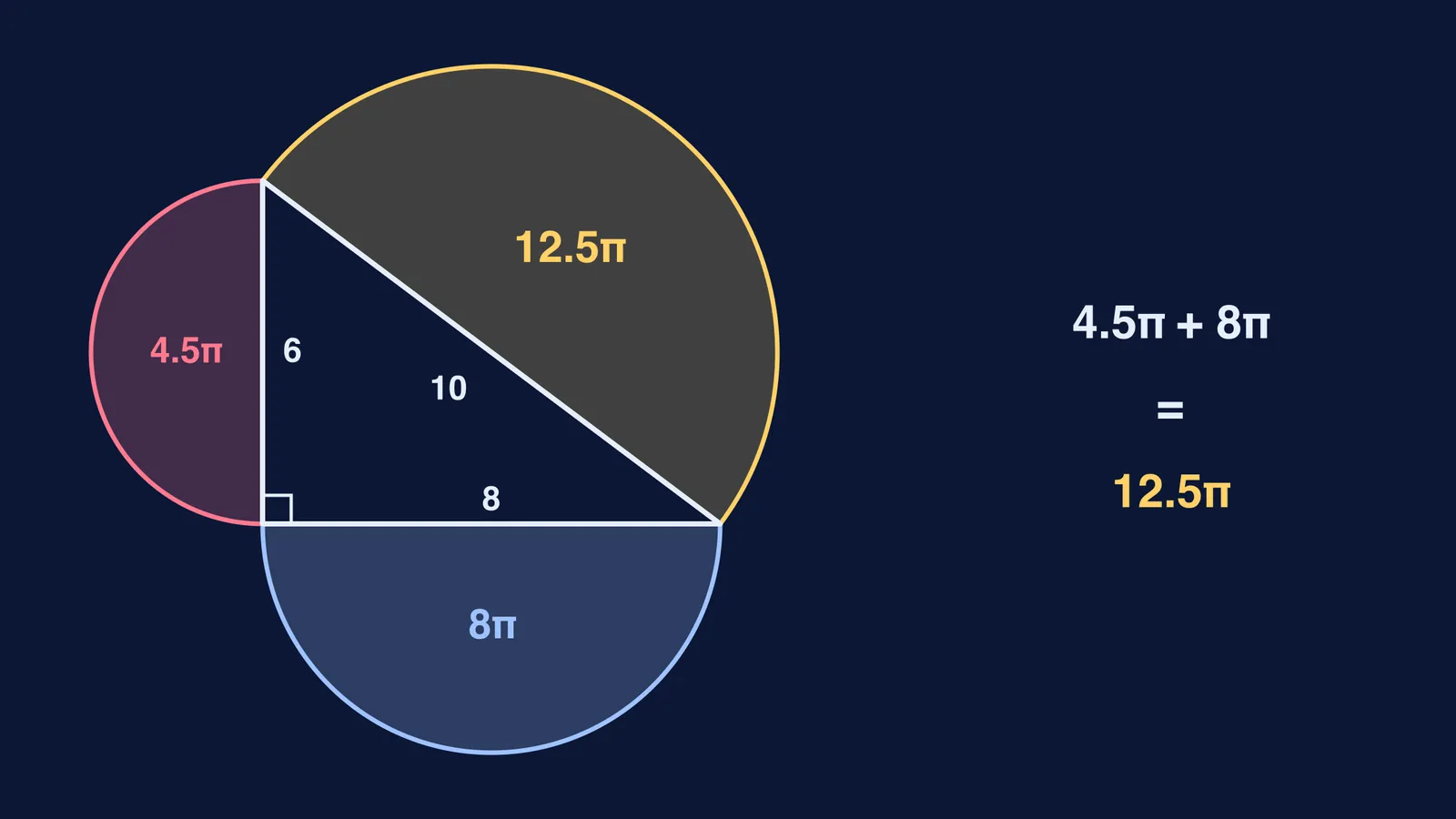
Take the right triangle with sides 6, 8 and 10 cm, since 36 + 64 = 100. A semicircle with diameter d has radius d/2, so its area is half of π(d/2)², which is πd²/8.
Semicircle on the 6 cm side: 36π/8 = 4.5π, about 14.1 cm²
Semicircle on the 8 cm side: 64π/8 = 8π, about 25.1 cm²
Semicircle on the 10 cm side: 100π/8 = 12.5π, about 39.3 cm²
And 4.5π + 8π = 12.5π exactly. The two small semicircles add up to the large one, just as the squares do.
If you said yes, check your reason: "it worked for squares" is not enough, as the fails below show.
Why does the area rule work for any similar shape?
Each semicircle area is the square of its side multiplied by the same number, π/8. So the semicircle version is just the ordinary theorem, 36 + 64 = 100, with both sides multiplied by π/8.
Scale any one shape so that a chosen edge has length s, and its area is k × s², where k depends only on the shape. Scaling lengths by a factor multiplies areas by that factor squared, which our post on how scale factor changes area and volume works through with maps and models. The same rule sits behind the area ratio of similar triangles.
So multiply a² + b² = c² by k and you get ka² + kb² = kc². Any family of similar shapes passes.
In Euclid's Elements, Book I, Proposition 47, the square on the side opposite the right angle equals the sum of the squares on the other two sides. Book VI, Proposition 31 extends this to "similar and similarly described figures" on the three sides; the notes on that page call it a generalisation of I.47 in which the squares are replaced by any similar rectilinear figures. Rectilinear means made of straight lines, so circles need one more step: Book XII, Proposition 2 proves that circles are to one another as the squares on their diameters.
Which shapes pass the test, and which fail?
Predict first, then check with the 6-8-10 triangle.
Equilateral triangles: area is (√3/4) × side², so 9√3 + 16√3 = 25√3. Pass.
Regular hexagons, or any regular polygon: area is a fixed number times side². Pass.
Copies of the right triangle itself, scaled so that each copy's hypotenuse lies on a side: pass. The altitude from the right angle cuts the triangle into exactly two such copies, which is one way to prove the theorem.
Rectangles all 1 cm wide: areas 6 + 8 = 14, but the big one is 10. Fail, because the rectangles are not similar to each other.
A square on one leg and a semicircle on the other: 36 + 8π is about 61.1, not 100 or 12.5π. Fail, because the shapes are different.
The fails show that the theorem is really about how area grows with the square of length, not about squares in particular.
What are Hippocrates' lunes?
Now fold the big semicircle inward so it covers the triangle, and keep the two small ones bulging outward. Two crescent shapes, called lunes, stick out past the big arc. Wolfram MathWorld's entry on lunes notes that Hippocrates proved the two lunes together have exactly the area of the triangle.
Check it: lunes = small semicircles + triangle − big semicircle = 4.5π + 8π + 24 − 12.5π = 24 cm², and the triangle's area is ½ × 6 × 8 = 24 cm². The π terms cancel because of the semicircle version of Pythagoras.
According to the MacTutor biography of Hippocrates of Chios, he lived from about 470 to about 410 BC and found the areas of lunes while trying to square the circle.
How can you test this yourself on paper?
Draw a 3-4-5 right triangle on squared paper, using 2 cm per unit.
Pick a shape and write your prediction: pass or fail, with one reason.
Work out the three areas in terms of side², then check whether the two small ones add to the big one.
Pick a shape you expect to fail and confirm that it does.
Explain the k × side² argument out loud in two sentences.
To watch shapes and areas change instead of reading about them, the Fermi Simulation Lab has interactive simulations for ideas that are easier to see than to read. For the classic square version, our Pythagoras dissection proof you can rearrange is the natural next step.