On this page
The product rule is usually handed to you as a line to memorise: the derivative of f times g is f' times g plus f times g'. The NCERT Class 11 chapter on limits and derivatives states it as part of Theorem 5 and then says, "We will not prove these here" (NCERT Class 11 Mathematics, Chapter 12). A rectangle lets you rebuild it in two minutes.
Why does the product rule have two terms?
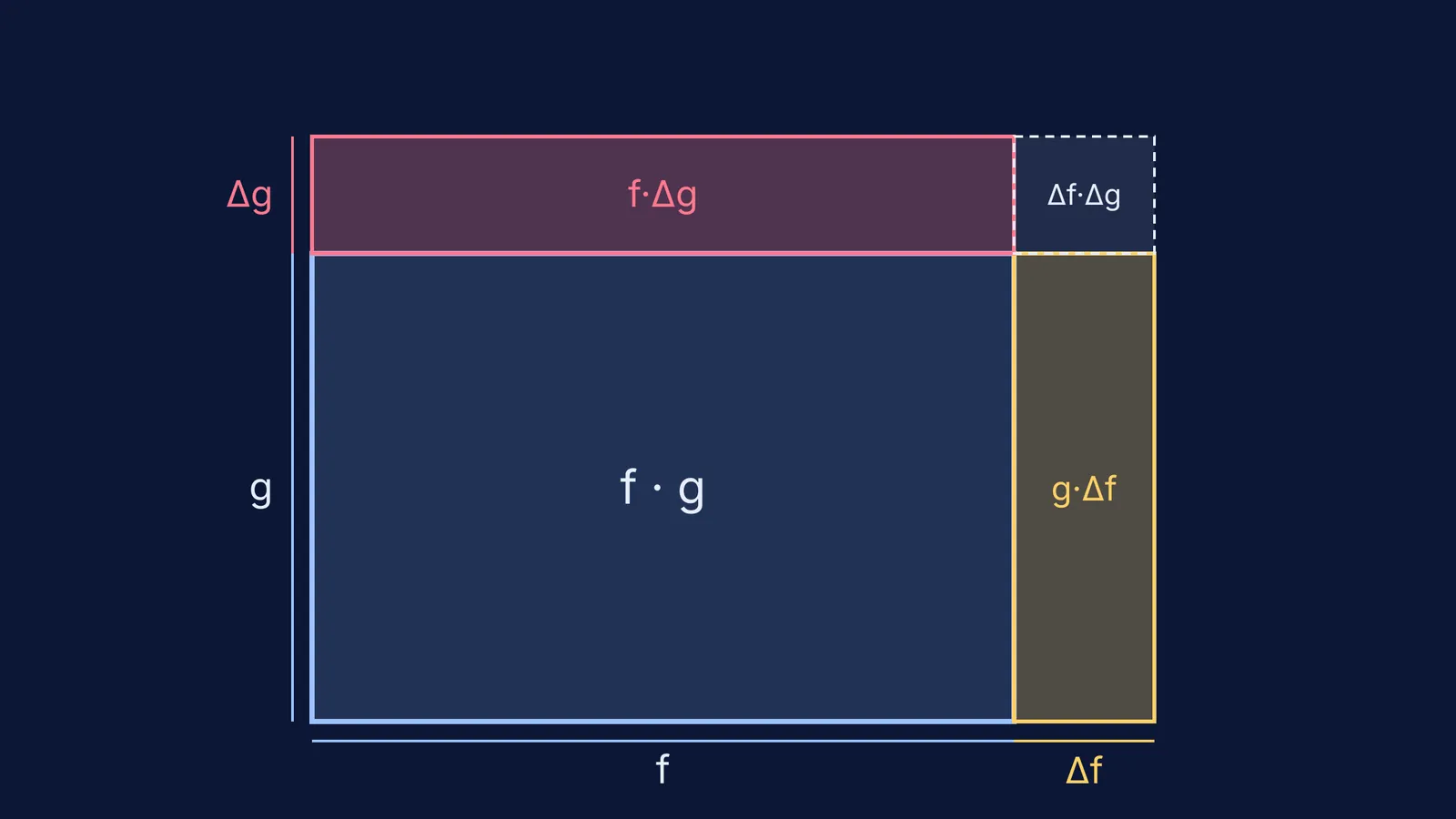
Draw a rectangle whose width is f(x) and whose height is g(x). Its area is f(x)·g(x), which is exactly the product you want to differentiate.
Now move x forward a tiny step. The width grows by Δf and the height grows by Δg. Before reading on, predict: how many new pieces of area appear, and what are their sizes?
There are three:
a tall strip down the right side, of width Δf and height g, with area g·Δf
a long strip across the top, of width f and height Δg, with area f·Δg
a small corner piece, with area Δf·Δg
So the change in area is Δ(fg) = g·Δf + f·Δg + Δf·Δg. Divide by the step Δx and let it shrink to zero. The first strip becomes g·f', the second becomes f·g', and the corner disappears because it is a small quantity times another small quantity. What is left is the product rule: (fg)' = f'g + fg'.
One strip comes from the width changing, the other from the height changing.
Who discovered the product rule?
The idea is old. Gottfried Leibniz gave the product rule in a manuscript dated 21 November 1675, and in 1684 he published the rules for derivatives of powers, products and quotients, without proofs, in his paper Nova Methodus pro Maximis et Minimis in the journal Acta Eruditorum, according to the MacTutor biography of Leibniz from the University of St Andrews. His own argument used infinitesimals and matches the rectangle piece for piece: d(uv) = (u + du)(v + dv) − uv = u·dv + v·du + du·dv, and he dropped du·dv as negligible (Wikipedia: Product rule). The same article notes that J. M. Child, a translator of Leibniz's papers, argued the rule is due to Isaac Barrow. NCERT still calls it "a Leibnitz rule for differentiating product of functions" (NCERT Chapter 12).
A worked example: does the corner really vanish?
Take f(x) = x² and g(x) = x³ at x = 2, so the rectangle is 4 wide and 8 tall. Its area is x⁵, so you already know the answer should be 5x⁴ = 80.
Nudge x by h = 0.01. Then Δf = 2.01² − 4 = 0.0401 and Δg = 2.01³ − 8 = 0.120601.
Right strip: g·Δf = 8 × 0.0401 = 0.3208
Top strip: f·Δg = 4 × 0.120601 = 0.482404
Corner: Δf·Δg = 0.0401 × 0.120601 ≈ 0.0048
Total: 0.8080401, exactly the true change 2.01⁵ − 32.
Divide each piece by h. The strips give 32.08 and 48.24, and the corner gives 0.48. Shrink h to 0.001 and the strips settle at 32.008 and 48.024, while the corner drops to about 0.048. In the limit you get 8 × 4 + 4 × 12 = 32 + 48 = 80, which is f'g + fg' and matches 5x⁴.
Why is the derivative of fg not f' times g'?
This is the most common product-rule mistake, and the rectangle shows what goes wrong. Writing (fg)' = f'g' just multiplies the two side changes, Δf/Δx and Δg/Δx, and throws away both strips, the only pieces that survive the limit. Try it on x·x: f'g' gives 1, but a square of side x grows along two edges, so the true answer is 2x.
How to practise it so it sticks
Use this five-minute predict-then-check routine.
Pick two simple functions, such as x and sin x, or x² and eˣ.
Sketch the rectangle and label the two strips in words before writing any symbols.
Predict the derivative from the strips, then check it with the formula.
Pick one value of x and a small h, and compute the strips and corner with a calculator, as in the example above.
Extend it: a box with sides f, g and k grows three main slabs, which gives the product rule for three functions.
The same rectangle, read in reverse, explains integration by parts as the area of a rectangle. If the idea of a derivative itself still feels shaky, start with the derivative as the slope of a tangent.
Some ideas are easier to see than to read, and we built the Fermi Simulation Lab of interactive simulations for exactly those. If a product-rule question still goes wrong after the picture makes sense, the Fermi Problem Library has worked problems with a step-by-step solver that explains the reasoning rather than printing an answer.
Next time you write f'g + fg', picture the two strips.