

On this page
When you have a product of two functions, u and v, the standard product rule is (uv)′ = u′v + uv′. But what happens if you add a third function, w, into the mix? A common mistake is to assume you simply multiply the derivatives together. Calculus does not work that way.
According to the OpenStax Calculus textbook, the derivative of a product of three functions follows a simple, symmetrical pattern: you differentiate one function at a time while leaving the other two unchanged, and then sum the results (LibreTexts/03%3A_Derivatives/3.03%3A_Differentiation_Rules)).
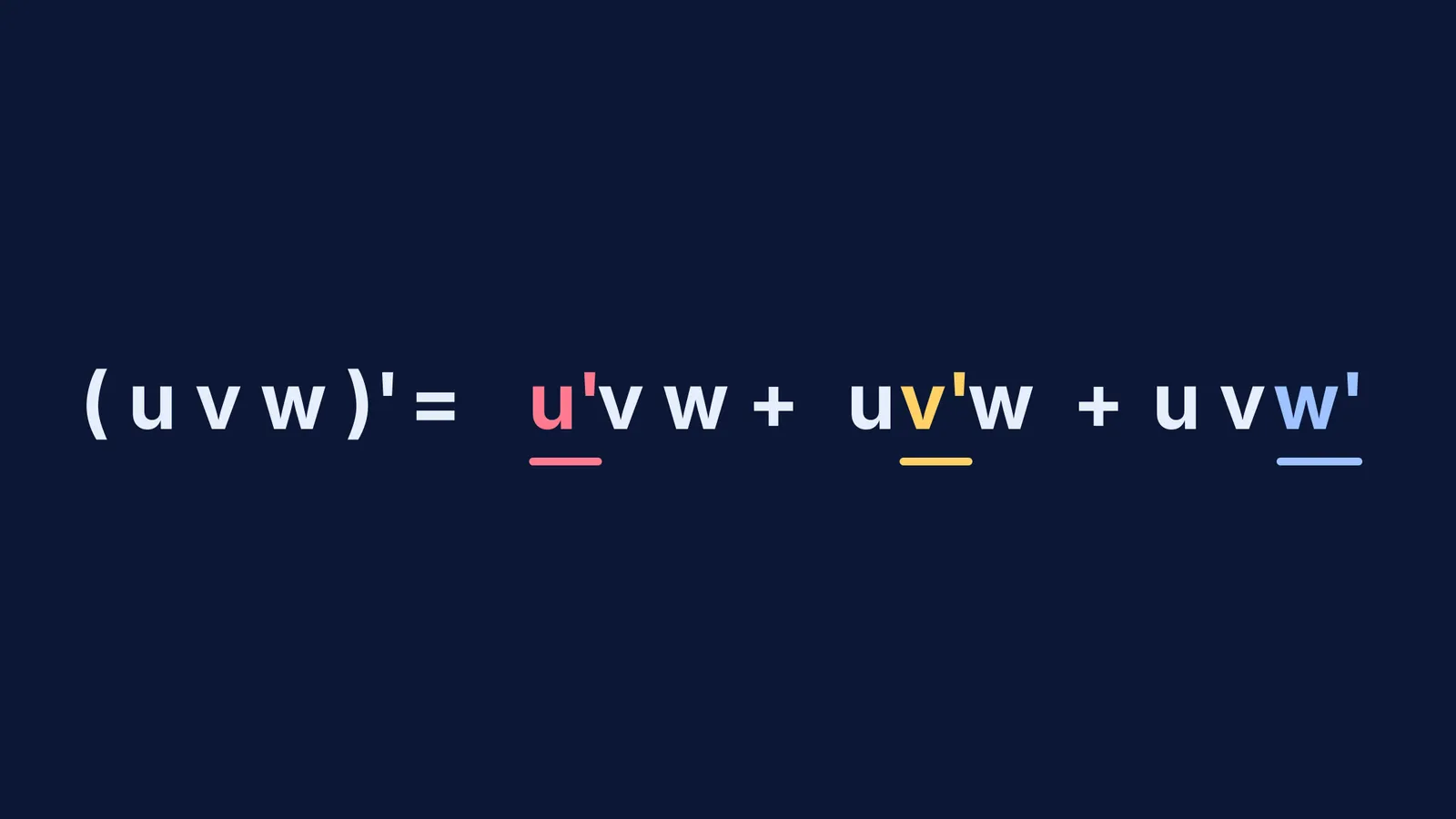
The formula is: (uvw)′ = u′vw + uv′w + uvw′
For example, if you need to differentiate y = x² · sin(x) · e^x, you identify your three pieces:
u = x², so u′ = 2x
v = sin(x), so v′ = cos(x)
w = e^x, so w′ = e^x
Plugging these into the formula gives: y′ = (2x)sin(x)e^x + x²(cos(x))e^x + x²sin(x)(e^x)
This pattern scales infinitely. If you had four functions, you would have four terms, each with a different function differentiated. Understanding how to differentiate one expression with respect to another becomes much easier when you can spot these structural patterns instead of memorising blind rules.
Why does the product rule for three functions work?
You do not need to memorise the three-function rule as a separate law. It is a direct consequence of the standard two-function product rule, and you can prove it by treating two of the functions as a single unit.
To prove it, treat the first two functions, (uv), as a single block. Let y = (uv)w.
Apply the standard product rule to the two pieces, (uv) and w: y′ = (uv)′w + (uv)w′
Now, look at the (uv)′ part. You already know how to expand this using the standard product rule: (uv)′ = u′v + uv′
Substitute this back into your main equation: y′ = (u′v + uv′)w + uvw′
Finally, multiply the w into the bracket to distribute it across both terms: y′ = u′vw + uv′w + uvw′
This grouping method is robust. Whether you are finding first derivatives or exploring second-order derivatives, breaking a large problem into nested, familiar chunks is a core mathematical strategy. By grouping terms, you reduce a new problem into a format you already know how to solve.
How to check it with logarithmic differentiation?
There is another, more elegant way to prove the rule and cross-check your work: logarithmic differentiation. As defined by Mathematics LibreTexts, logarithmic differentiation involves taking the natural logarithm of both sides of an equation to turn complex products and powers into simple sums before differentiating (LibreTexts/03%3A_Derivatives/3.09%3A_Derivatives_of_Exponential_and_Logarithmic_Functions)).
Let y = uvw.
Step 1: Take the natural logarithm of both sides. ln y = ln(uvw)
Step 2: Use the properties of logarithms to expand the right side. The logarithm of a product is the sum of the logarithms. ln y = ln u + ln v + ln w
Step 3: Differentiate both sides implicitly with respect to x. Remember that the derivative of ln(y) is (1/y)y′. (1/y) y′ = (1/u)u′ + (1/v)v′ + (1/w)w′
Step 4: Multiply both sides by y to isolate y′. y′ = y [ (u′/u) + (v′/v) + (w′/w) ]
Step 5: Substitute the original expression (uvw) back in for y. y′ = uvw [ (u′/u) + (v′/v) + (w′/w) ]
When you multiply the uvw into the bracket, the denominators cancel out one by one. For the first term, the u cancels, leaving u′vw. For the second, the v cancels, leaving uv′w. y′ = u′vw + uv′w + uvw′
This confirms our formula perfectly. When tackling higher-level problems, such as integrating acceleration given as a function of v, having multiple ways to cross-check your algebra keeps careless errors at bay. Using the Fermi Concept Library can help you build this habit, encouraging you to see the underlying connections between different calculus techniques rather than treating them as isolated tricks.
How do you apply the product rule for three functions?
When you encounter a product of three or more functions in an exam, follow this checklist to keep your working clear:
Define your pieces: Explicitly write down u, v, and w on the side of your page.
Find the individual derivatives: Differentiate each piece separately to find u′, v′, and w′. Writing these out before assembling the final equation prevents careless sign errors, especially when dealing with trigonometric or exponential functions.
Assemble the terms: Write out the three terms, making sure exactly one piece is differentiated in each block.
Look for common factors: Often, exponential terms like e^x or powers of x will appear in every term of your final answer. Factor them out to leave your final derivative in its simplest form.
This structured approach saves time and prevents you from losing track of terms halfway through a calculation.


