On this page
On paper, ax + by + cz = d can feel like letters with no picture behind it. The fix is to look at one arrow, the plane's normal vector, and watch what each number does to it.
What does the equation of a plane actually tell you?
A normal vector is an arrow perpendicular to every line lying in the plane. OpenStax's Calculus Volume 3, section 2.5 defines a plane through a point P with normal vector n = ⟨a, b, c⟩ as the set of all points Q with n · PQ = 0. Expand that dot product and you get a(x − x₀) + b(y − y₀) + c(z − z₀) = 0, which tidies into ax + by + cz = d.
So (a, b, c) is the direction the plane faces, and d says how far along that direction it sits. OpenStax writes ax + by + cz + d = 0, so its d has the opposite sign; check which form your textbook uses.
Put the origin into the same section's point-to-plane distance formula and you get the key number: the distance from the origin to ax + by + cz = d is the size of d divided by √(a² + b² + c²).
How do a, b, c and d move the plane?
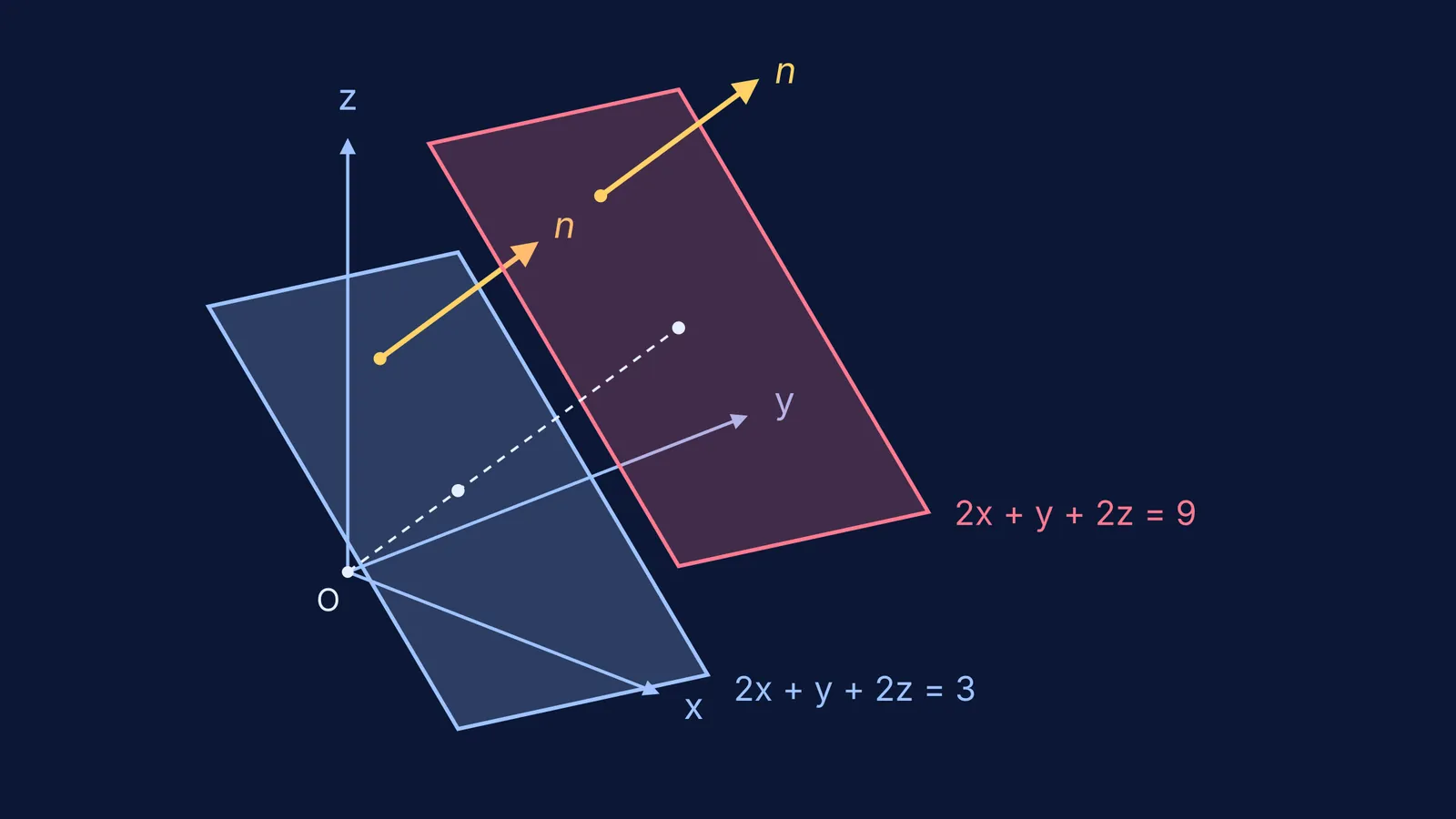
Take 2x + y + 2z = 3 as the starting plane. Its normal is (2, 1, 2), with length √(4 + 1 + 4) = 3, so the plane sits 3 ÷ 3 = 1 unit from the origin. Before reading each answer, say your prediction out loud.
Change d from 3 to 9. The plane slides along its normal, without tilting, to 9 ÷ 3 = 3 units from the origin.
Set d = 0. The origin now satisfies the equation, so the plane passes through it.
Double everything: 4x + 2y + 4z = 6. Nothing moves; every point that fitted before still fits.
Set c = 0: 2x + y = 3. The normal (2, 1, 0) lies flat, so the plane stands upright, parallel to the z-axis.
Change a alone, from 2 to 0: y + 2z = 3. The normal swings to (0, 1, 2), so the plane tilts until it runs parallel to the x-axis.
Flip the signs of a, b and c only: −2x − y − 2z = 3. That is 2x + y + 2z = −3, a parallel plane 1 unit from the origin on the opposite side.
Why do parallel planes share a normal?
OpenStax states it in one line: when two planes are parallel, their normal vectors are parallel (OpenStax Calculus Volume 3, section 2.5). The whole tilt of a plane lives in the direction of its normal, so two planes facing the same way can differ only in d.
The quick test: if (a, b, c) of one plane is a multiple of the other's, the planes are parallel or identical; if not, they meet in a line. The same section finds the angle between two planes from their normals, so the dot product method for the angle between vectors carries straight over. For a line meeting a plane there is a twist, explained in why the angle between a line and a plane uses sin, not cos.
How do you find the gap between two parallel planes?
Find the distance between 2x + y + 2z = 3 and 4x + 2y + 4z = 18.
Make the normals match. Divide the second equation by 2: 2x + y + 2z = 9.
Find the normal's length: √(2² + 1² + 2²) = 3.
Find each plane's distance from the origin along the normal: 3 ÷ 3 = 1 and 9 ÷ 3 = 3.
Both values of d are positive, so the planes are on the same side of the origin: the gap is 3 − 1 = 2 units.
How can you visualise a plane in 3D without software?
Stand a pencil on a notebook. The pencil is n. Tilt the pencil and the notebook tilts; slide the notebook up the pencil and only d changes.
Sketch with intercepts. 2x + y + 2z = 3 cuts the axes at x = 1.5, y = 3 and z = 1.5. Join them; that triangle is a piece of the plane.
To turn the picture on a screen, the Fermi Simulation Lab has interactive simulations for ideas that are easier to see than to read. If the dot product feels shaky, the Fermi Concept Library gives each mathematics concept its own lesson, and vector projection visualised as a shadow builds the same intuition.
One syllabus note: the CBSE Class XII mathematics syllabus for 2025-26 covers lines, not planes, under three-dimensional geometry. For JEE Main, check the current syllabus on the official NTA site.