On this page
Every AI chatbot answers you using a huge file of numbers. Where that file lives decides what it costs, who can see your questions, and whether it works without internet.
What is an open source AI model?
The Open Source Initiative defines weights simply: "AI weights are the set of learned parameters that overlay the model architecture to produce an output from a given input" (OSI Open Source AI Definition 1.0). Training adjusts those numbers; the finished weights are the model.
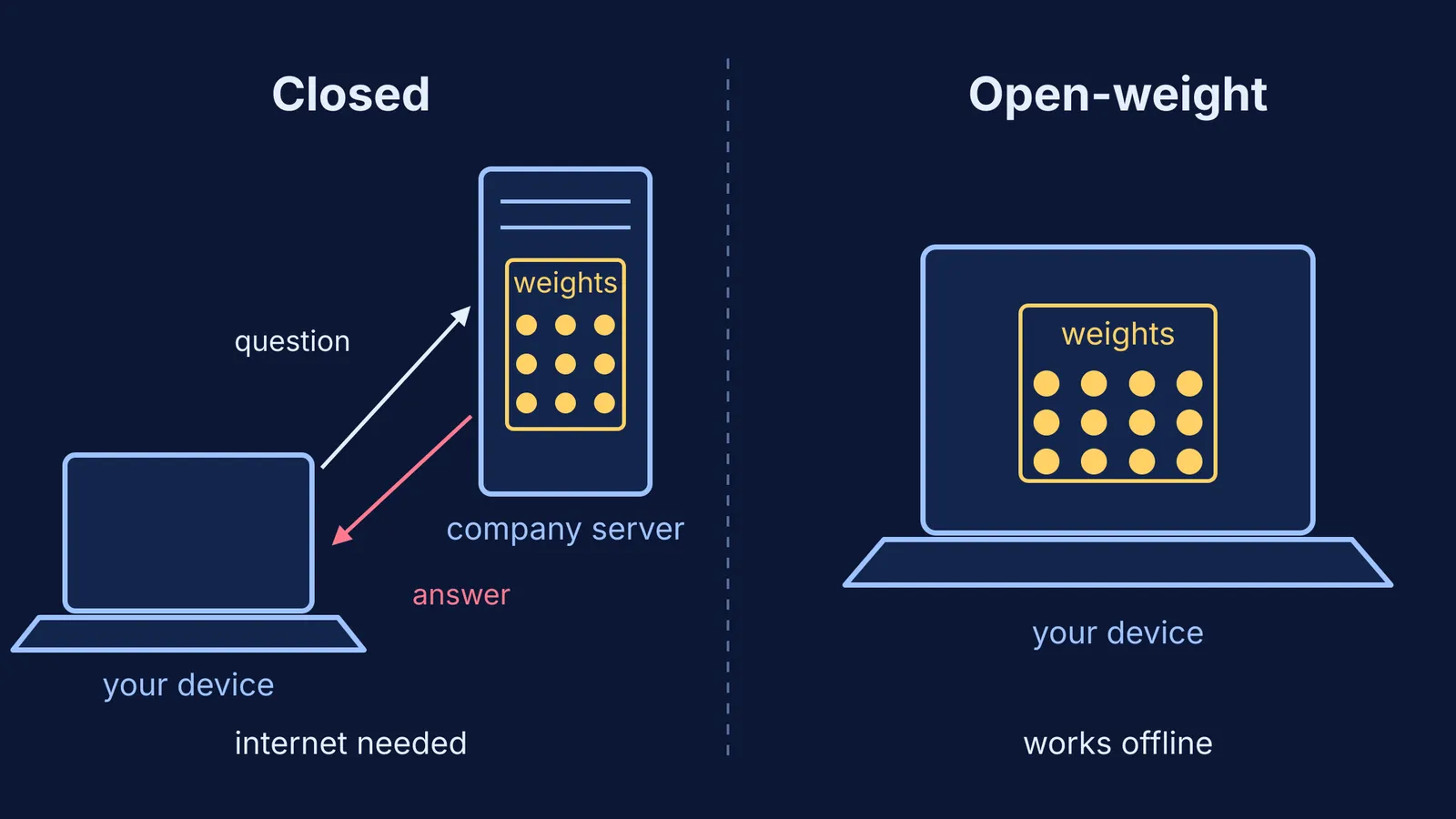
An open-weight model is one whose maker publishes the weights so that anyone can download and run them. A closed model keeps its weights on the company's servers; you reach it only through an app, a website or a paid connection.
"Open source" is a stricter label than "open weights". The same OSI definition asks for the freedom to use, study, modify and share the system, plus enough information about the training data "so that a skilled person can build a substantially equivalent system", and the full code used to train it. Many models called open release the weights but not the data, so they are open-weight, not open source.
The licence matters too. Meta's Llama 3.1 licence says that a company whose products had more than 700 million monthly active users when that version was released must ask Meta for a licence. OpenAI's gpt-oss models, by contrast, come under the permissive Apache 2.0 licence, according to their model card on Hugging Face.
Are open models as good as closed ones?
On some benchmarks, they are close. Stanford's 2025 AI Index found that open-weight models cut the performance difference with closed models from 8% to 1.7% on some benchmarks in a single year. The same report found that the cost of running a system at the level of GPT-3.5 fell over 280-fold between November 2022 and October 2024.
A benchmark is not your chemistry homework, so test any model on questions you can already answer.
What does open versus closed mean for cost, privacy and offline use?
Cost. Closed models often charge through subscriptions or per use. Open weights are free to download, but you pay for the computer that runs them. The smaller gpt-oss model runs within 16 GB of memory, while the larger one fits on a single 80 GB graphics card (gpt-oss model card).
Privacy. With a closed model, your question goes to the company's servers and is handled under its policy. With an open-weight model on your own machine, your question does not need to leave it.
Offline use. A local open-weight model keeps working without internet once it is downloaded. A closed model needs a connection. We cover the setup in can you use AI offline on your laptop for studying.
Upkeep. A closed model is updated by its maker. A model on your laptop is yours to update.
Why does the difference matter for schools?
Schools handle children's data. The Government of India notified the Digital Personal Data Protection Rules on 14 November 2025, and they say verifiable consent from a parent or guardian is needed when a child's personal data is involved, unless the processing relates to essential services such as healthcare, education or real-time safety (PIB backgrounder on the DPDP Rules). The same backgrounder says organisations get an eighteen-month period for phased compliance.
UNESCO's guidance on generative AI in education, published in September 2023, urges governments to adopt data protection and privacy standards and sets an age limit of 13 for the use of AI tools in the classroom.
For a school, an open-weight model on its own server can keep student questions inside the school. A closed tool is easier to run, but the school must check where student data goes. Whatever the model, students should still know what personal information not to share with an AI chatbot.
How do you choose between an open and a closed AI tool?
Ask these five questions about any AI tool, at home or at school:
Where does the model run: on this device, on the school's server, or on a company's servers?
Who can read what I type, and for how long is it kept?
Does it work without internet?
What does the licence allow, especially for a school or a business?
When it is wrong, who notices and who fixes it?
A worked example: a school lab with patchy internet wants an AI helper for Class 11 revision. Questions 1 and 3 point to a small open-weight model on a lab computer. A student at home with good internet and a parent's permission may pick a closed tool, and avoid typing names, phone numbers or school details. For more questions to ask an app, see what AI-powered means in edtech apps.
For learning, the model underneath matters less than what the tool does with it. Fermi's AI tutor is built to teach rather than answer: it works out what you already know, builds a plan for the session and checks understanding as it goes.
Next time you open an AI app, ask question 1 first.