On this page
A robot that walks over rough ground or lifts an egg without cracking it does three things at once: it obeys physics, reads its sensors many times a second, and runs a controller that, in many labs today, was learned rather than hand-written. Here is how those fit, with real numbers for the egg and a paper-cup activity.
How do robots learn to walk?
Every step, a walking robot decides how hard each motor pushes, based on what its joint and body sensors report.
Reinforcement learning is a method in which a program tries actions, gets a score for good outcomes such as moving forward and staying upright, and adjusts itself to score higher. Training on real robots is slow, costly and full of falls, so much of the practice happens in a physics simulation.
In a 2019 Science Robotics paper, Jemin Hwangbo, Marco Hutter and colleagues moved controllers trained in simulation onto the four-legged ANYmal robot, which then ran faster than before and recovered from falls. In a 2020 follow-up, Joonho Lee and colleagues showed a controller trained on much simpler simulated terrain coping with mud, snow and rubble it had never met in training.
What helps simulation carry over to reality is variety. When OpenAI researchers trained a robot hand to turn objects in its fingers, they randomised physical properties such as friction coefficients in simulation, so the hand would not depend on one exact value.
Why is picking up an egg so hard for a robot?
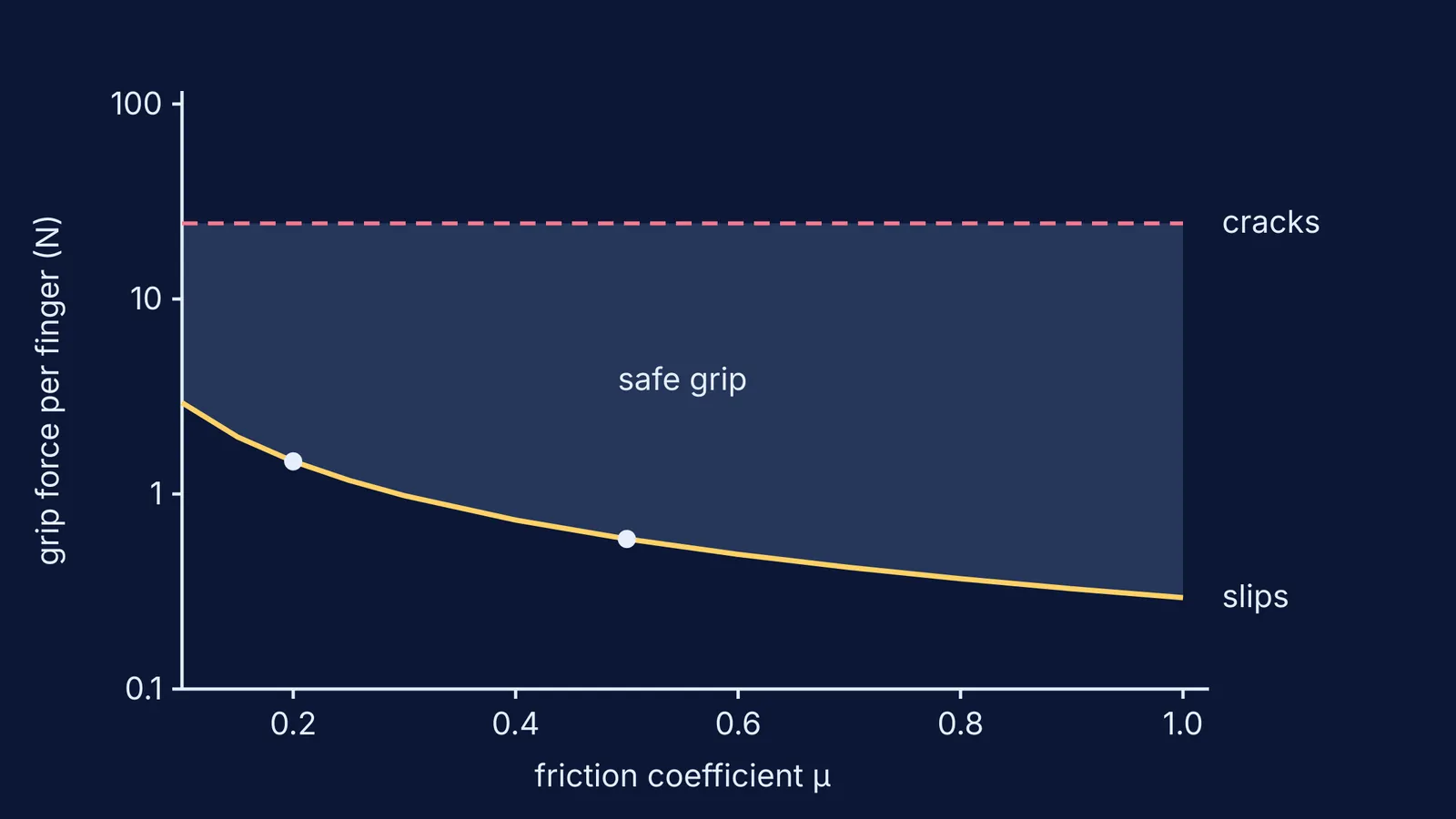
Grip too lightly and the egg slips; grip too hard and it cracks. In a 2024 study of 240 older laying hens, eggs in the weak-shell group broke at about 24 N on average and those in the strong-shell group at about 45 N.
The lower limit comes from Class 11 friction:
Under EU marketing rules a medium egg weighs 53 g to under 63 g, so use m = 0.06 kg.
Its weight is mg = 0.06 × 9.8 ≈ 0.59 N.
Two fingers each press with normal force N, so the most friction they can give is 2μN. To hold the egg, 2μN ≥ mg.
Assume μ = 0.5 for a dry fingertip on shell. Then N ≥ 0.59 ÷ 1.0 ≈ 0.6 N per finger.
Now the egg is wet and μ drops to, say, 0.2. Then N ≥ 0.59 ÷ 0.4 ≈ 1.5 N.
On paper the safe window is wide: from about 0.6 to 1.5 N up to about 24 N for a weak shell. But the robot does not know μ or exactly where the shell is, and a stiff gripper that closes to a set position, not a set force, can shoot past the window in a blink. If the friction step feels shaky, read our explainer on why static friction is not always equal to μN.
Your hand solves this with feedback. Johansson and Westling's 1987 study in Experimental Brain Research found that fingertip touch sensors detect tiny slips, and about 74 ms later the grip automatically tightens relative to the load, leaving a safety margin.
What is feedback control, and how can you try it?
Feedback control means measuring the gap between where you are and where you want to be, then acting to shrink it, again and again. In proportional control, each step moves by K times the error. For the history, read our profile of Norbert Wiener and how feedback steers learning.
Part 1, be the controller on paper (10 minutes). Start at 0 with a target of 1. Each step, add K × (1 − current position). Try three gains:
K = 0.4 gives 0, 0.4, 0.64, 0.78, 0.87: slow and smooth, never overshoots.
K = 1.6 gives 0, 1.6, 0.64, 1.22, 0.87: overshoots, wobbles, then settles.
K = 2.0 gives 0, 2, 0, 2, 0: swings forever and never arrives.
A gripper with too high a gain can behave like K = 2.0, slamming past the target force; too low and the egg slides out first.
Part 2, feel it with a paper cup (5 minutes):
Pinch an empty paper cup near the rim, as lightly as you can.
Ask someone to pour water in slowly. Notice that you squeeze harder just before it slips, without deciding to.
Repeat with your eyes closed. Which sense is doing the job?
Squeeze too hard and the cup dents: the egg's upper limit.
If overshoot is easier to see than read, the Fermi Simulation Lab has interactive simulations, and Fermi's AI tutor can work through the friction maths alongside you, checking your understanding as it goes.
Where does this lead if you like it?
Robot motion is where mechanics, coding and calculus meet. Our guide on how to start robotics as a school student lists first steps. Tonight, redo Part 1 with K = 1.0 and predict the answer before you calculate.