

On this page
Building a robot is one of the few ways to see your code move something in the physical world. If you enjoy taking things apart or figuring out how machines work, robotics is a natural next step. It also builds a strong foundation for future study; a 2022 review in the Journal for STEM Education Research noted that the FIRST LEGO League competition currently involves over 318,000 students globally, boosting participants' motivation and STEM learning.
For many students, what starts as a weekend hobby turns into a degree in engineering or computer science. When your robot fails to stop at a wall, you learn how to debug both your code and your wiring. That cycle of trying, failing, and fixing builds resilience, and it makes abstract maths and physics tangible.
Why is robotics more than just a hobby?
Robotics forces you to step away from the screen and deal with the unpredictability of the physical world. A program that runs perfectly in a simulation might fail on the floor because of friction, battery voltage, or a loose wire.
Working through these physical problems requires patience. You have to isolate the fault: is the sensor reading the wrong value, is the logic backwards, or is the motor simply jammed? By solving these layered problems, students naturally practice the scientific method. They form a hypothesis about why the robot turned left instead of right, change one variable in the code, and test it again.
This hands-on troubleshooting is invaluable for future engineering students. Instead of just reading about torque and gear ratios in a textbook, they experience these physics concepts in action when their robot tries to climb a ramp. Understanding the physical constraints of hardware gives students a distinct advantage when they transition to university-level engineering coursework.
What are the best robotics kits for beginners?
You do not need to solder custom circuit boards to start. The best way to begin is with a kit that lets you focus on the logic of robotics rather than gathering individual components.
Microcontrollers: The Arduino Uno is the standard brain for beginner robots. You can buy a starter kit that includes the board, jumper wires, light-emitting diodes, a motor, and a distance sensor. It is affordable and has a massive library of beginner tutorials online.
Single-board computers: If you want your robot to process images or run complex models, a Raspberry Pi works like a full computer. It is better suited for students who already have some programming experience.
Snap-together kits: Kits like LEGO Spike Prime or VEX IQ remove the wiring step entirely. You build the structure by clicking pieces together and program the motors via a connected app. These are excellent if you want to focus purely on the algorithms and mechanical design.
When choosing your first kit, prioritize platforms with a large, active community. A vast community means that when you encounter a strange error code, someone else has likely already solved it and posted the solution on a forum.
How do I learn robotics programming?
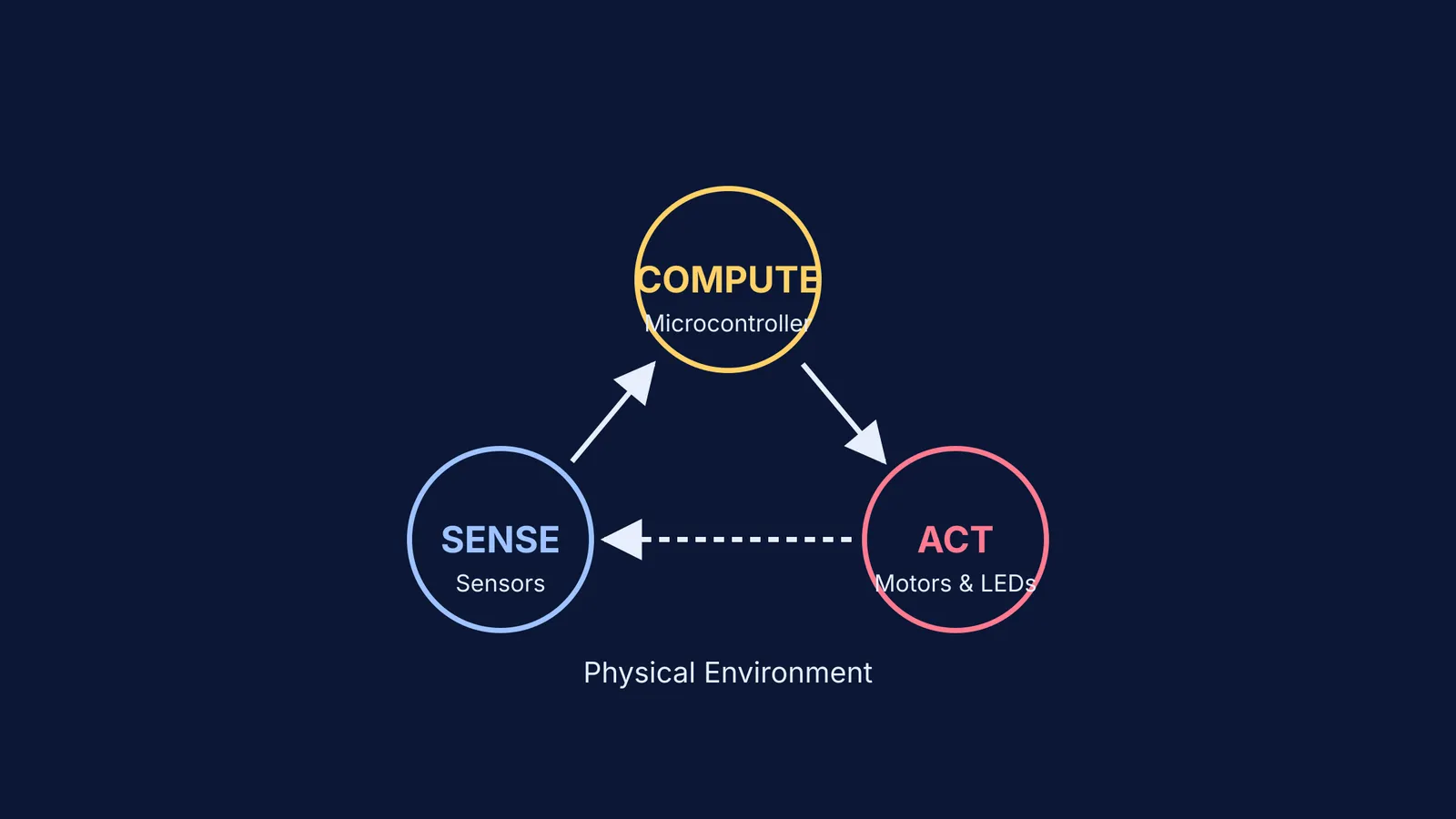
Every robot runs on a control loop: sense, compute, act. Your code reads data from a sensor, makes a decision, and sends a command to a motor.
If you are new to coding, start with block-based languages like Scratch or Blockly. You drag and drop commands to build the logic without worrying about missing semicolons. When you are ready for text, Arduino uses a simplified version of C++, while Raspberry Pi projects typically use Python. You can even practice the logic by writing your own physics simulation in Python before running the code on physical hardware.
If you are stuck on the logic of your code, Fermi's AI tutor can work out what you already know and build a plan for the session, helping you debug your reasoning step by step. If you need to review the electronics principles behind your sensors, the Fermi Concept Library explains every concept in physics and computing, each with its own lesson and its place in the map.
How do I join robotics competitions?
Working alone is a good start, but robotics is inherently a team effort. Joining a team exposes you to different ways of solving the same problem and teaches you how to divide complex tasks.
Competitions release a new challenge every year. Teams have a few months to design, build, and program a robot to complete specific tasks on a playing field under a time limit.
You do not need a school team to enter. Many teams are community-based, operating out of local maker spaces, libraries, or garages. You can find local teams through the official websites of major competition leagues. Participating in these intense, iterative events often shifts how families handle setbacks, making it easier when talking about failure at home.
Robotics is rarely about getting it right on the first try. It is about understanding why a wheel spins backward or why a sensor misreads a shadow, and methodically solving the puzzle.


