On this page
Put a steel tumbler on the table, switch off the room light and hold your phone torch at the rim. A sharp, bright curve with a dent in it appears on the bottom of the cup. Move the torch and the curve changes shape. It is geometry, and you can draw it with a compass and ruler.
Why is there a heart-shaped light inside a cup?
The inside wall of a steel cup is a curved mirror. Each ray from the torch hits the wall and bounces off by the law of reflection: the angle of incidence equals the angle of reflection, measured from the normal, and on a curved mirror the normal runs along the radius (NCERT Class 12 Physics, Ray Optics).
A caustic is the envelope of light rays reflected or refracted by a curved surface: a curve that every ray touches. Caustics are often seen as patches of light or their bright edges (Wikipedia: Caustic (optics))).
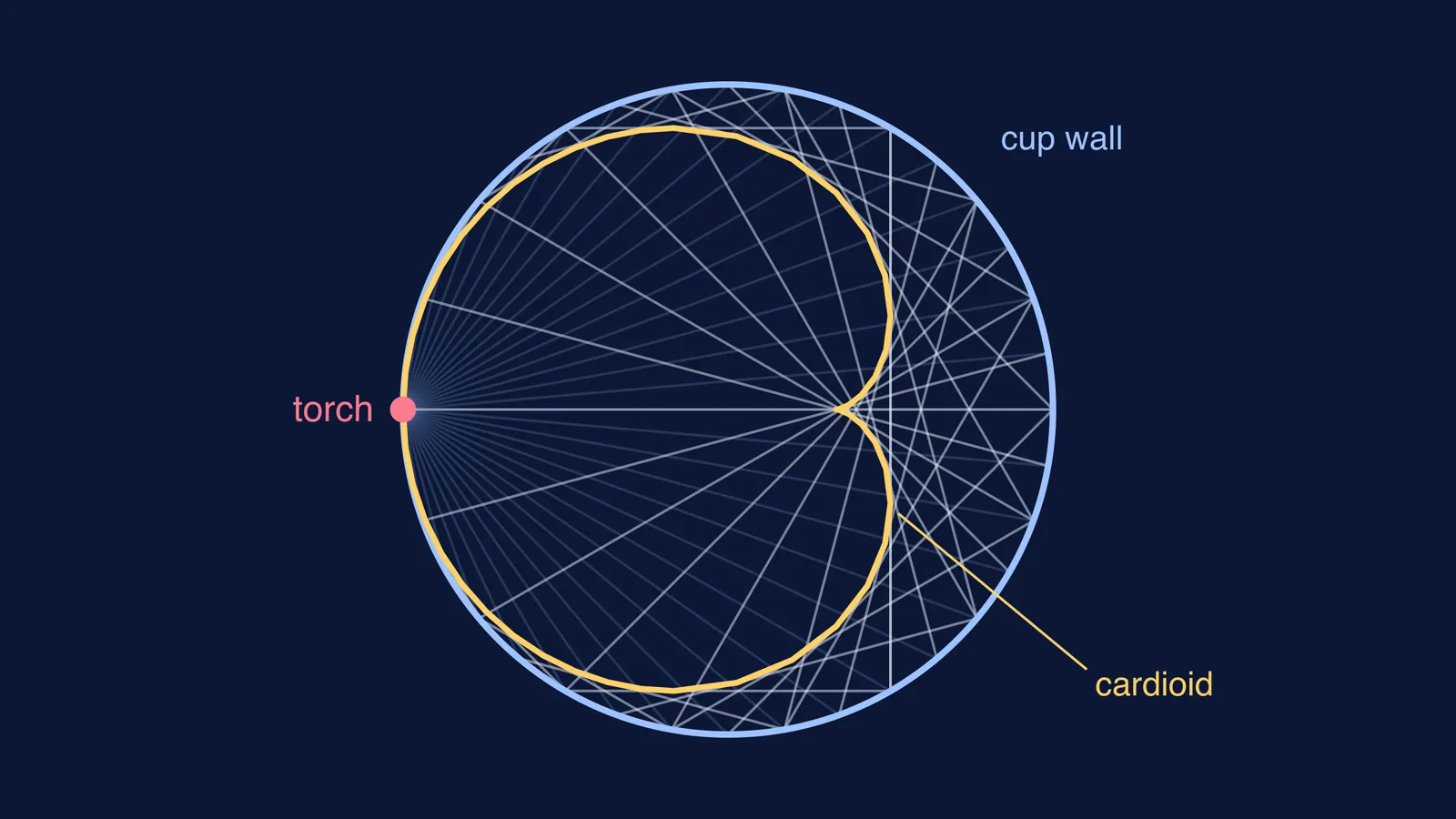
When the light source sits at a point on the rim of a circle, the reflected rays inside are all tangents of a cardioid (Wikipedia: Cardioid). Wolfram MathWorld gives the same result. The name comes from the Greek kardia, heart, and Giovanni Salvemini, also known as de Castillon, coined it in 1741.
Why do reflected rays crowd into one bright curve?
What changes is how many rays pass through each patch of the cup floor. Along the caustic, neighbouring rays run almost side by side before they cross, so light piles into a thin line. On one side of the edge rays crowd in; on the other there are almost none.
The dent in the heart is a cusp, a sharp point that caustics often have (Wikipedia: Caustic (optics))). It sits at the focus of the curved wall, where rays that hit the far wall almost head-on meet after reflecting.
What happens when you move the torch?
Hold the torch at the rim and you get the cardioid. Pull it away and the curve slowly changes. In the limit of parallel light, as from the Sun, the caustic of a circle is a nephroid, a kidney-shaped curve (Wolfram MathWorld: Nephroid). Parallel rays hitting a reflecting half-circle give tangents to a nephroid (Wikipedia: Nephroid), which is why sunlight on a cup usually shows only half the curve: only the half of the wall facing the Sun is lit.
You can predict where the cusp sits with the school mirror formula. NCERT shows that a spherical mirror has focal length f = R/2 and gives the mirror equation 1/v + 1/u = 1/f (NCERT Class 12 Physics, Ray Optics). Here is a worked example for a tumbler 8 cm across, so R = 4 cm and f = 2 cm, using distances as plain lengths:
Torch on the rim: rays heading through the centre travel u = 8 cm to the far wall.
1/v = 1/2 − 1/8 = 3/8, so v = 8/3 cm, about 2.7 cm in front of the far wall.
That puts the cusp R/3, about 1.3 cm, past the centre of the cup.
Sunlight: u is very large, so v = f = 2 cm, halfway to the centre.
As the torch moves back, the cusp slides about 0.7 cm towards the far wall and the heart opens into the kidney. The formula holds only for rays near the axis; rays further out miss the focus and draw the curve instead. Our post on spherical aberration and paraxial rays explains that limit.
How can you draw the cardioid yourself?
The law of reflection gives a shortcut: with the torch at point 0, a ray hitting the wall at angle a leaves towards the point at angle 2a. This matches the classic construction where chords joining point n to point 2n have a cardioid as their envelope (Wikipedia: Cardioid).
Draw a circle about 16 cm across.
Mark 36 points, one every 10 degrees, and number them 0 to 35.
Point 0 is your torch. Lightly draw a line from point 0 to point 1, then a firmer line from point 1 to point 2. That is one ray and its reflection.
Join every point n to point 2n. If 2n is more than 35, subtract 36, so 20 joins 4.
Point 18 joins 0: that ray goes straight across and back.
Step back. The heart is the curve that all your lines touch.
To see sunlight's curve, start again and join n to 3n, subtracting 36 or 72 as needed. The envelope is a nephroid (Wikipedia: Nephroid).
Where can you explore more mirror ideas?
Each drawing shows only one torch position. The Fermi Simulation Lab has interactive simulations for ideas that are easier to see than to read. To practise predicting images first, try our concave mirror simulation at six object positions. Parents can pair the cup experiment with our plan for a parent and teen science simulation session.