On this page
A fruit battery is two different metals pushed into a fruit, with the juice as the electrolyte. In the study below, swapping the metals changed the voltage more than swapping the fruit, so keep one lemon, swap the metal pairs, and test your predictions.
Which metal pair gives the highest voltage in a fruit battery?
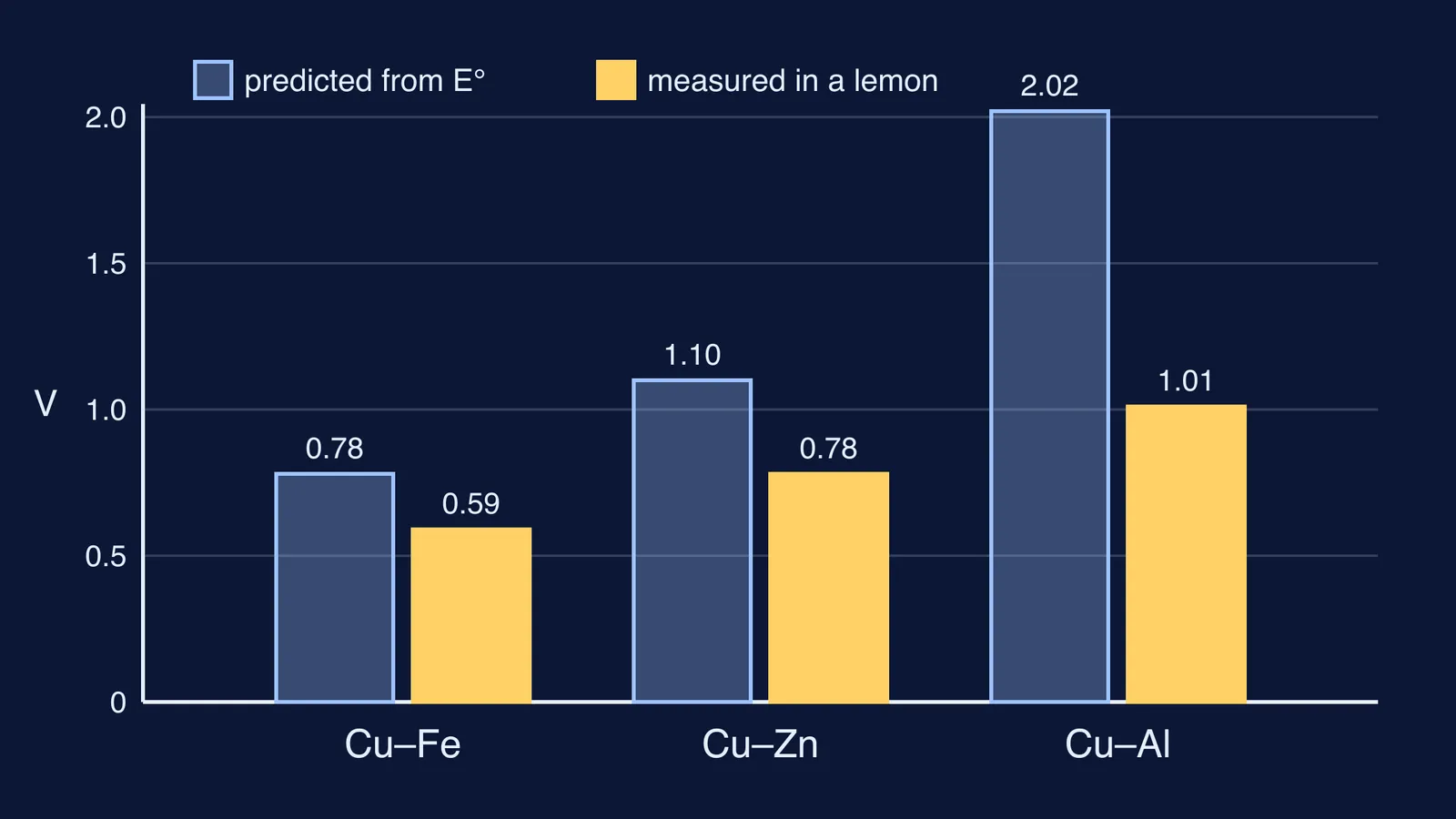
Of the three copper pairs tested, copper with aluminium gives the highest reading, copper with zinc comes next, and copper with iron gives the lowest. That is what a team at SCMS School of Engineering and Technology in Ernakulam found when they tested five fruits with a copper wire and a second metal, each pushed 30 mm deep and 20 mm apart (Deepa S and colleagues, IJARSCT, 2021).
Their lemon readings, from the same paper:
Copper-iron: 0.59 V
Copper-zinc: 0.78 V
Copper-aluminium: 1.01 V
The order held in apple, orange, star fruit and tomato too (IJARSCT, 2021).
How do you predict a fruit battery's voltage from the electrochemical series?
Use the standard reduction potentials. Standard reduction potentials are Al −1.68 V, Zn −0.76 V, Fe −0.44 V and Cu +0.34 V, measured against the standard hydrogen electrode (LibreTexts table of standard reduction potentials).
The more negative metal is the anode, the negative terminal. The predicted voltage is E°cell = E°(cathode) − E°(anode).
Worked example for copper and zinc: 0.34 − (−0.76) = 1.10 V, with zinc as the negative terminal. Do the same for every pair you can make from the four metals:
Copper-aluminium: 0.34 − (−1.68) = 2.02 V
Iron-aluminium: −0.44 − (−1.68) = 1.24 V
Copper-zinc: 0.34 − (−0.76) = 1.10 V
Zinc-aluminium: −0.76 − (−1.68) = 0.92 V
Copper-iron: 0.34 − (−0.44) = 0.78 V
Zinc-iron: −0.44 − (−0.76) = 0.32 V
The further apart two metals sit in the series, the bigger the voltage. Write your predictions down before measuring.
Why are measured fruit battery voltages lower than predicted?
We divided the lemon readings in the Kerala study by the predictions. Copper-iron reached about 76% of its predicted value, copper-zinc about 71%, and copper-aluminium only about 50% (IJARSCT, 2021). Four things help explain the gaps.
1. The copper is not really a copper electrode. Copper's E° assumes a solution of copper ions; lemon juice has almost none. The Siemens Stiftung teacher guide puts it plainly: a copper-zinc fruit battery "is in reality a hydrogen-zinc cell", because hydrogen ions from the juice, not copper ions, pick up electrons at the copper (Siemens Stiftung, Lemon batteries and other batteries). The Kerala paper writes the same cathode reaction, 2H⁺ + 2e⁻ → H₂ (IJARSCT, 2021).
2. Nothing is at standard concentration. E° values assume standard (1 mol/L) conditions. The Siemens guide notes that once students know voltage depends on concentration, "there is no longer any discrepancy" between the table and their readings (Siemens Stiftung). This is the Nernst equation at work.
3. Aluminium hides under oxide. Untreated aluminium "is coated with an oxide layer that severely hinders electrochemical processes", and anodised aluminium is nearly inert, the same guide says (Siemens Stiftung). That may help explain aluminium's big gap, so sand it hard first.
4. The surface and the meter matter. Readings vary with the fruit's water and acid content, the state of the metal surfaces and the clip contacts (Siemens Stiftung). Small electrodes mean high internal resistance, so the voltage collapses under a load such as a motor. Our post on why a potentiometer measures emf better than a voltmeter explains why even a meter takes a little current.
How do you run the metal-swap test at home?
You need one lemon, strips or nails of copper, zinc (a galvanised nail works), iron (a plain steel nail) and aluminium, sandpaper, and a digital multimeter on the 2 V DC range.
Sand every electrode until it is bright. Give aluminium extra work.
Roll the lemon on a table to break up the pulp inside.
Push both metals in to the same depth and keep the same gap each time. The Kerala team used 30 mm deep and 20 mm apart (IJARSCT, 2021).
Clip the black lead to the metal you predicted as negative. A minus sign on the meter means you had it backwards.
Note the reading once it settles.
Repeat each pair in a fresh spot in the lemon.
Work out measured ÷ predicted and rank the gaps.
Throw the lemon away afterwards rather than eating it. One lemon cell will not light an LED: the red LED in the Siemens kit needs about 1.7 V, so connect cells in series (Siemens Stiftung).
To watch electrons and ions move first, try our galvanic cell simulation with predictions or the Fermi Simulation Lab, interactive simulations for ideas easier to see than to read. The same electrode potentials explain why galvanised iron does not rust, and the Fermi Concept Library has a lesson on each concept behind them.