

On this page
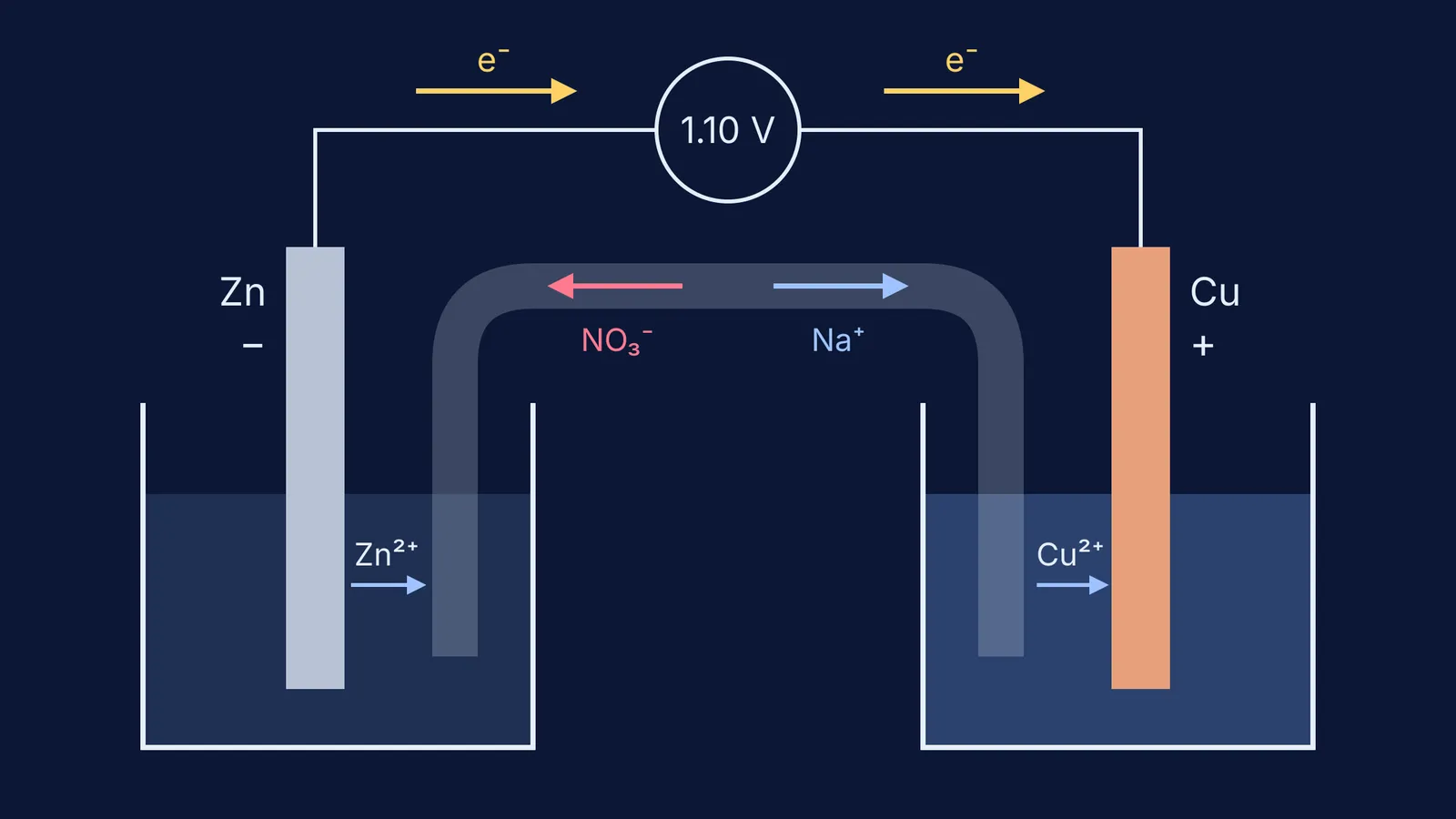
In a galvanic cell you see two metal strips and a voltmeter, never the electrons or ions. In a 2024 study of 1,032 senior high-school students in Turkey and Indonesia, understanding of electrochemistry was relatively weak, and a shared misconception was that electrons migrate through the solution from one electrode to the other (Nakiboglu and colleagues, Chemistry Education Research and Practice). A teachers' summary of that study adds that some students thought electrons travel through the salt bridge (RSC Education).
A simulation helps only if you commit to an answer before you look. Here are five predictions for the zinc-copper (Daniell) cell, with numbers from the NCERT Class 12 chemistry textbook to check against the screen.
How do you set up a zinc-copper cell in a simulation?
In any galvanic cell simulation, set up:
Left beaker: a zinc strip in 1 M zinc sulfate solution.
Right beaker: a copper strip in 1 M copper sulfate solution.
A wire joining the two strips through a voltmeter.
A salt bridge of sodium or potassium nitrate.
For other ideas that are easier to see than to read, the Fermi Simulation Lab has interactive simulations you can run the same way.
Which way do electrons flow in a galvanic cell?
Prediction 1: electrons leave the zinc, travel through the wire, and arrive at the copper.
NCERT's Table 2.1 lists Zn²⁺/Zn at −0.76 V and Cu²⁺/Cu at +0.34 V (NCERT Class 12 Chemistry, Unit 2). The lower value means zinc gives up electrons more readily, so zinc is oxidised. The half-cell where oxidation happens is the anode and is negative; electrons flow from the negative electrode to the positive one, and conventional current flows the opposite way.
On screen, any current arrows in the wire should point from copper to zinc.
Which electrode loses mass, and how much?
Prediction 2: the zinc strip gets lighter and the copper strip gets heavier.
At the anode, Zn(s) → Zn²⁺(aq) + 2e⁻, so zinc atoms leave the strip as ions; at the cathode, Cu²⁺(aq) + 2e⁻ → Cu(s), so copper plates out (NCERT Class 12 Chemistry, Unit 2). The grams differ because the atomic weights differ.
A worked example for a cell delivering 0.10 A for one hour:
Charge = current × time = 0.10 A × 3600 s = 360 C.
Moles of electrons = 360 C ÷ 96487 C mol⁻¹ (the Faraday constant NCERT uses) = 0.00373 mol.
Each zinc atom gives 2 electrons and each Cu²⁺ ion takes 2, so 0.00187 mol of each metal changes.
With standard atomic weights of 65.38 for zinc (CIAAW) and 63.546 for copper (CIAAW), zinc loses about 0.122 g and copper gains about 0.119 g.
What does the salt bridge do, and do electrons go through it?
Prediction 3: no electrons cross the salt bridge. Ions do.
The salt bridge keeps the two solutions apart while maintaining charge balance (OpenStax Chemistry 2e). Here Zn²⁺ builds up on the left and Cu²⁺ is used up on the right, so nitrate ions from the bridge drift towards the zinc side and sodium or potassium ions towards the copper side, as OpenStax shows for a copper-silver cell. Electrons carry the charge in the wire; ions carry it in the solutions and the bridge.
Prediction 4: lift the salt bridge out and the current stops. With no ion path, charge would build up in each beaker, so the reaction cannot continue.
How do you calculate the cell voltage from standard potentials?
Prediction 5: the voltmeter reads about 1.10 V with both solutions at 1 M.
NCERT writes E°cell = E°right − E°left, with the cathode on the right, so E°cell = 0.34 V − (−0.76 V) = 1.10 V (NCERT Class 12 Chemistry, Unit 2). Use both reduction potentials as listed; do not also flip the anode's sign. Strictly, 1.10 V is the emf: the potential difference when no current is drawn.
Then push the simulation further:
Dilute the zinc sulfate to 0.1 M and keep copper at 1 M. NCERT's form of the Nernst equation for this cell, E = E° − (0.059/2) log([Zn²⁺]/[Cu²⁺]), predicts about 1.13 V.
Swap copper for silver in silver nitrate. Ag⁺/Ag is +0.80 V in the same NCERT table, so E° = 0.80 − (−0.76) = 1.56 V. You double the silver half-reaction to balance electrons, but not its potential.
For the full method, see our guide to cell notation, EMF and the Nernst equation; to pick the oxidised metal in any pair, use the electrochemical series to predict redox reactions.
What should you do when the simulation surprises you?
A mismatch is the useful part. Find the step in your written reasoning that failed and fix that step, not just the answer.
If you stay stuck, Fermi's AI tutor notices where you are stuck and decides whether to explain, ask or show, checking your understanding as it goes.
Start with prediction 1 tonight: write it down, then build the cell.


