On this page
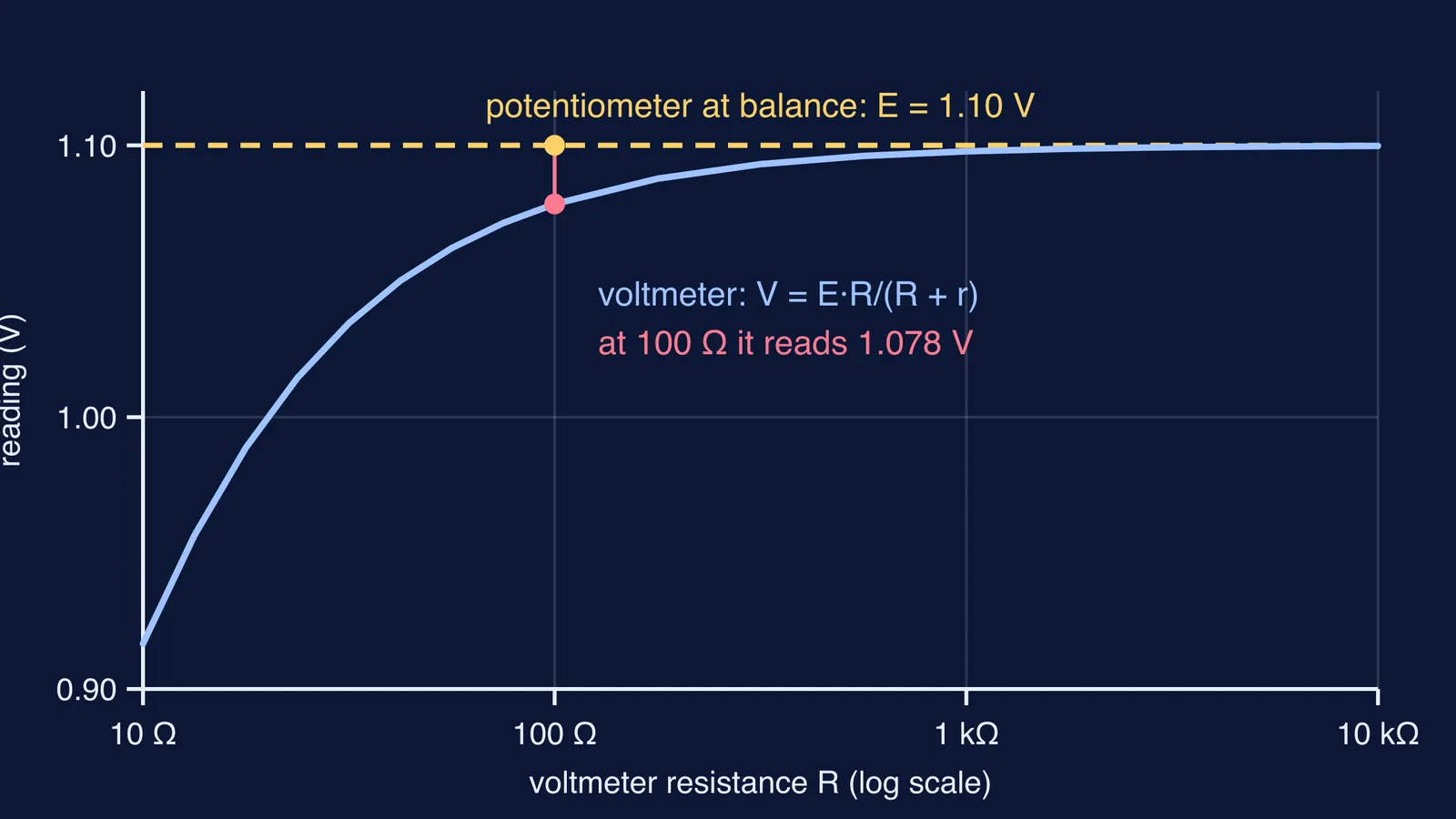
Suppose a voltmeter across a Daniell cell shows 1.08 V while the same cell balanced on a potentiometer gives 1.10 V. The difference is current, and that idea answers a classic Class 12 question.
Why can't a voltmeter read the true emf of a cell?
A voltmeter needs a small current, which also flows through the cell's internal resistance r. So it reads the terminal voltage, not the emf. OpenStax College Physics writes this as V = emf − Ir, where I is the current that flows and r is the internal resistance. The same page gives the key idea: if the current could be made zero, then V = emf.
With a voltmeter of resistance R across the cell, I = E/(R + r), so the reading is V = E × R/(R + r). It is always below E, and the gap grows as R falls or r rises.
How does a potentiometer draw no current at balance?
A potentiometer is a long uniform wire carrying a steady current from a driving battery. The NCERT Class 12 physics laboratory manual states the principle: the potential difference between two points on the wire is proportional to the length between them, V = φl, where φ is the potential gradient.
The cell under test connects through a galvanometer to a jockey sliding along the wire. Where the wire's potential difference equals the cell's emf, the galvanometer shows zero. The Wikipedia article on the potentiometer) puts it this way: at that null point no current is drawn from the unknown source, "and so the reading is independent of the source's internal resistance, as if by a voltmeter of infinite resistance."
Hence the NCERT manual's line: a voltmeter measures only the terminal potential difference, a potentiometer gives the emf.
Worked example: voltmeter vs potentiometer on a Daniell cell
A Daniell cell has a standard emf of 1.10 V at 25 °C. Suppose your lab cell has an internal resistance r = 2 Ω (an assumed value for this example). Using V = E × R/(R + r) from OpenStax:
Voltmeter with R = 100 Ω: V = 1.10 × 100/102 = 1.078 V, about 2% low.
Voltmeter with R = 1000 Ω: V = 1.10 × 1000/1002 = 1.098 V, about 0.2% low.
Voltmeter with R = 10 Ω: V = 1.10 × 10/12 = 0.917 V, about 17% low.
Now the potentiometer. Take a 400 cm wire, a length the NCERT manual mentions, with the driving battery and rheostat set so that 1.60 V drops across it. Then φ = 1.60/400 = 0.004 V per cm. The cell balances where φl = 1.10 V, so l = 1.10/0.004 = 275 cm. There the cell supplies no current, so raise r from 2 Ω to 20 Ω and every voltmeter reading above falls, but the balancing length stays at 275 cm.
A second cell of, say, 1.45 V balances at 362.5 cm, and E1/E2 = l1/l2 = 275/362.5, the NCERT formula. φ cancels, so you need not know it to compare two cells.
Does a digital multimeter make the potentiometer pointless?
Modern meters draw very little current: digital multimeters have a fixed input impedance that is often one or ten megohms. With R = 10 MΩ and r = 2 Ω, the reading is low by about 2 parts in 10 million, far below what the display shows. The exam point still stands: a voltmeter reads E − Ir however small I is, while a null method makes the current zero by design and compares emfs with a metre scale rather than a meter's calibration.
Two honest limits. The NCERT manual requires the driving emf E to exceed both E1 and E2, or no balance point exists. And until you hit the exact null a tiny current flows, which is why the manual shorts a protective resistance box near balance to sharpen the null.
How do you write this answer in a board exam?
Four steps:
A voltmeter draws a current I from the cell, so it reads V = E − Ir, which is less than E.
In a potentiometer, the cell's emf is balanced against the potential drop φl along the wire.
At balance the galvanometer shows no deflection, so no current is drawn from the cell and Ir = 0.
So the potentiometer measures the emf itself, like a voltmeter of infinite resistance.
If you have space, add one line of numbers from OpenStax's formula: a 1.10 V cell with r = 2 Ω reads 1.078 V on a 100 Ω voltmeter.
To watch the null point move, try the potentiometer simulation for comparing two emfs; for practical errors, read meter bridge and potentiometer: principle and practical errors. When a numerical mixes internal resistance, balancing lengths and potential gradient, the Fermi Problem Library has worked problems with a step-by-step solver that explains the reasoning rather than printing an answer.