On this page
Take a paper or plastic cup, poke two small holes in its side and fill it with water. Two jets arc out. Now hold it over a bucket and let go. Before you read on, decide what the jets will do while the cup is falling.
This is a classic lecture demonstration. The University of Iowa's demonstration notes say that when the cup is in free fall, no water should come out of the holes.
What do you predict will happen to the jets?
Pick one and write it down before you scroll:
The jets keep going, the same as before.
The jets get stronger, because the water is now moving fast.
The jets get weaker but keep leaking.
The jets stop while the cup falls.
Then write one sentence saying why. If your reason is "water is heavy, so it always pushes out", hold on to it; that is the idea the experiment tests.
Why does water leak from a cup with a hole?
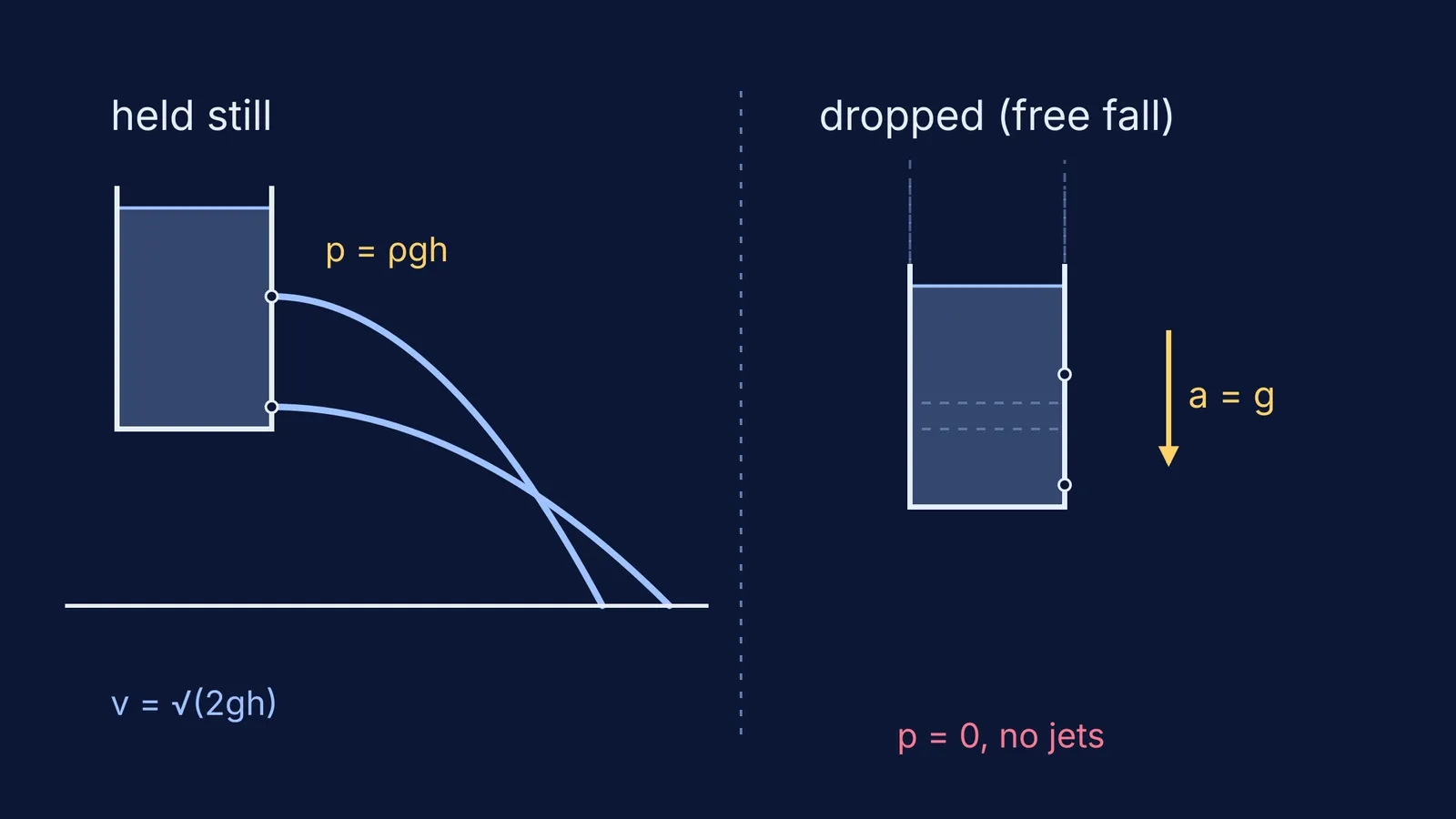
Water leaks because of hydrostatic pressure. The pressure due to the weight of a fluid at depth h is P = hρg, where ρ is the fluid's density, as OpenStax College Physics derives it from the weight of the fluid above a point. A hole lower down sits under more water, so it feels more pressure.
That pressure pushes water out. Torricelli's theorem gives the exit speed as v = √(2gh), where h is the height of the water surface above the hole, as shown in this LibreTexts physics chapter. The lower hole squirts faster, so when the cup is held well above the bucket, its jet usually lands further out.
Here is a worked example. Say a hole sits 8 cm below the water surface. Using the average value g = 9.80 m/s² from OpenStax and water's density of 1000 kg/m³:
Pressure from the water above the hole: p = 1000 × 9.80 × 0.08 ≈ 784 Pa.
Exit speed: v = √(2 × 9.80 × 0.08) ≈ 1.25 m/s.
Notice that g sits inside both formulas. Whatever changes the g the water feels changes the leak. That is the key to the whole puzzle.
Why does water stop leaking when the cup is dropped?
Once you let go, the cup and the water both fall. OpenStax states the experimental fact: if air resistance is negligible, all objects at a given place fall with the same constant acceleration, whatever their mass.
So the water has no reason to move relative to the cup: the water at the top is not pressing on the water below, which is accelerating away at the same rate. The University of Colorado Boulder's demonstration page puts it in one line: in the cup's freely falling reference frame, the effective gravity is zero, which eliminates the hydrostatic pressure that drives the leak.
Put that into the worked example. With effective gravity zero, p = ρ × 0 × h = 0 and v = √(2 × 0 × h) = 0. No pressure, no jet. Gravity has not switched off; it is pulling on the cup and the water equally, and that is why the water stays put. The Colorado page also links this demo to the equivalence principle, the idea that gravity and acceleration have matching effects.
The same reasoning runs through lift problems. If you want to see it with a weighing scale instead of a cup, read our post on apparent weight on a scale in an accelerating lift, and then try buoyancy in an accelerating lift, where the same effective g changes the upthrust.
How can you test it at home?
The Iowa demonstration notes suggest covering the holes and filling the cup about three-quarters full, and warn that the cup will not survive the fall, so use a cheap cup and a catch basin. The Colorado page warns about splashes, so keep phones and anything electrical away.
Work over a bucket in the bathroom or outdoors.
Poke two holes at different heights with a pencil tip. Cover them with your fingers and fill the cup.
Uncover the holes, watch the two jets for a second, then let go.
Film it on your phone in slow motion. Watch the jets during the fall, not the splash.
Compare what you saw with what you predicted, and fix your one-line reason.
A drop from 1.5 m lasts only about 0.55 s, from y = ½gt² in OpenStax, so slow motion helps.
If your phone video is too blurry to show what happened, the Fermi Simulation Lab has interactive simulations for ideas that are easier to see than to read. Our post on how pressure changes with depth in a fluid is a good place to start.
If the formula still feels shaky, the Fermi Concept Library gives every concept in physics its own lesson and its place in the map.