

On this page
You can learn the formula for pressure in a liquid in a minute. Believing it takes longer, especially the claim that a narrow tube and a wide tank filled to the same height press equally hard at the bottom. A simulation lets you test that with real numbers, so it becomes something you have checked rather than memorised.
What decides the pressure at a depth in a liquid?
For a liquid at rest, the pressure at depth h is p = p₀ + ρgh, where p₀ is the pressure at the surface, ρ is the liquid's density and g is the acceleration due to gravity (OpenStax University Physics, section 14.1). The ρgh part is the gauge pressure, which OpenStax section 14.2 defines as “the pressure relative to the atmospheric pressure”.
So the formula makes three predictions before you touch anything:
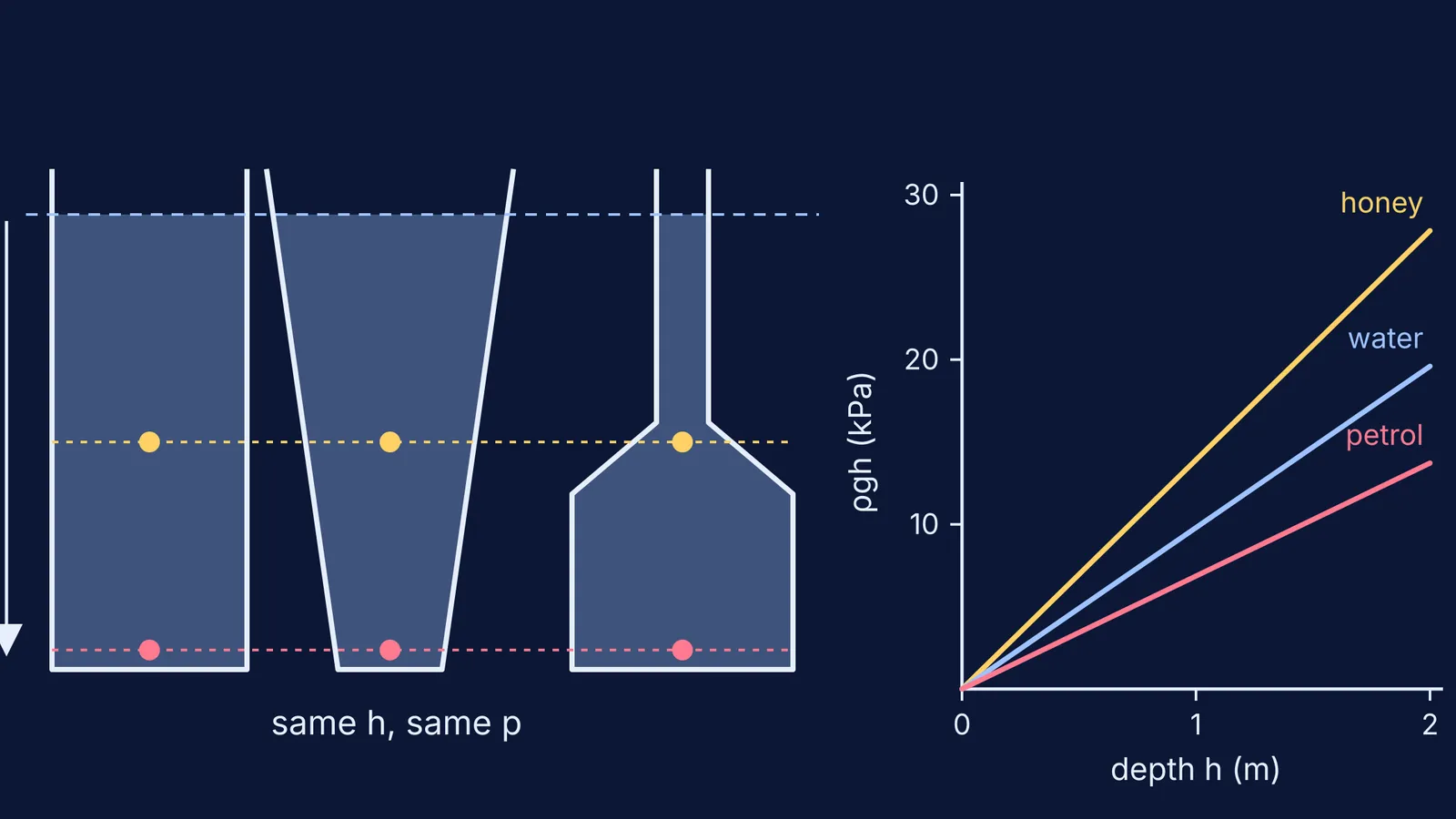
Gauge pressure grows in a straight line with depth: twice as deep, twice the gauge pressure.
A denser liquid gives more pressure at the same depth.
Stronger gravity gives more pressure at the same depth.
Atmospheric pressure at sea level is about 101 kPa, according to OpenStax College Physics, which also notes that just 10.3 m of water creates the same pressure as 120 km of air.
How do you test pressure at depth in a simulation?
The free PhET simulation Under Pressure, from the University of Colorado Boulder, gives you pools to fill, a pressure gauge you can drag anywhere, a ruler, and controls for fluid density, gravity and the atmosphere. When we opened the simulation file, its gravity control ran from Mars (3.71 m/s²) to Jupiter (24.9 m/s²). Its density control ran from gasoline (700 kg/m³) to honey (1420 kg/m³). It also has pools of different shapes, including a rectangular one and a trapezoid.
Switch the atmosphere off first, so the gauge reads ρgh alone. Then write each prediction down before you move a slider. Use water at 1000 kg/m³ (OpenStax table 14.2) and Earth's g of 9.8 m/s² (NASA Planetary Fact Sheet).
Water, Earth, 1 m deep: 1000 × 9.8 × 1 = 9,800 Pa, or 9.8 kPa.
Water, Earth, 2 m deep: 19.6 kPa. Double the depth, double the reading.
Honey (1420 kg/m³), Earth, 2 m: about 27.8 kPa, which is 1.42 times the water reading.
Petrol, which the simulation calls gasoline (700 kg/m³), Earth, 2 m: about 13.7 kPa.
Water at 2 m on Mars (3.71 m/s²): about 7.4 kPa. On Jupiter (24.9 m/s²): about 49.8 kPa.
Atmosphere back on, Earth gravity: every reading goes up by the same amount, roughly the 101 kPa of atmospheric pressure at sea level.
If the gauge disagrees by more than rounding, check that you measured h from the surface, used kPa not Pa, and had the atmosphere off for steps 1 to 5.
Why doesn't the shape of the container matter?
OpenStax says it plainly: the pressure in a fluid “depends only on the depth from the surface and not on the shape of the container” (University Physics, section 14.1). It feels wrong because a wide tank holds far more water than a thin pipe. Here is why it holds:
In a still liquid, points at the same depth must have the same pressure. If they didn't, the liquid would flow sideways from high to low pressure, and it isn't flowing.
In a vessel that widens upward, the sloping walls carry the weight of the extra water.
In a vessel that narrows upward, the walls push down on the liquid. So the base feels a full column of height h, even under the narrow part.
Either way, the extra force the liquid puts on the base is ρgh times the base area, whatever the walls are doing. The same idea explains the dam example in OpenStax College Physics: the pressure on a dam depends on the water's average depth there, not on how far the reservoir stretches behind it.
To see it, fill the trapezoid pool and put the gauge 1 m down near a slanted wall. Then move it to the middle at the same depth. Repeat in the rectangular pool. All three readings should match.
What should you do after the simulation?
Then follow up with this plan:
Sketch gauge pressure against depth for water and honey. Both lines start at zero, and each one's slope is ρg.
Solve a few written questions on pressure at depth and gauge pressure, changing one quantity at a time.
Link it to Pascal's law in hydraulic machines, where pressure passes through a liquid to lift a car.
To know when simulations help and when they don't, read what PhET research says simulations are good for.
If the slanted-wall argument still feels slippery, the Fermi Simulation Lab has interactive simulations for ideas that are easier to see than to read. Fermi's AI tutor can run the simulation and draw the figure with you, checking your understanding as it goes.
Start with one prediction: what gauge pressure does the water exert at the bottom of a bucket 1 m deep? Then go and measure it.


