

On this page
Drop an ice cube into a glass of water inside a lift and press the button. As the lift speeds up going up, the ice feels heavier, and so does the water. That second part is the one most students forget, and it is the whole answer to this classic JEE question.
Does buoyant force change in an accelerating lift?
Yes. Buoyant force is the upward force a fluid exerts on any object in it, and by Archimedes' principle it equals the weight of the fluid the object displaces (OpenStax University Physics, section 14.4). In a lift, 'weight' means weight measured in the lift's frame.
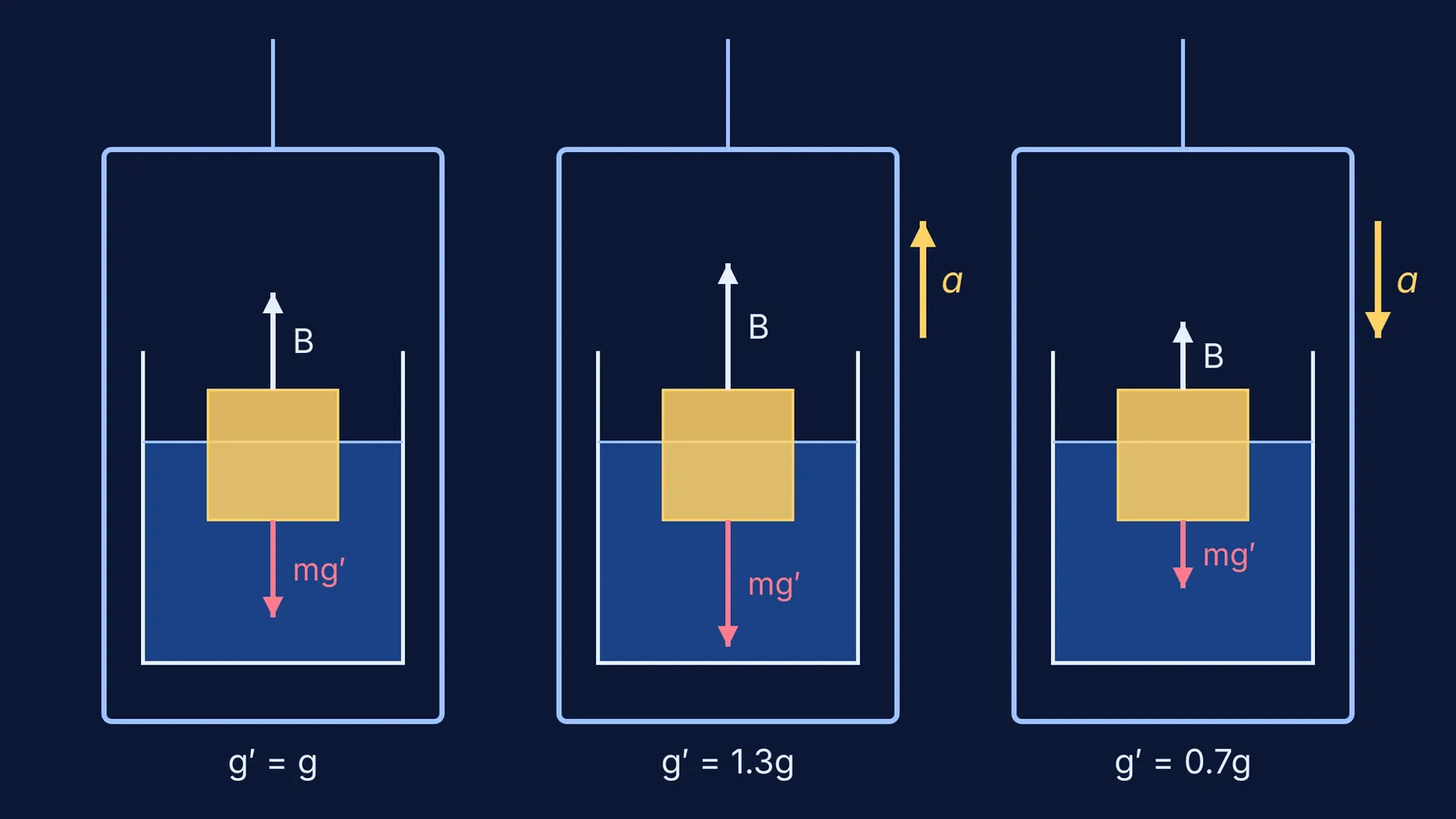
The cleanest way to handle this is effective g. In a lift accelerating upward at a, every object behaves as if gravity were g′ = g + a. Accelerating downward, g′ = g − a. In free fall, g′ = 0.
Physicist C. E. Mungan works this out for a cork floating in a beaker in a lift accelerating upward at 0.3g (Mungan, US Naval Academy, 2014). The pressure at depth h is no longer ρgh but ρ(g + a)h, because the water below has to push harder to accelerate the water above it. The extra push comes from the larger normal force the bottom of the beaker exerts on the water. So the buoyant force grows by exactly the same factor as the cork's own apparent weight.
Why does the fraction submerged stay the same?
Write the floating condition in the lift frame. The body has density σ and volume V, and the liquid has density ρ. A volume Vₛ is under the surface.
Buoyant force = apparent weight
ρ Vₛ g′ = σ V g′
Vₛ / V = σ / ρ
The g′ cancels. The fraction submerged is the density ratio, the same result OpenStax gives for a body at rest (OpenStax). Mungan makes the same point using the equivalence principle: no measurement inside the lift can tell a lift accelerating at 0.3g on Earth from a lift standing still on a planet where gravity is 1.3g. Since g drops out of the floating condition, the depth can't change either (Mungan).
So a wooden block of density 600 kg/m³ floats 60% submerged in water whether the lift is at rest, going up or going down. The buoyant force on it does change, though, because it always equals mg′.
Free fall is the edge case. With g′ = 0, both forces vanish. Mungan notes that ideal theory says the depth would still not change, but in real water surface tension and viscosity take over and the cork sinks (Mungan).
What does a spring balance read for an immersed body in a lift?
Here effective g does show up in the answer. Hang a body from a spring balance with the body fully under water. In the lift frame:
Reading T = σVg′ − ρVg′ = mg′(1 − ρ/σ)
Worked example (take g = 10 m/s²): a 2 kg metal block of density 4000 kg/m³ has volume 5 × 10⁻⁴ m³. It is fully immersed in water of density 1000 kg/m³.
Lift at rest, g′ = 10: weight term 20 N, buoyant force 5 N, so the balance reads 15 N.
Lift accelerating up at 2 m/s², g′ = 12: weight term 24 N, buoyant force 6 N, so the balance reads 18 N.
Lift accelerating down at 2 m/s², g′ = 8: weight term 16 N, buoyant force 4 N, so the balance reads 12 N.
Lift in free fall, g′ = 0: the balance reads 0 N.
Notice the pattern. The reading is always 75% of the apparent weight, because 1 − ρ/σ = 1 − 1000/4000 is fixed. Effective g scales the reading, while the density ratio sets the fraction lost. If a beaker with a floating body sits on a weighing machine, the machine reads the total mass times g′, the same way as in our post on weighing machine readings in a lift.
A three-step check for any lift-and-fluid problem
Find g′ first: g + a for upward acceleration, g − a for downward. A lift moving at constant speed has g′ = g.
Replace g with g′ everywhere: in the weight, in ρg′h, and in the buoyant force. Never in only one of them.
Ask what the question wants. A ratio (fraction submerged, density from a float) does not depend on g′. A force (buoyant force, tension, a balance reading) is proportional to g′.
The same substitution works for a simple pendulum in a lift or accelerating car. It sits on the broader idea in solving problems from an accelerating frame with pseudo forces.
If the pressure-with-depth step still feels shaky, the Fermi Concept Library gives every concept in physics its own lesson and its place in the map. To practise numericals like these, try the Fermi Problem Library, whose step-by-step solver explains the reasoning rather than printing an answer.


