On this page
In electromagnetic induction, many Class 12 students collect formulas: Blv for a rod, NBAω sin ωt for a coil. A chatbot picks one and hands you a number, and the next problem looks brand new again.
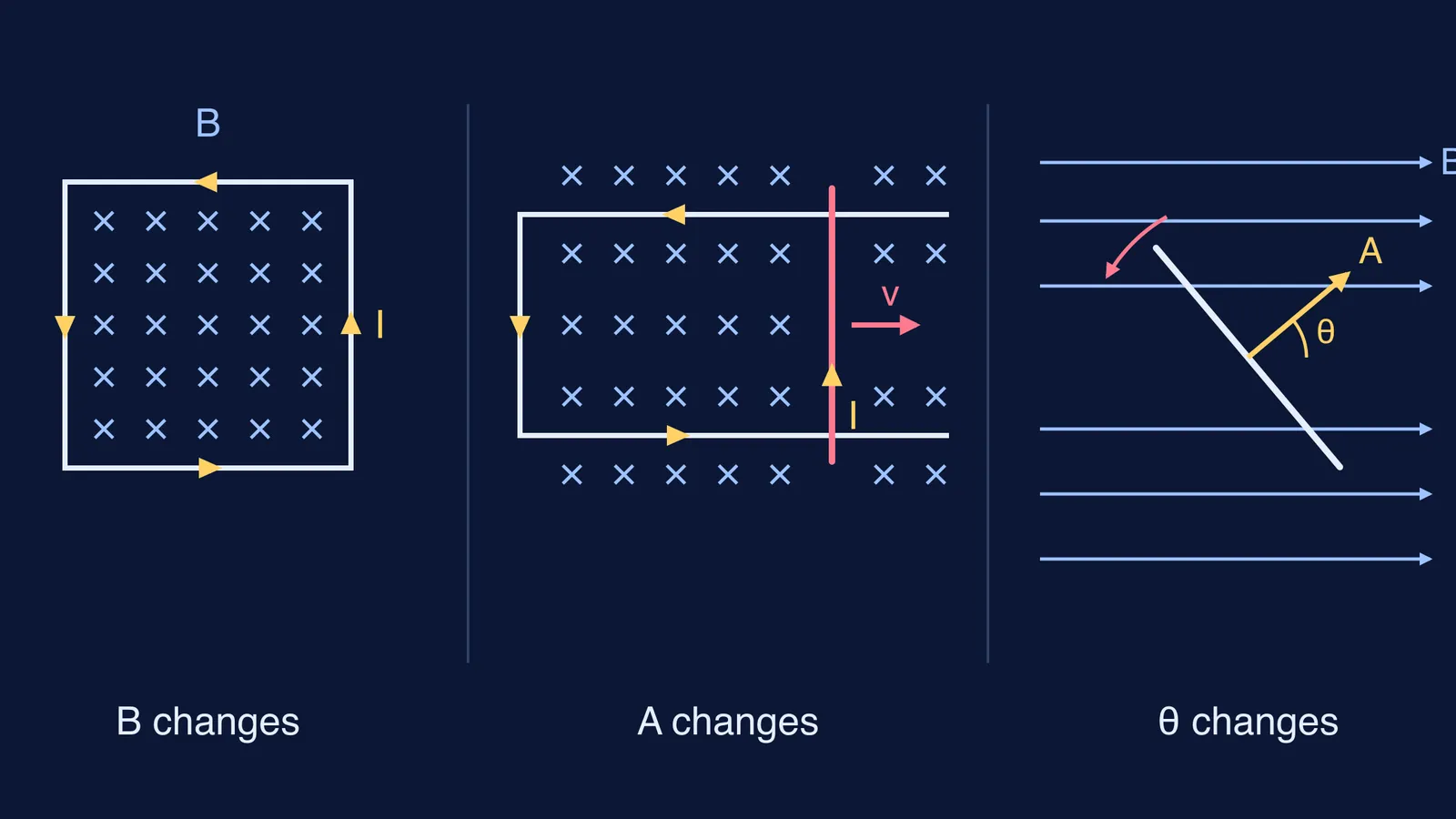
The fix is to start every problem with the same question. Magnetic flux through a flat area A in a uniform field B is Φ = BA cos θ, where θ is the angle between B and the area vector (NCERT Class 12 Physics, Chapter 6). The chapter notes that flux can be changed through any one or more of B, A and θ, and an emf is induced in each case. That is a three-way sort for almost every problem.
What changes the flux: field, area or angle?
Field (B) changes: a magnet approaches a coil, a nearby current switches on, or B is given as a function of time.
Area (A) changes: a rod slides on rails, or a loop enters or leaves a field region.
Angle (θ) changes: a coil rotates, as in an AC generator.
The direction then follows from Lenz's law: "The polarity of induced emf is such that it tends to produce a current which opposes the change in magnetic flux that produced it" (NCERT, Chapter 6). If flux into the page is increasing, the induced current makes a field out of the page, so it flows anticlockwise as you look at the page. If that flux is decreasing, the current is clockwise. Unsure what flux measures? See the difference between magnetic field and magnetic flux.
Why should you predict the direction before calculating?
A prediction makes you commit. In a study of physics classroom demonstrations, students who only watched a demonstration understood the idea no better than students who never saw it, while students who predicted the outcome first showed significantly greater understanding (Crouch, Fagen, Callan and Mazur, American Journal of Physics, 2004).
Answer-giving AI can backfire. In a field experiment with nearly a thousand high school maths students, a plain GPT-4 chat raised practice grades by 48%, but once access was removed, those students scored 17% lower than students who never had it (Bastani et al., PNAS, 2025). A tutor version with learning safeguards largely avoided that drop.
How should you prompt an AI tutor for EMI problems?
Paste the problem, then use these lines in order:
"Don't solve yet. Which of B, A or θ is changing, and how do you know?"
"Is the flux increasing or decreasing, and which way does it point?"
"I predict the current is ___. If I'm wrong, ask me a question instead of correcting me."
"Now write Φ as a function of time and find the emf."
"Does the sign match my Lenz's law prediction?"
Fermi's AI tutor teaches rather than just answering: it holds a line of reasoning across a session, notices where you are stuck, and decides whether to explain, ask or show, which suits a predict-first routine like this one.
Worked example: three problems, one routine
Problem 1 (B changes). A loop of area 0.02 m² lies flat on the page. A uniform field into the page rises steadily from 0.1 T to 0.5 T in 0.2 s.
What changes: only B.
Prediction: flux into the page increases, so the current is anticlockwise.
Calculation: emf = (0.4 × 0.02) ÷ 0.2 = 0.04 V.
Problem 2 (A changes). A 0.2 m rod slides right at 2 m/s on rails closed at the left end, in a 0.5 T field into the page.
What changes: the area, growing 0.2 × 2 = 0.4 m² per second.
Prediction: anticlockwise again, so up through the rod.
Calculation: emf = 0.5 × 0.4 = 0.2 V. More shapes in our walk-through of the expanding loop problem.
Problem 3 (θ changes). NCERT's Example 6.3: a 500-turn coil of radius 10 cm, facing the earth's horizontal field of 3.0 × 10⁻⁵ T, turns through 180° in 0.25 s (NCERT, Chapter 6).
What changes: θ, from 0° to 180°.
Prediction: flux goes from +BA to −BA, so the change is 2BA, not zero. That is the trap.
Calculation: NCERT gets an average emf of about 3.8 × 10⁻³ V.
If a turning coil is hard to picture, the Fermi Simulation Lab has interactive simulations for ideas easier to see than read.
How do you check the AI's answer on current direction?
AI tutors get directions wrong too, so check:
Did it name what changes, and whether the flux rises or falls, before writing a formula?
Does the induced field oppose the change, not the field? Falling flux gives an induced field along the original field.
For a moving rod, does the force on the charges agree with Lenz's law?
Is the loop wholly inside a uniform field? Then the flux is steady and there is no current, as NCERT's Example 6.4 notes.
To see why the minus sign must be there, read why Lenz's law follows from conservation of energy, then try the five prompts on your next three EMI problems.