

On this page
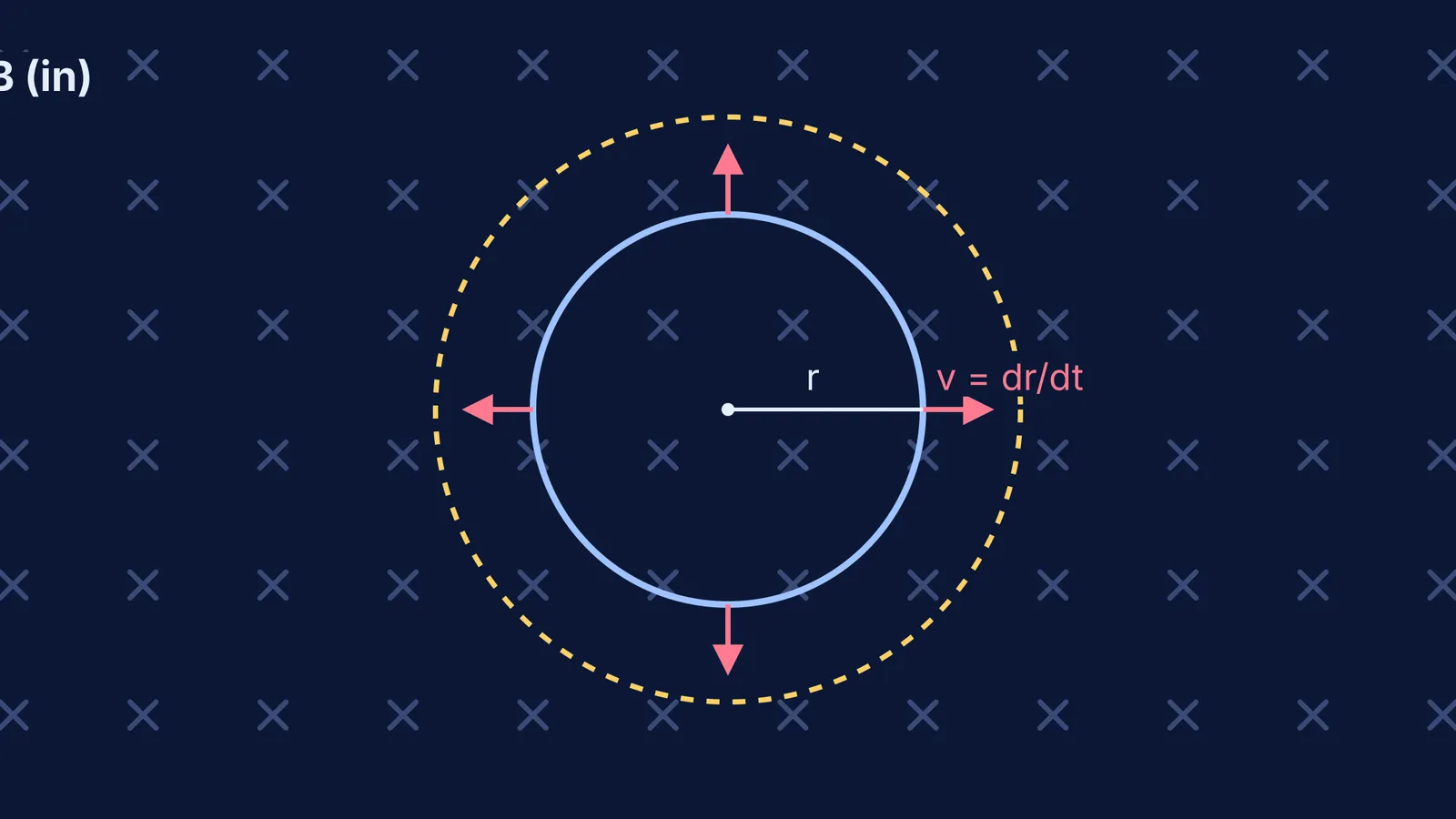
Most students learn Faraday’s law of induction through the classic "moving magnet" experiment. In that scenario, you push a bar magnet toward a coil of wire, the magnetic field gets stronger, and a current flows. But what if the magnetic field is perfectly steady, and the loop itself changes shape?
A common problem in board exams and competitive tests like the JEE is finding the induced EMF in a circular wire whose radius is increasing at a constant rate. While it looks like a straightforward application of a single formula, the physical insight required often catches students off guard.
Why does a changing area induce an EMF?
According to Faraday's law, an EMF is induced whenever the magnetic flux (Φ) passing through a circuit changes. Flux is the product of the magnetic field (B) and the area (A) perpendicular to it.
If the magnetic field is constant, the only way to change the flux is to change the area. The rate of change of flux is exactly the rate of change of the area multiplied by the field: ε = B × dA/dt
Even in weak fields, this principle holds. For instance, the Earth's natural magnetic field at the surface ranges from 30 to 60 microteslas. If you were to rapidly expand a giant loop of wire outdoors, you would induce a small EMF purely from sweeping through the Earth's steady field.
How to calculate EMF for a growing circle?
If a circular loop's radius (r) grows at a steady rate, we call this rate dr/dt. This is a velocity (measured in m/s).
Because the area of a circle is A = πr², we use the chain rule to find how fast the area is growing: dA/dt = 2πr × (dr/dt)
Substituting this into Faraday's law gives the induced EMF: ε = B × 2πr × (dr/dt)
If you want to read about the reverse case where the field changes instead of the area, see Faraday's law for a changing B: the circulating E inside a solenoid.
Why does the EMF keep increasing?
Notice that r is in the formula. If the radius is growing at a constant speed, the rate dr/dt is constant, and the field B is constant. But the EMF is *not* constant.
As the circle gets wider, its perimeter (2πr) gets longer. In every passing second, a much longer segment of wire is sweeping outward through the magnetic field compared to when the circle was small. Because the swept area per second is larger, the induced voltage keeps increasing.
For more on how magnetic forces act on moving charges, check out the Helical path of a charge in a magnetic field: radius and pitch.
What happens if the loop is shrinking?
The same physics applies if the loop is shrinking instead of growing, but the direction of the induced current changes.
If the radius is shrinking, the rate of change dr/dt is negative. This means the area is decreasing, and the magnetic flux through the loop is dropping. According to Lenz's law, the induced EMF will try to oppose this change. The induced current will flow in a direction that creates its own magnetic field pointing in the *same* direction as the external field, attempting to replace the lost flux.
Conversely, in an expanding loop, the flux is increasing. The induced current will flow to create a magnetic field that points in the *opposite* direction to the external field, fighting the increase. Understanding this directional flip is crucial for mastering multiple-choice questions on induction.
A worked example
Imagine a circular metal loop expanding in a steady 0.5 T magnetic field pointing into the page. Its radius is increasing uniformly at 2 mm/s (which is 0.002 m/s). What is the induced EMF at the exact moment the radius reaches 10 cm (0.1 m)?
Identify the given values from the problem statement: B = 0.5 T, dr/dt = 0.002 m/s, and instantaneous radius r = 0.1 m.
Apply the derived induction formula: ε = B × 2πr × (dr/dt).
Plug in the numbers carefully: ε = 0.5 × 2 × π × 0.1 × 0.002.
Calculate the final voltage: ε = 0.0002π V, or approximately 0.63 millivolts.
Because the magnetic flux is increasing (more field lines are being enclosed as the area grows), the induced current will flow in a direction that creates an opposing magnetic field pointing out of the page.
If you struggle to picture why the flux changes when the field does not, the Fermi Concept Library can help you trace the idea back to the Lorentz force. If you are stuck on applying the chain rule to induction problems, the Fermi Problem Library provides worked problems with a step-by-step solver that explains the reasoning rather than printing an answer.


