On this page
Hold a slinky by its top coil and let it hang. Before you read on, answer one question: the instant you let go, what does the bottom coil do? Write your answer down; a prediction you can check teaches you more than an answer you only read.
What happens to the bottom of a slinky when you drop it?
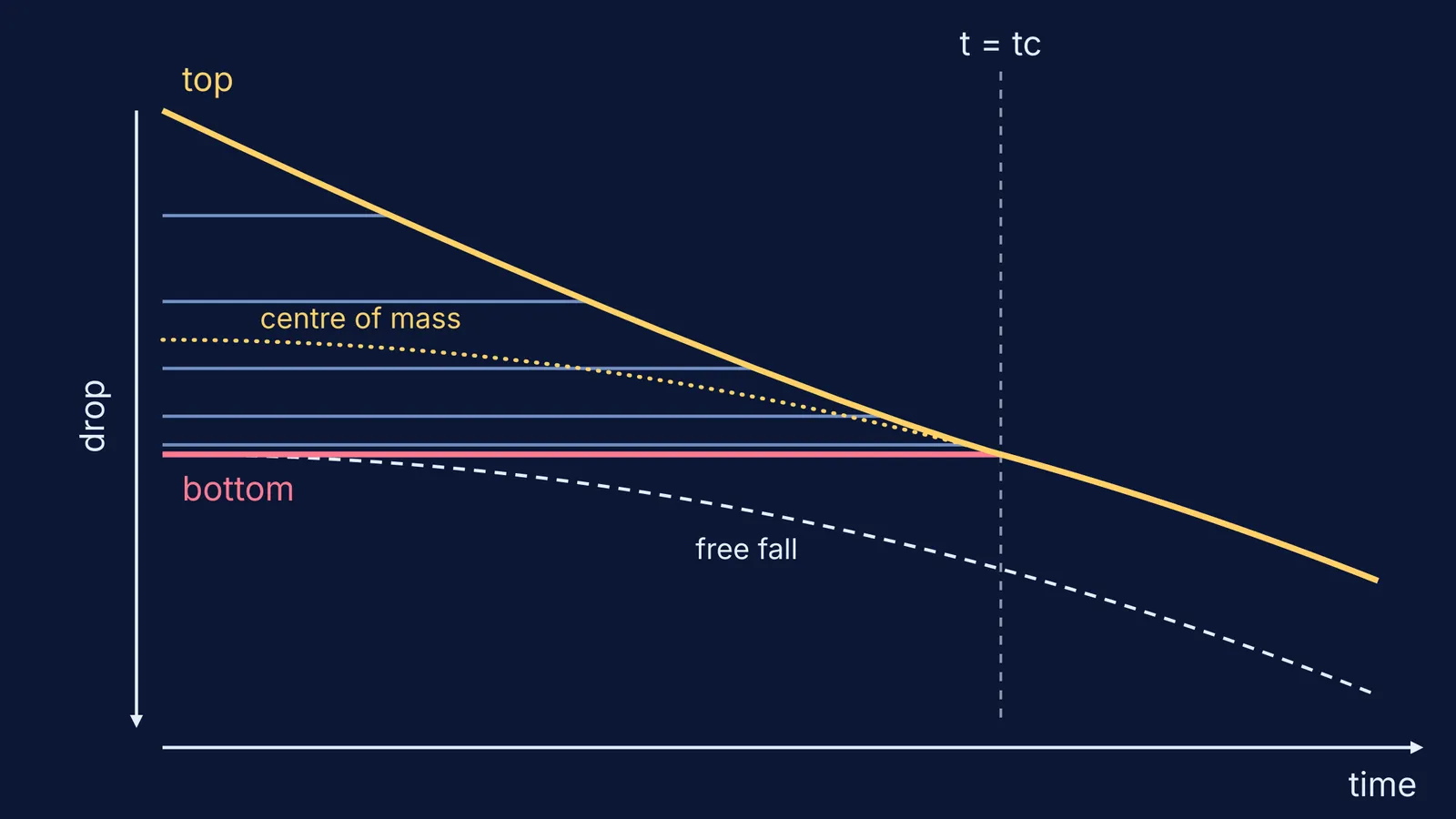
It stays where it is. The top races downward, the coils snap together one by one from the top, and the bottom hangs in mid-air until the collapsed bunch crashes into it. Only then does the whole slinky fall together.
In Modeling a falling slinky (American Journal of Physics, 2012), R. C. Cross and M. S. Wheatland write that the bottom "does not begin to fall until the top section of the slinky, which collapses turn by turn from the top, collides with the bottom." They filmed real drops with a high-speed camera at 300 frames per second (free arXiv version).
Why does the bottom of a dropped slinky stay still?
Before release, gravity pulls the bottom coil down. The stretched coil above it pulls it up with an equal tension. The net force is zero, so it hangs at rest.
Letting go changes the force at the top, not at the bottom. The bottom coil only feels the coil just above it, and that coil only feels its neighbours. Tension near the bottom changes only when the spacing of the nearby coils changes, and that news has to travel down the spring. Cross and Wheatland put it this way: "a finite time is required for a wave front to propagate down the slinky communicating the release of the top" (arXiv version). Until that front arrives, gravity and tension on the bottom still balance, so it does not move.
W. G. Unruh reaches the same picture in The falling slinky: the bottom stays at rest until a wave arrives from above, and because the coils collide, that wave becomes a shock travelling downward.
How long does the bottom of a slinky wait?
For a slinky that is stretched along its whole length as it hangs, the instant-collapse model in the Cross and Wheatland paper gives the collapse time as t = √(m / 3k), where m is the slinky's mass and k its spring constant.
Take their plastic slinky B, which hangs with no coils bunched at the bottom. It has a mass of 48.7 g and a best-fit spring constant of 0.22 N/m (arXiv version).
Convert the mass: m = 0.0487 kg.
Multiply: 3k = 3 × 0.22 = 0.66 N/m.
Divide: 0.0487 ÷ 0.66 ≈ 0.074 s².
Take the square root: t ≈ 0.27 s.
That matches the paper's 0.27 s for slinky B, and its summary that collapse typically takes about 0.3 s. Notice what is missing from this formula: g. In this model, a heavier or floppier slinky waits longer, but gravity does not set the waiting time.
In 0.27 s a freely falling object drops ½ × 9.8 × 0.27² ≈ 0.36 m. In that time the bottom coil does not drop at all. At the paper's 300 frames per second, 0.27 s is about 81 frames of a coil sitting still in mid-air.
How do you film a slinky drop and track the tension wave?
You need a slinky, a phone with a slow-motion mode, a plain wall and a friend.
Predict. Write what the top, the middle and the bottom will do in the first instant.
Mark. Stick a strip of tape on the bottom coil and another on a coil halfway down.
Film. Hold the slinky against the wall, start slow motion, and let go cleanly without pushing.
Step frame by frame. Note the frames where the top, the middle tape and the bottom tape first move.
Track the front. The boundary between bunched and stretched coils is the wave. Coils above it are moving; coils below it have not heard yet.
Explain. Compare with your prediction and write one sentence on what you got wrong.
The middle tape should move before the bottom tape, and nothing below the front should move. If your bottom drifts early, check whether your hand jerked as you let go.
What should you connect this to?
The hanging stretch comes from Hooke's law, which you can test in our post on the Hooke's law spring extension simulation. The centre-of-mass rule is the same one behind the exploding projectile simulation. And the travelling front is a compression wave in a spring, close cousin of the one in how to visualise a longitudinal sound wave.
If waves are hard to picture before you film your own drop, the Fermi Simulation Lab has interactive simulations for ideas that are easier to see than to read. If the forces still feel slippery, the Fermi Concept Library gives each physics concept its own lesson.
Make your prediction, drop the slinky, and count the frames before the bottom moves.