On this page
Picture two double pendulums (one pendulum hanging from the bottom of another) side by side. You lift both to the same angles and let go together, except that one upper arm starts a thousandth of a millimetre further out.
Before you read on, make your call. Do the two swing together for a minute? Ten seconds? One second? Write a number down, so you have something to check against.
What happens when two double pendulums start a hair apart?
For a moment they look like one pendulum. Then the lower arms begin to disagree, one flips over the top while the other falls back, and from then on the two paths share nothing. Your guess was probably too long.
A double pendulum is chaotic: its motion follows Newton's laws exactly, with nothing random in it, yet a tiny difference in where it starts grows until the two motions are unrelated. Physicists call this sensitive dependence on initial conditions.
In 1992 Troy Shinbrot, Celso Grebogi, Jack Wisdom and James Yorke built a double pendulum to measure this. They found that small uncertainties grew exponentially, with an exponent of λ = 7.5 ± 1.5 per second, and a computer model of an idealised pendulum gave 7.9 ± 0.4 per second (Shinbrot et al., American Journal of Physics).
Why does a tiny change give a different path?
With an ordinary pendulum, a small change in the start gives a small change in the swing, and it stays small. A double pendulum is different because each arm keeps pushing and pulling the other. When the lower arm is near the top, a tiny nudge decides whether it goes over or comes back, and that choice changes everything after it. These forks keep coming, and each one widens the gap.
Exponential growth means the gap multiplies by the same factor in every equal slice of time, instead of adding the same amount.
Edward Lorenz found the same behaviour in 1963 in a simple model of convection: slightly differing starting states could evolve into considerably different states, and he examined what this meant for very-long-range weather prediction (Lorenz, Journal of the Atmospheric Sciences). For an earlier chapter of the story, read about Mary Cartwright and the mathematics of chaos.
How fast do the paths split?
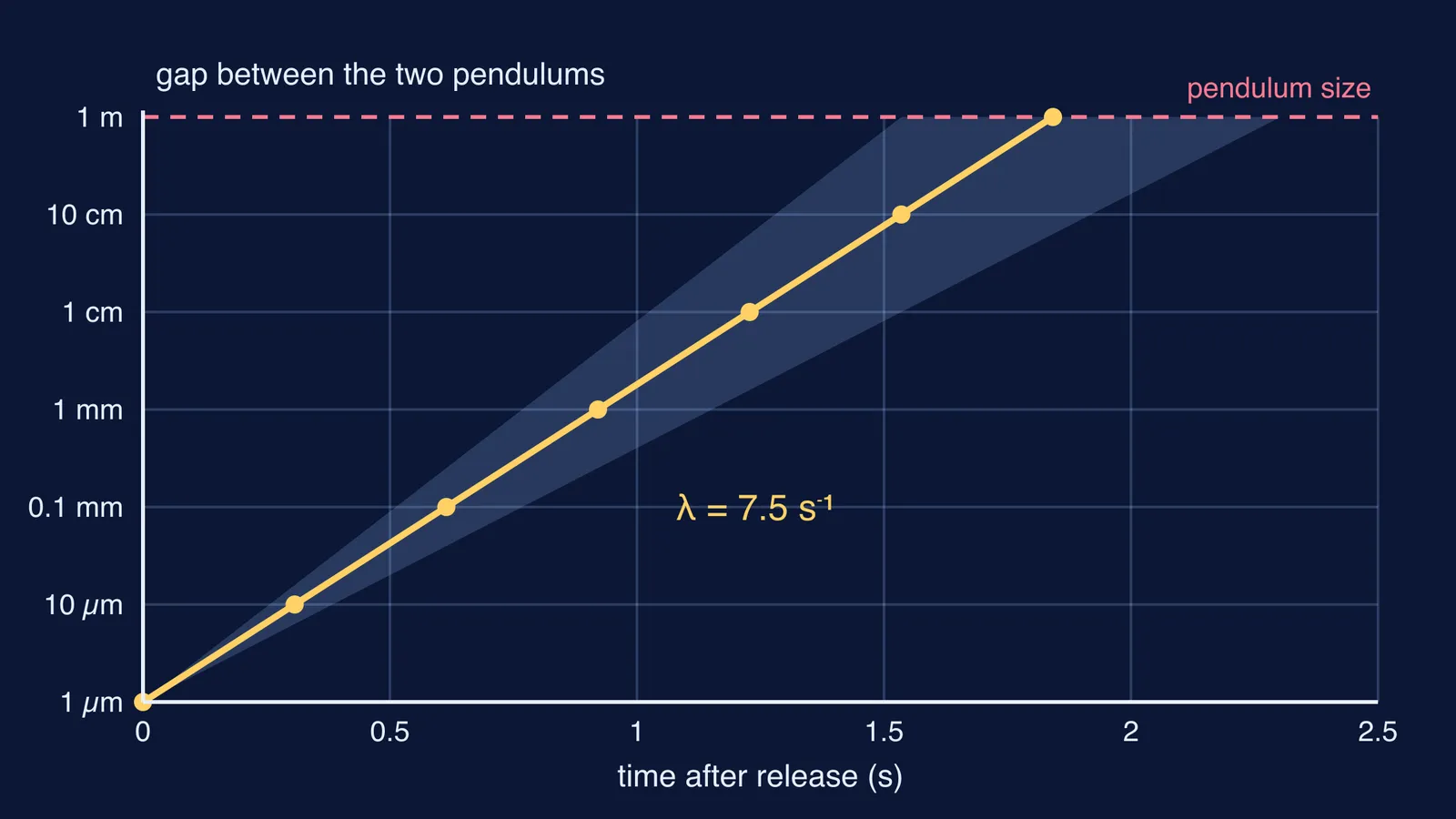
Here is a worked example using the growth rate Shinbrot's team measured, λ = 7.5 per second (Shinbrot et al.). The arithmetic is ours.
The gap grows by a factor of e (about 2.7) every 1/7.5 ≈ 0.13 seconds.
It doubles every ln 2 / 7.5 ≈ 0.09 seconds.
It grows tenfold every ln 10 / 7.5 ≈ 0.31 seconds.
Start 0.001 mm apart. To reach 1 m, which we take as the size of the pendulum, the gap must grow a million times: six tenfolds, so 6 × 0.31 ≈ 1.8 seconds.
Now make your start a thousand times more precise, 0.000001 mm. That adds three tenfolds, only about 0.9 seconds more.
Two honest limits. The gap stops growing once it reaches the size of the pendulum, because it cannot get bigger than the machine. And the measured rate is for typical starting conditions in Shinbrot's experiment. Release both pendulums from a few degrees and they behave like the gentle coupled pendulums that trade energy back and forth, staying together far longer.
How can you test this yourself?
Use any double-pendulum simulation that lets you type in the starting angles. Predict before every run.
Run A: both arms at 120 degrees. Run B: upper arm at 120.001 degrees, lower arm at 120. Predict the time when you can see them split, and write it down.
Run both and time the split. Compare with your guess.
Repeat with both arms at 10 degrees. Predict first: sooner, later, or never?
Make the starting difference ten times smaller. Predict how much extra time you gain.
Write one sentence explaining why step 4 gained so little.
Our post on what physics simulations can and cannot tell you goes further.
What should you take from this?
Chaos is not the same as randomness. The double pendulum obeys the same F = ma you use in every mechanics problem; it is the growth of small differences that limits prediction. The habit worth keeping is the one you just used: predict, run, compare, explain.
If you want to practise that habit on other ideas that are easier to see than read, the Fermi Simulation Lab has interactive simulations you can change as they run. And if a result surprises you, Fermi's AI tutor can run the simulation alongside you and decide whether to explain, ask or show.
Start with your written guess, then press play.