

On this page
When British engineers were developing high-power radar just before World War II, they ran into a problem. If they pushed their radio amplifiers too hard, the output signals became erratic. Engineers assumed the thermionic valves (vacuum tubes) were defective or picking up random noise.
In January 1938, the Radio Research Board sent a memorandum to the London Mathematical Society asking for help. A mathematician named Mary Cartwright saw the memo and became interested. She teamed up with J.E. Littlewood to investigate the differential equations modelling the circuits. What they found shifted the direction of modern dynamical systems theory.
Why did radar amplifiers behave erratically?
The circuits were governed by a non-linear differential equation known as the forced van der Pol equation. Most introductory physics courses focus on linear systems, like an ideal simple pendulum, where doubling the input simply doubles the output, and the response is always a neat periodic wave.
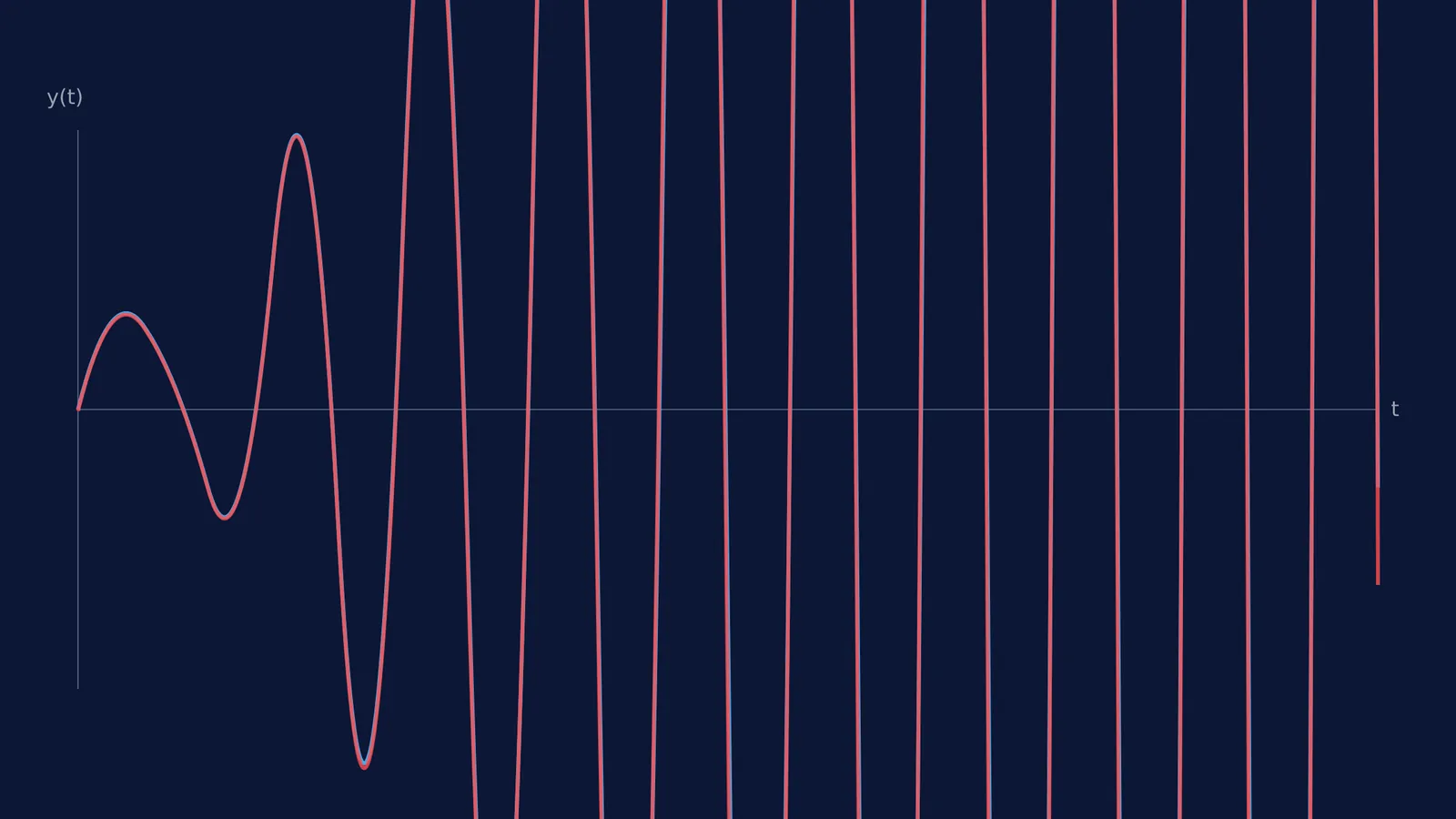
But the amplifiers were highly non-linear and subjected to strong external forcing. When Cartwright and Littlewood analysed the equations, they realised the "noise" wasn't a defect at all. It was an inherent property of the mathematics. The system was producing subharmonic oscillations—frequencies that were strange fractions of the input—and wandering unpredictably.
How did Cartwright and Littlewood discover chaos?
Because they lacked computers, the two mathematicians had to rely on rigorous analytical methods and hand-drawn approximations. Littlewood later recalled that they suddenly found a "dramatic fine structure of solutions."
They had stumbled upon what we now call sensitive dependence on initial conditions. Two radio signals could start with almost exactly the same properties, but the tiny initial difference would cause their paths to diverge completely. This deterministic chaos meant that long-term prediction of the exact wave was impossible, even though the underlying equation had no random variables in it.
When you face a differential equation that seems to make no sense, it helps to walk through the logic without skipping steps. Fermi's AI tutor can work out what you already know and build a plan for the session, teaching through the problem rather than just giving the final answer.
What is the forced van der Pol equation?
The equation they studied models an oscillator with non-linear damping. In plain text, it looks like this:
y″ − k(1 − y²)y′ + y = b λ k cos(λt + a)
The left side represents the amplifier circuit itself, with a damping term `k(1 − y²)` that pumps energy in when the signal is small, and bleeds energy out when the signal is large. The right side is the periodic radio signal forcing the system.
When `k` is very large, the mathematics becomes extraordinarily difficult. In their 1945 paper, Cartwright and Littlewood proved that this equation produces aperiodic, chaotic behaviour. Their work paved the way for the modern topological study of dynamical systems. If you are trying to understand how such equations dictate physical behaviour, you can explore worked examples in the Fermi Problem Library, which includes a step-by-step solver that explains the reasoning rather than just printing an answer.
How do you approach a problem that makes no sense?
When a physics or maths problem produces a bizarre answer, it is tempting to assume the question is wrong. Here is a checklist for pushing through the confusion:
Check the linearity: Is the system linear (like Hooke's Law) or non-linear (like air resistance proportional to v²)? Non-linear systems naturally produce complex answers.
Re-run the first step: Did you make a sign error in setting up the initial equation? A small mistake in initial conditions drastically changes the outcome.
Trace the energy: Where is energy entering and leaving the system? In the van der Pol equation, the damping term acts as both a source and a sink depending on the amplitude.
Graph it: Sketch the function or plot a few points. If the curve looks chaotic or jumps unexpectedly, you might be looking at a feature, not a bug.
When did Mary Cartwright join the Royal Society?
For her work untangling the mathematics in radio waves, Mary Cartwright achieved a historic milestone. In 1947, she became the first woman mathematician to be elected a Fellow of the Royal Society.
She went on to serve as Mistress of Girton College, Cambridge, and her collaboration with Littlewood remains one of the finest examples of pure mathematics solving a messy, real-world engineering problem.
The next time a problem looks like pure noise, remember Cartwright and Littlewood: there might be a beautiful mathematical structure hidden just beneath the surface. You can see how other differential equations model real-world behaviour by studying Population growth and cooling: exponential models via dy/dt = ky or exploring how equations shape spacetime with Amal Raychaudhuri and the equation of focusing gravity.


