On this page
If your NCERT textbook glows yellow by February, you are in good company. Highlighting feels like work: the pen moves, the page changes colour, and the chapter looks done. The research tells a less comfortable story, and the fix is small enough to start tonight.
Does highlighting a textbook actually help you learn?
The best-known review of study methods is a 2013 monograph by John Dunlosky and colleagues, which rated ten techniques on how widely they help (Psychological Science in the Public Interest). Highlighting was rated low utility, alongside rereading and summarisation, while practice testing and distributed practice were rated high. We walk through all ten in our guide to the Dunlosky review of study techniques.
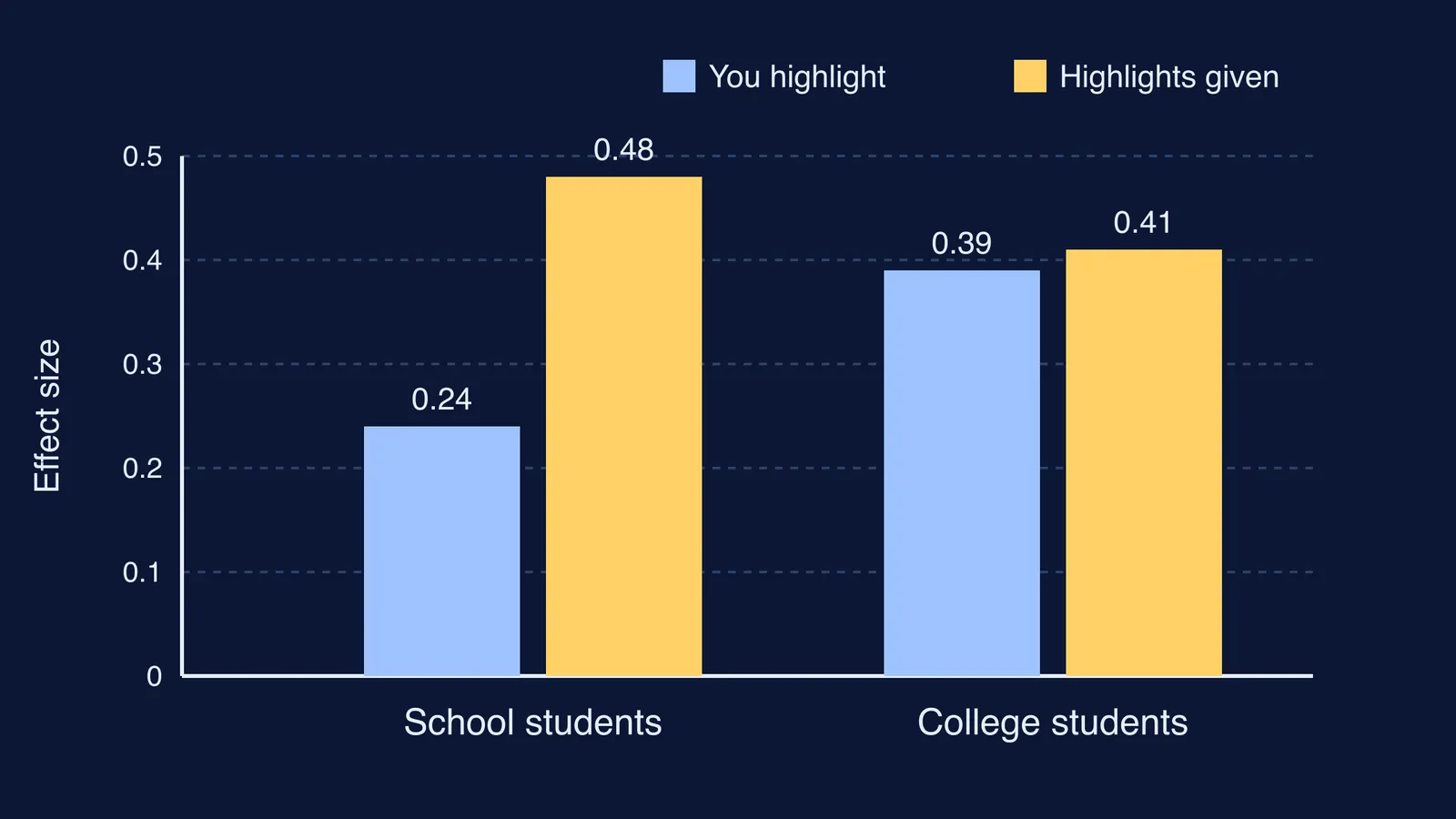
A 2022 meta-analysis by Héctor Ponce, Richard Mayer and Ester Méndez pooled 36 published articles from 1938 to 2019, giving 85 effect sizes (Educational Psychology Review). Its findings, in plain terms:
Highlighting text yourself improved memory (average effect size 0.36) but not comprehension (0.20).
Highlighting text yourself helped college students (0.39) but not school students (0.24).
Reading text that someone else had already highlighted improved both memory and comprehension (0.44 each), for school students (0.48) and college students (0.41).
An effect size compares students who highlighted, or read highlighted text, with students who read the same text without highlights; the bigger the number, the bigger the gap.
Why does highlighting feel like it works?
In a 2006 experiment, Henry Roediger and Jeffrey Karpicke had students either reread prose passages or take recall tests on them (Psychological Science). On a final test 5 minutes later, rereading won. On tests 2 days and 1 week later, the students who had tested themselves remembered substantially more, even though rereading had made students more confident.
That is the trap. Looking at a highlighted line again feels familiar, and familiarity feels like knowing. A 2009 survey of 177 college students found that most reread their notes or textbook, and relatively few tested themselves while studying (Memory). Our post on rereading vs practice testing over one week sets the two side by side.
What should you do instead of highlighting?
Keep the highlighter, but change what a highlight is for. A 2017 meta-analysis by Olusola Adesope and colleagues found that practice tests were more beneficial for learning than restudying and every other comparison condition it examined (Review of Educational Research). So treat each highlight as a note to yourself: ask me about this tomorrow.
The highlight-to-question swap:
Read the section once with the pen down, so you see the whole argument first.
On the second pass, highlight no more than one line per paragraph.
Next to each highlight, write a question whose answer is that line. Ask why or what happens if, not fill-in-the-blank.
The next day, cover the page and answer each question aloud or on rough paper before you look.
Tick what you got right. Circle what you missed, and ask those again in a few days.
Step 4 is where the learning happens. The gap is deliberate: in Roediger and Karpicke's study, the advantage of testing showed up on the delayed tests, not the immediate one. Some forgetting overnight makes the answer take effort, and Ebbinghaus's forgetting curve explains how quickly that forgetting starts.
Here is how it looks with two Class 11 chapters:
Physics. Highlight: action and reaction forces act on different bodies. Question: a book rests on a table; what is the reaction to the book's weight, and which body does it act on? Answer: the book's pull on the Earth, acting on the Earth, not the table's push on the book.
Chemistry. Highlight: atomic radius decreases across a period. Question: why is a chlorine atom smaller than a sodium atom when it has more electrons? Answer: nuclear charge rises across the period while the new electrons go into the same shell, so they are pulled in more tightly.
If you cannot answer your own question the next day, that is useful, not a failure: you found a gap before the exam did. For a concept that still will not stick, the Fermi Concept Library covers every concept in physics, chemistry, biology, mathematics and computing, each with its own lesson.
How can parents help without checking every page?
A heavily highlighted book tells you your child sat with it, not what they remember. Try this short script after dinner:
"Pick three highlights from yesterday. Read me the questions you wrote."
"Answer them without looking. I'll hold the book."
"Which one was hardest? That one goes on tomorrow's list."
You do not need to know the subject. If your child does not know where to begin with a chapter, Fermi's AI tutor works out what a student already knows, builds a plan for the session and checks understanding as it goes.
Start with tonight's chapter: five highlights, five questions, answered tomorrow before you open the book.