On this page
You asked an AI to explain something and got twelve paragraphs back. It made sense then; by morning, most of it is gone. The fix is one page of Cornell notes that turns the explanation into questions you can answer without looking.
What are Cornell notes, and why use them for AI explanations?
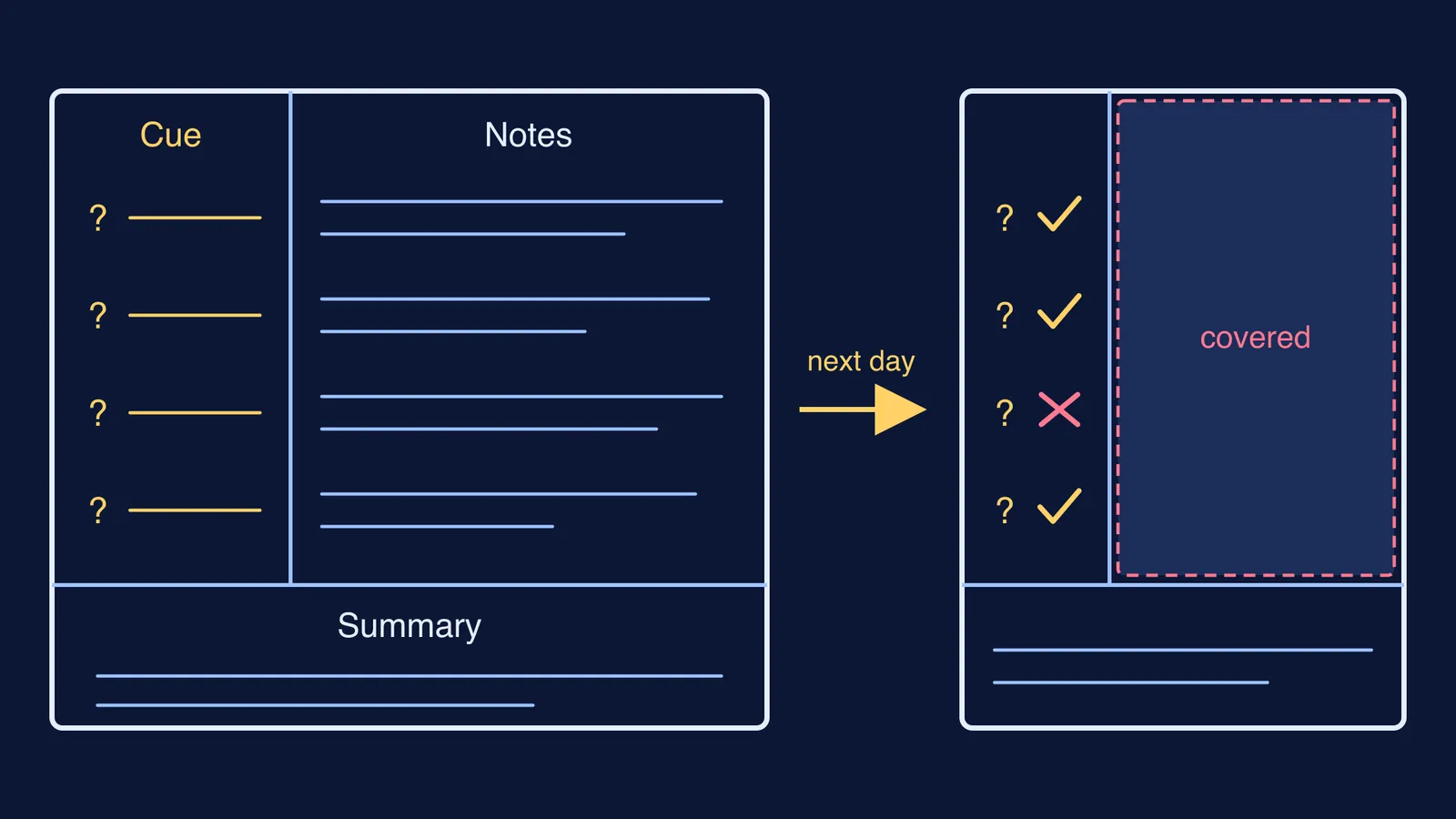
Cornell notes are a page layout with a narrow cue column on the left, a wide notes column on the right and a summary strip at the bottom. The system was originally developed by Cornell education professor Walter Pauk, who described it in his book How to Study in College, according to Cornell University's Learning Strategies Center.
AI answers, like fast lectures, feel clear in the moment, so you skip checking whether you could explain the idea yourself. The cue column forces that check.
The research mainly backs the testing part. In a 2006 study in Psychological Science, Roediger and Karpicke had students either restudy prose passages or take free-recall tests on them. Restudying did better on a test 5 minutes later, but testing produced substantially greater retention after 2 days and after 1 week, even though restudying made students more confident.
A review by Dunlosky and colleagues (2013) rated 10 learning techniques and gave practice testing and distributed practice a high utility rating, while summarization, highlighting and rereading were rated low utility. That suggests the summary strip mainly helps you organise, while the cue questions and the next-day recall do most of the work.
How do you turn an AI explanation into Cornell notes?
Rule a page first: a cue column about a third of the width, a notes column for the rest, and five or six lines at the bottom for the summary. Then:
Read the whole AI answer once without writing.
In the notes column, write each main idea in your own words, one or two lines each. Never copy full sentences.
Check anything you are unsure of against NCERT or your textbook. AI answers can be wrong.
In the cue column, next to each idea, write a question whose answer is that idea. Prefer why and how questions.
Close the chat, cover your notes, and write a two-to-four-sentence summary in the bottom strip from memory.
Next day, cover the notes column and answer each cue question out loud or on rough paper.
For the paper version used in a live lecture, see the Cornell note-taking method with a physics class example.
What does it look like for a real physics answer?
Say you asked why escape velocity does not depend on the mass of the object you launch, and got a long derivation. One page might look like this.
Notes column, in your own words:
Escape means reaching infinity with zero or more speed, so total energy must be zero or more.
Kinetic energy is half m v squared; gravitational potential energy is minus G M m over R. Both contain m.
Set the sum to zero and m cancels, giving v equals the square root of 2 G M over R.
So escape speed depends only on the planet's mass M and radius R.
Energy is a scalar, so in the ideal case (no air, no rotation) launch direction does not matter.
Cue column, one question per idea:
What energy condition means an object escapes?
Why does the launched mass cancel out?
What two quantities does escape speed depend on?
Why does launch direction not matter in the ideal case?
Summary strip: "To escape, total energy has to reach zero. Kinetic and potential energy are both proportional to the object's mass, so mass cancels and escape speed depends only on the planet's mass and radius."
The AI's introduction and restatements are gone: a long answer became five lines.
How should you do the next-day recall?
Cover the notes column. Read each cue and answer it fully before you uncover the notes, then mark it with a tick or a cross.
For every cross, check the idea, then rewrite it from memory.
Ask the AI only about crosses, narrowly: "Show me just the step where mass cancels."
Recall the page again a few days later; the Dunlosky review also rated spacing out practice as high utility.
A cross that keeps returning usually means a gap in an underlying idea. The Fermi Concept Library gives each concept its own lesson and its place in the map, so you can see what the shaky idea rests on.
You can also turn your notes into active recall cards with AI, or try our one-week rereading vs practice testing experiment.
A long explanation is easier to learn from when it holds a line of reasoning and checks understanding as it goes, which is how Fermi's AI tutor teaches. Whatever tool you use, rule tonight's page and cover the notes tomorrow.