On this page
Put two identical coins on a table. Hold one still. Roll the other around its edge, without slipping, until it comes back to where it started. How many times has the rolling coin turned? Write your answer down before you read on. Many people say one, because the two edges are the same length.
How many times does a coin turn rolling around another coin?
Twice. A coin rolled once around an equal, fixed coin makes two complete rotations, as Wolfram MathWorld's entry on the coin paradox states. This is the coin rotation paradox: not a true paradox, just a correct answer that clashes with the obvious guess.
For coins of different sizes, the rolling coin makes R/r + 1 turns, where R is the radius of the fixed coin and r is the radius of the rolling one (MathWorld). With equal coins R/r = 1, so you get 1 + 1 = 2.
Why is it two turns and not one?
There are two ways the coin turns, and the guess of "one" counts only the first.
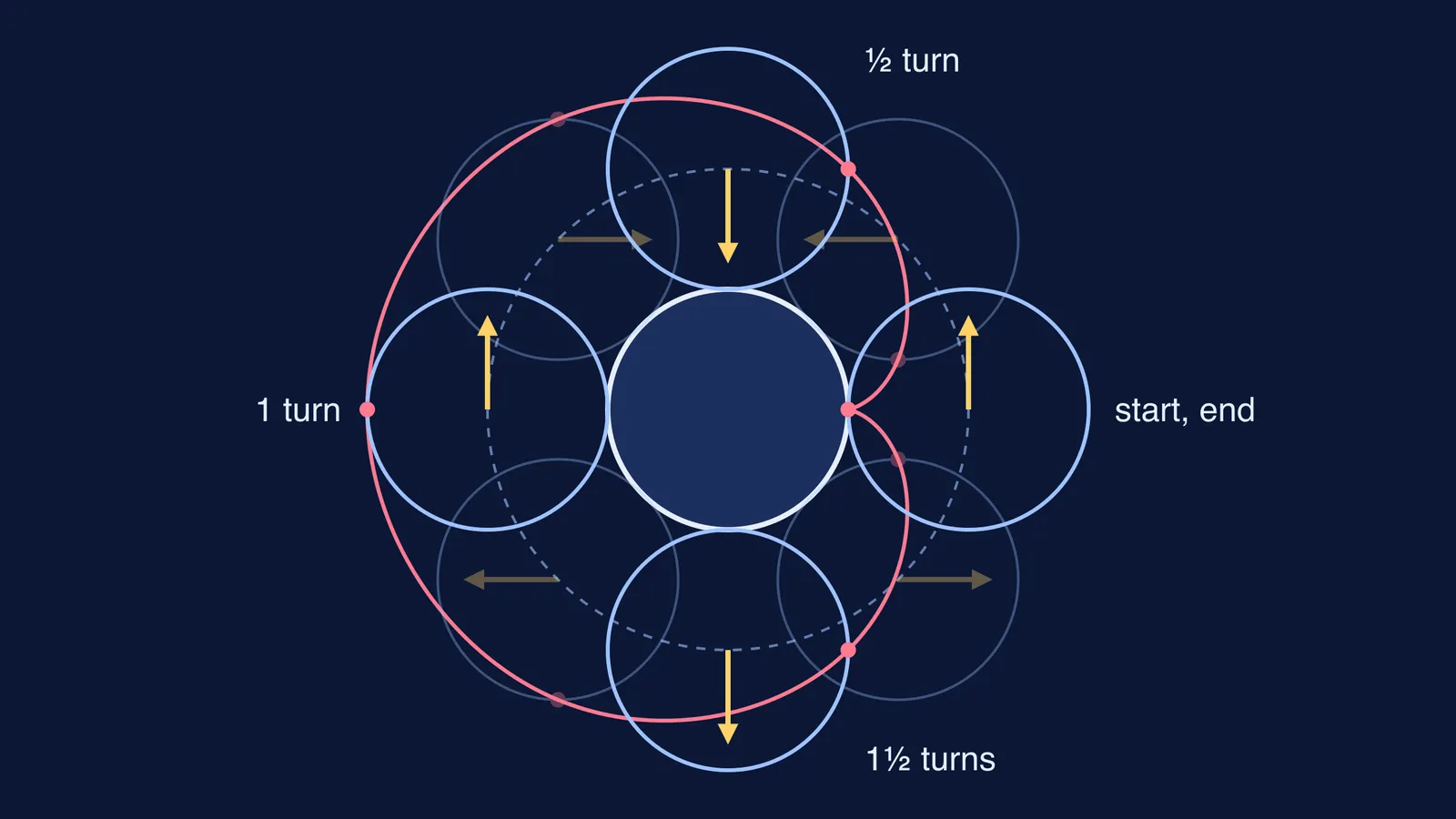
Watch the centre of the rolling coin. It does not run along the fixed coin's edge. It stays one radius further out, so it travels a circle of radius R + r (MathWorld). That path's radius is R/r + 1 times the coin's own radius, so the path is R/r + 1 times the coin's circumference (Wikipedia: Coin rotation paradox). For equal coins, the centre covers two circumferences, which means two turns.
MathWorld counts it a second way. Rolling along the edge gives R/r turns measured against the line joining the two centres, and that line itself swings round once more (MathWorld). In Scientific American, Jack Murtagh describes the extra turn as coming from revolving around an object, "which contributes one rotation regardless of its size."
You live with this extra turn every day. Relative to the stars, Earth completes a rotation in 23 hours and 56 minutes, called a sidereal day. The Sun takes about four more minutes to come back overhead, which gives us the 24-hour day (Scientific American).
What went wrong on the 1982 SAT?
On 1 May 1982, the SAT, a US college admissions test, included a multiple-choice question on the coin rotation problem (Wikipedia). It asked how many rotations circle A completes as it rolls around circle B, whose radius is three times as large. The answer choices were three halves, three, six, nine halves and nine, but the correct answer is four (Scientific American). Three students, Doug Jungreis, Shivan Kartha and Bruce Taub, showed that none of the options was correct, and the test had to be regraded (Wikipedia). Scientific American reports that about 300,000 students took the test and every exam had to be rescored.
The lesson carries over to JEE Main practice. If one ratio jumps out at you, stop and ask what the question is really counting: turns against the table, or turns relative to the other coin.
How can you test it with two coins?
You need two identical coins (two ₹5 coins work) and five minutes.
Lay both coins heads up, touching, with the rolling coin's face upright as you look at it.
Hold the fixed coin down firmly with one finger.
Roll the other coin around it slowly. Keep the edges pressed together so they roll and do not slide.
Stop halfway, on the far side. Before you look, predict whether the face is upside down or upright.
Carry on back to the start, counting each time the face comes upright.
What you should see: at the halfway point the face is already upright, so one full turn is done. Back at the start, that makes two. The diagram at the top of this post shows the same thing. The arrow on the rolling coin points down a quarter of the way round, up again halfway, and up once more at the end.
Then check other sizes with the MathWorld formula before you roll:
Equal coins (R = r): 1 + 1 = 2 turns.
Fixed coin with twice the radius (R = 2r): 2 + 1 = 3 turns.
The SAT case (R = 3r): 3 + 1 = 4 turns.
Where can you explore rolling further?
Rotation is hard to count from a still picture. The Fermi Simulation Lab has interactive simulations for ideas that are easier to see than to read. If you get stuck partway, Fermi's AI tutor can draw the figure and run the simulation, checking your understanding as it goes.
If rolling has caught your interest, these posts take it further: angular momentum of a rolling disc about the contact point, why pure rolling at constant speed needs no friction and why wheels look like they spin backwards on video.
Next time you see a coin puzzle, make your prediction first, then roll and count.