On this page
Two AA cells and a torch bulb: join the cells one way and the bulb glows brighter; join them the other way and it looks no brighter, but stays lit far longer. You can predict both on paper, then let the bulb tell you if you were right.
What happens to voltage when cells are in series vs parallel?
The rules are in sections 3.10 and 3.11 of the NCERT Class 12 Physics chapter on current electricity. The emf of a cell is the potential difference between its terminals in an open circuit, when no current flows. Under load, the terminal voltage is V = ε − Ir, where r is the cell's internal resistance.
Series: the equivalent emf of n cells in series is the sum of their emfs, and the equivalent internal resistance is the sum of their internal resistances.
Parallel: 1/r_eq = 1/r₁ + 1/r₂ and ε_eq/r_eq = ε₁/r₁ + ε₂/r₂. For two identical cells, that gives the same emf and half the internal resistance.
OpenStax College Physics adds that a parallel connection "can produce a larger current" because the total internal resistance is smaller. Series gives you voltage; parallel shares the work.
How much current does a bulb draw in each arrangement?
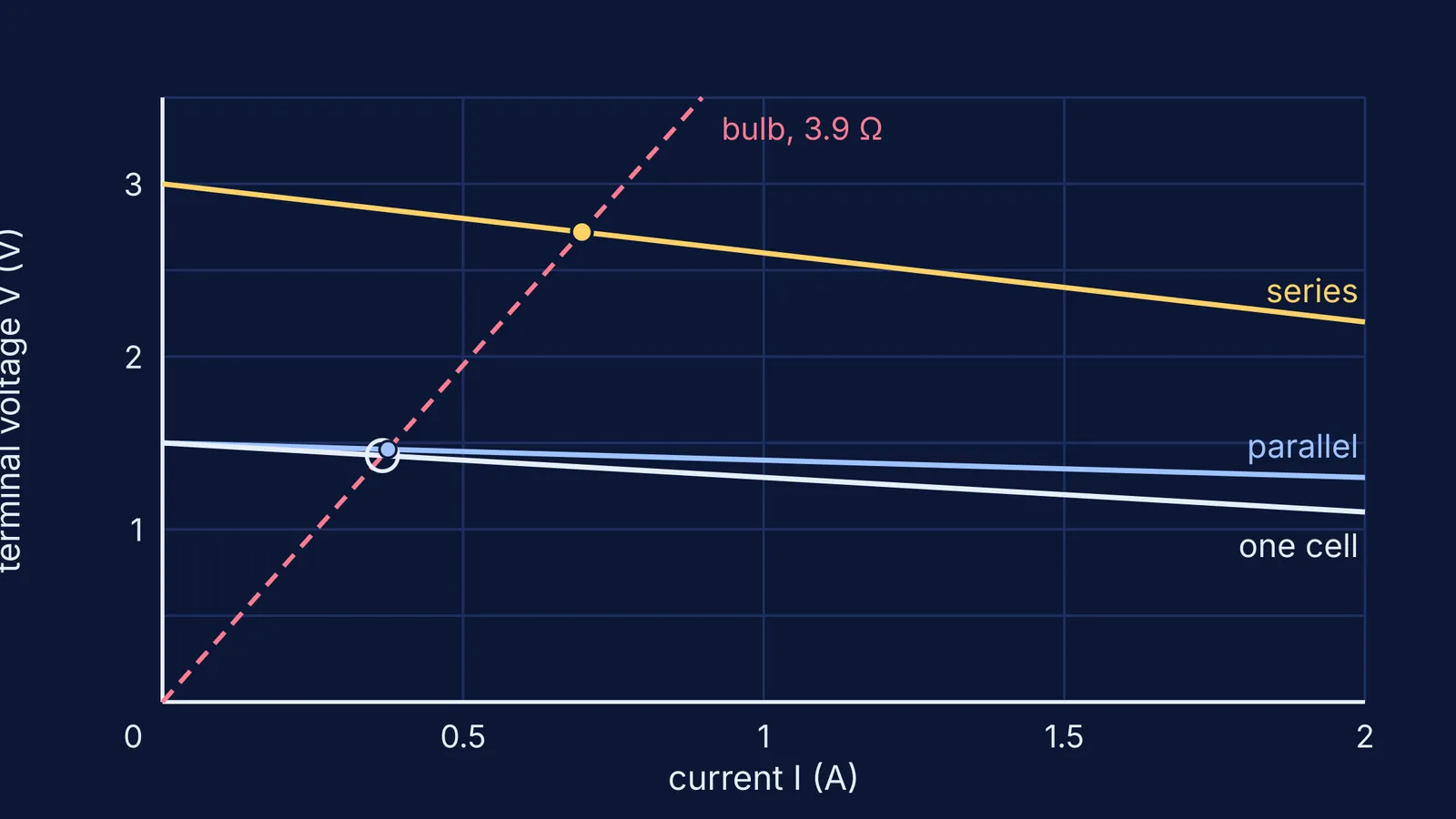
The Energizer E91 datasheet lists a nominal voltage of 1.5 V and an internal resistance of 150 to 300 milliohms for a fresh alkaline AA cell. Take ε = 1.5 V and r = 0.2 Ω for each cell, and a bulb of R = 3.9 Ω, the load the datasheet uses for its portable-lighting test. Then use I = ε_eq / (R + r_eq).
One cell: I = 1.5 / 4.1 ≈ 0.37 A; bulb gets 1.43 V and 0.52 W.
Series (3.0 V, 0.4 Ω): I = 3.0 / 4.3 ≈ 0.70 A; bulb gets 2.72 V and 1.9 W. Each cell carries all 0.70 A.
Parallel (1.5 V, 0.1 Ω): I = 1.5 / 4.0 ≈ 0.375 A; bulb gets 1.46 V and 0.55 W. Each cell carries about 0.19 A.
The series bulb gets about 3.6 times the power, so it is clearly brighter. The parallel bulb looks almost unchanged, because a fresh cell's internal resistance is small next to the bulb's, so halving it barely matters. Our post on why battery terminal voltage drops with load shows when that stops being true.
Which lasts longer, cells in series or in parallel?
Parallel wins here, by more than you might guess. The same Energizer E91 datasheet plots capacity against discharge current, for continuous discharge to 0.8 V: roughly 3,000 mAh at 25 mA, 2,500 mAh at 100 mA, 2,000 mAh at 250 mA and 1,500 mAh at 500 mA. Drain a cell hard and it gives up less charge. Hours ≈ capacity ÷ current per cell:
One cell at 0.37 A: about 1,700 to 1,800 mAh, so roughly 4 to 5 hours.
Series, each cell at 0.70 A: at most about 1,500 mAh, so 2 hours or less.
Parallel, each cell at 0.19 A: about 2,200 mAh, so roughly 11 to 12 hours.
On these estimates, parallel lasts over twice as long as one cell because each cell works at a gentler current. They are rough chart readings; a real bulb dims well before 0.8 V. Our guide to how long a 3000 mAh battery lasts explains the method.
How do you test the predictions with a bulb?
Write down your predictions first: brightness, bulb voltage, current and run time for each set-up. Then:
Take two identical fresh cells from one pack, a torch bulb in a holder and a multimeter.
Measure each cell's voltage with nothing connected. That is your emf.
Connect one cell to the bulb; measure the bulb's voltage and current.
Repeat for series, then parallel, and compare with your predictions.
Leave the single-cell and parallel set-ups on side by side and note when each bulb dims.
The gaps are the lesson. A filament's resistance rises as it heats, so work out R = V / I from your readings and predict again. If you are unsure why both series cells carry the same current, see whether current is used up in a series circuit.
Never put an old cell in parallel with a new one. Cells with different emfs drive a current around their own loop even with the bulb off: a 1.5 V and a 1.3 V cell, each with 0.2 Ω, would push (1.5 − 1.3) / 0.4 = 0.5 A from one into the other.
The same predict, run, explain habit works on screen: the Fermi Simulation Lab has interactive simulations for ideas that are easier to see than to read. For numericals on cell combinations, the Fermi Problem Library has a step-by-step solver that explains the reasoning rather than printing an answer.