On this page
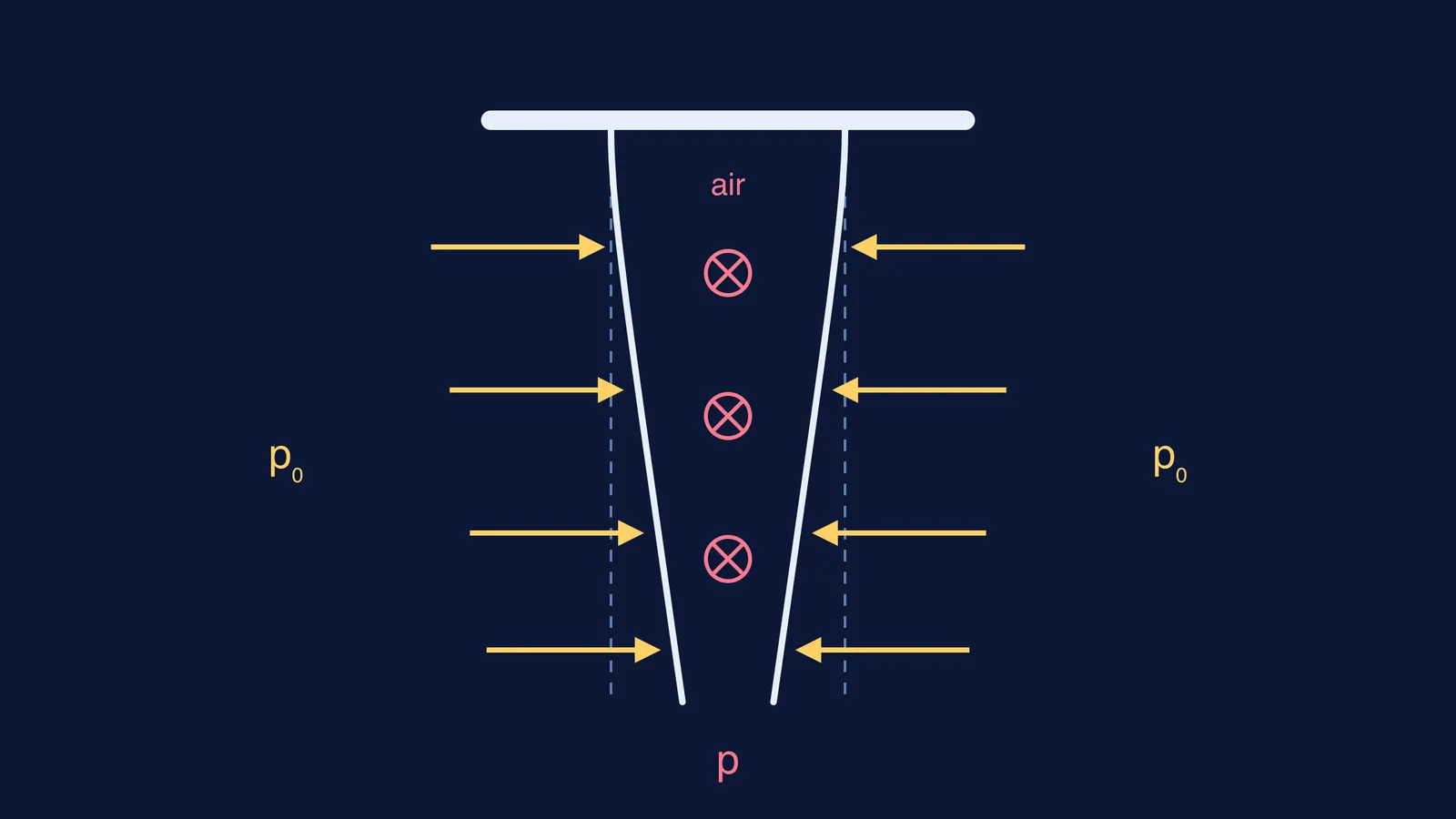
Hold two sheets of paper so they hang a couple of finger-widths apart, then blow hard into the gap. First, write down your prediction: will they fly apart or move together? Commit, then try it.
Do two sheets of paper come together when you blow between them?
Yes. The sheets swing towards each other. Balloons do the same: in a Science Buddies activity published by Scientific American, two balloons hung with a gap of about 15 cm move toward each other when you blow through a paper-towel tube between them.
The prediction step is not decoration. Comparing ways of presenting lecture demonstrations, Crouch, Fagen, Callan and Mazur (American Journal of Physics, 2004) found that students who passively watched understood the concepts no better than students who did not see the demonstration at all. Students who predicted the outcome before seeing it showed significantly greater understanding. So writing a prediction down, even a wrong one, is part of the experiment.
How do you test it at home?
You need two sheets of A4 paper and, if you have one, a drinking straw.
Hold the sheets by their top edges in front of your mouth, hanging parallel, a couple of finger-widths apart.
Write your prediction and one sentence explaining it.
Blow gently into the gap. Then blow hard. Watch how far the bottom edges move.
Change one thing at a time: a wider gap, a narrower gap, then a straw for a thinner, faster stream.
Run a control: hold a single flat sheet (a postcard stays flatter) level and blow across its top surface only.
For each run, note your prediction, what happened, and what surprised you.
The control matters. Writing in NSTA's Science 101 column, Matt Bobrowsky says that if you blow across the top of a flat piece of paper, it will not rise, no matter how hard you blow. If fast air on its own always meant low pressure, it would. Something about the two-sheet setup is different.
Why is the pressure lower between the sheets?
Start with Newton, not Bernoulli. The sheets accelerate inward, so the net force on each one points inward. Air pushes on both faces of each sheet, so the push from the still room air outside must be bigger than the push from the air in the gap. The experiment itself tells you the gap pressure is lower than the room pressure outside.
The usual one-liner, "faster air means lower pressure", cuts corners. In a study of university students by Suarez, Dutra, Monteiro and Marti, the researchers note that higher speed means lower pressure only under certain conditions, and found that many students still applied the idea where it is no longer valid after finishing their General Physics courses. They also report that an approach based on Newton's laws is more natural for fixing this. Bobrowsky makes a related point in the column above: a stream of air out in the open does not have lower pressure than the air around it.
A careful way to see the two-sheet case: your breath drags air along with it out of the gap. Replacement air has to rush in from the still room through the open edges, speeding up as it squeezes into the narrow space. Follow one parcel of that air from the still room, at room pressure, into the gap where it moves fast. Comparing two points along the same flow like this is when Bernoulli's equation applies, and it says the pressure where the air is fast must be lower. A single flat sheet has no such squeeze.
How should you write this in an exam answer?
Use three steps, in this order:
Observation: the sheets move towards each other.
Force: a net inward force on each sheet means the pressure in the gap is lower than the outside air pressure.
Cause: air drawn into the narrow gap moves fast; comparing still outside air with this fast air along the same streamline, Bernoulli's equation gives a lower pressure in the gap.
Before you write "fast air, so low pressure" anywhere, run this check:
Am I comparing two points along the same streamline?
Is the flow steady, and is it fair to ignore viscosity?
Is the air confined by surfaces, or is it an open jet that has already settled to room pressure?
If any answer is no, use Newton's laws instead. Our post on asking AI when Bernoulli's equation cannot be used works through more of these edge cases.
Speed and pressure in a narrowing flow are easier to see than to read. The Fermi Simulation Lab has interactive simulations for ideas like these, and our walkthrough of a Bernoulli fluid flow simulation in a narrowing pipe suggests predictions to make first. When a result catches you out, use our guide to asking AI why a simulation surprised you to turn the surprise into a reason.
Tonight, try the two sheets and the single flat sheet, write your predictions first, and see which one you got wrong.