

On this page
You adjust the parameters on an interactive simulation, click run, and watch the screen with confidence. Then the unexpected happens: the curve bends the wrong way, the velocity refuses to drop, or the circuit carries far more current than expected. Your first instinct is often confusion, followed quickly by skepticism. It is easy to assume the virtual lab is buggy or oversimplified.
That moment of surprise is the most valuable opportunity in science learning. In a seminal 1982 paper on conceptual change, George Posner and his colleagues showed that learners do not replace intuitive beliefs simply by hearing correct explanations (Posner et al., 1982). Genuine accommodation requires what Posner termed dissatisfaction: you must experience an undeniable contradiction between your existing mental model and physical reality.
Why does a simulation result contradict your prediction?
Simulations reveal the consequences of physical laws without mathematical abstraction getting in the way. A 2004 study by Catherine Crouch and Eric Mazur at Harvard University demonstrated that students who passively observe demonstrations learn no more than those who see no demonstration at all (Crouch et al., 2004). However, when students commit to a prediction before observing the outcome, their conceptual understanding increases significantly.
Contradiction occurs because everyday intuition relies on shortcuts that hold true only under limited circumstances. As interactive simulation research shows, dynamic models make invisible variables explicit. When an outcome defies your forecast, physics has not failed; you simply applied a formula outside its valid boundary conditions.
How do students usually react when a simulation surprises them?
When confronted with contradictory data, our natural impulse is self-defense. In a foundational 1993 study published in the *Review of Educational Research*, Clark Chinn and William Brewer documented seven distinct ways science students respond to anomalous data (Chinn and Brewer, 1993).
Chinn and Brewer identified that students routinely protect their initial theories by:
Ignoring the contradictory observation entirely.
Rejecting the data by claiming the simulation is flawed.
Excluding the result as an irrelevant special case.
Holding the data in abeyance, assuming future lessons will explain it.
Reinterpreting the data to fit their original theory.
Making peripheral adjustments that preserve the core error.
Only the seventh response—theory change—produces meaningful conceptual growth. A critical review of 61 empirical studies by Lara Smetana and Randy Bell concluded that simulations fail to achieve their full learning potential unless students are explicitly guided to confront and resolve these cognitive discrepancies (Smetana and Bell, 2012).
How should you describe a simulation surprise to an AI tutor?
Pasting "why did this happen?" into a generic chatbot often produces a wall of textbook derivations that overlooks your specific confusion. A meta-analysis of tutoring systems by Kurt VanLehn found that step-based intelligent tutors achieve an effect size of d = 0.76 over conventional instruction, performing nearly on par with human tutors at d = 0.79 (VanLehn, 2011). Tutoring succeeds because it intervenes at the exact step where reasoning breaks down.
To diagnose your misconception through a step-by-step AI dialogue, structure your question around four components:
Setup: List every initial parameter you entered, including height, speed, resistance, or angle.
Prediction: Describe what you expected to happen and name the specific formula or intuitive rule you used.
Observation: State the exact discrepancy the simulation displayed instead.
Diagnosis request: Ask the tutor which premise or boundary condition broke down.
Here is a practical script you can adapt:
"I set up a simulation with these initial conditions: [insert values]. Based on [insert formula or concept], I predicted that [insert prediction]. Instead, the simulation showed [insert observed result]. What hidden assumption in my thinking is invalid in this scenario?"
This structure allows Fermi's AI tutor to notice where your reasoning broke down, isolate the invalid boundary condition, and check understanding as you work through the fix.
What does an elevated projectile launch teach about hidden assumptions?
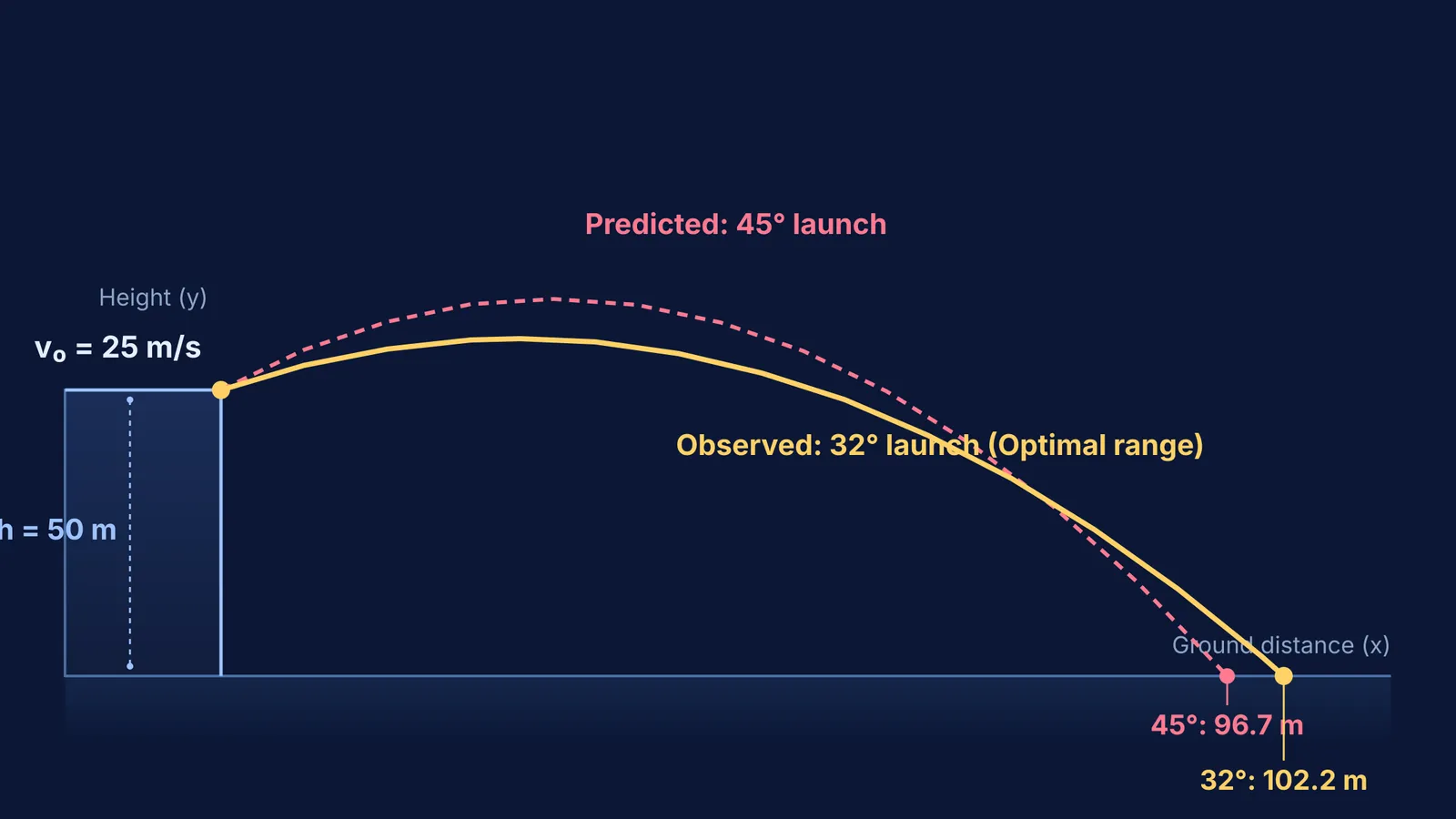
Consider an experiment in a projectile motion simulation. Physics students routinely memorize that a 45° launch angle yields maximum range.
According to the standard equations of projectile kinematics, placing a virtual cannon on a 50-meter cliff with a launch speed of 25 m/s yields a surprising result. Firing at 45° lands the projectile 96.7 meters from the base. If you lower the angle to 32°, the ball travels 102.2 meters—gaining 5.5 extra meters.
The simulation result did not match your prediction. When you feed this scenario into the four-step framework, the AI tutor clarifies why:
The standard range equation R = v² sin(2θ) / g assumes equal launch and landing heights (y = 0).
When launch height h is positive, the projectile spends more total time falling than rising.
The optimal angle is θ = arcsin(1 / √(2 + 2gh/v²)), which evaluates to approximately 32° for a 50-meter drop at 25 m/s.
Trading launch height for extra horizontal velocity capitalizes on the prolonged descent time.
If you want to explore how parameter changes alter physical trajectories, the Fermi Simulation Lab offers interactive simulations for ideas that are easier to see than to read.
What checklist should you run before leaving the simulation?
Before resetting your virtual experiment, pause to cement the concept:
Identify the silent premise: Note in your journal the exact variable that your initial rule neglected.
Test the limiting case: Adjust the simulation back to the textbook baseline (such as setting cliff height to zero) to confirm that 45° becomes optimal again.
Write the revised rule: Summarize the principle in one sentence that highlights its boundaries.


